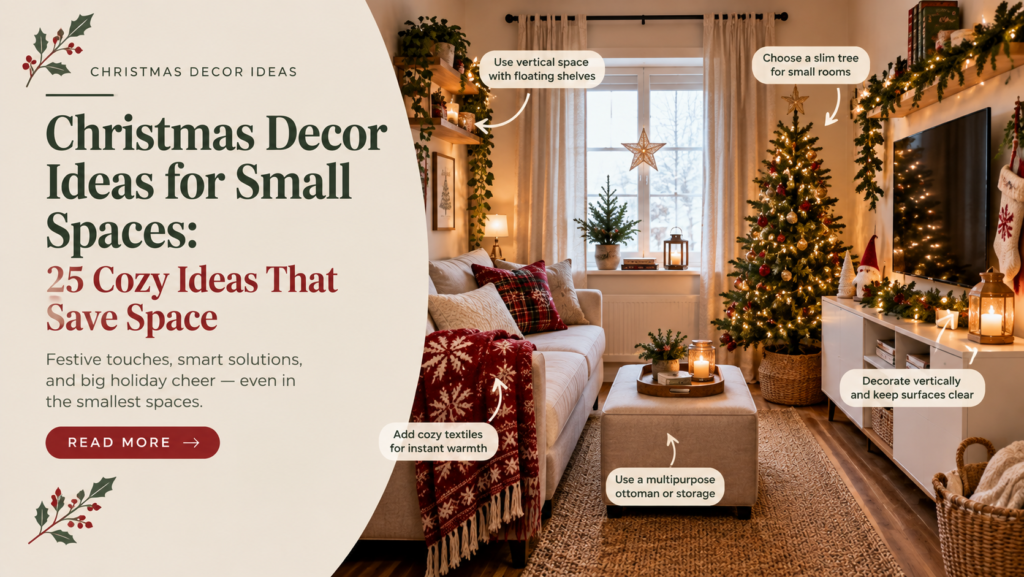
Hallways rarely get the Christmas treatment. They are the spaces we rush through on the way to somewhere else — the corridor to the bedrooms, the landing at the top of the stairs, the narrow passage between the kitchen and the living room. Yet those are exactly the spaces guests walk through first, and the ones your family passes dozens of times a day in December. A little thoughtful decorating here goes a long way, because you do not need a big room to create a big feeling.
The trick with a hallway is restraint. Unlike a living room, a corridor has one main job: getting people safely from one room to another. That means everything you add should hug the walls, hang above head height, or sit on a ledge that is already there. Keep the center of the walkway clear, choose battery-operated lights where outlets are scarce, and favor lightweight, renter-friendly hanging methods that come down in January without a trace. Done right, your hallway becomes a warm, festive passage instead of a cluttered obstacle course.
Below are 15 Christmas hallway decor ideas built for real American homes — narrow 36-inch corridors, wide upstairs landings, split-level stairwells, and everything in between. Each one includes practical measurements, safety notes, and simple swaps so you can make it work whether you own your home or rent it.
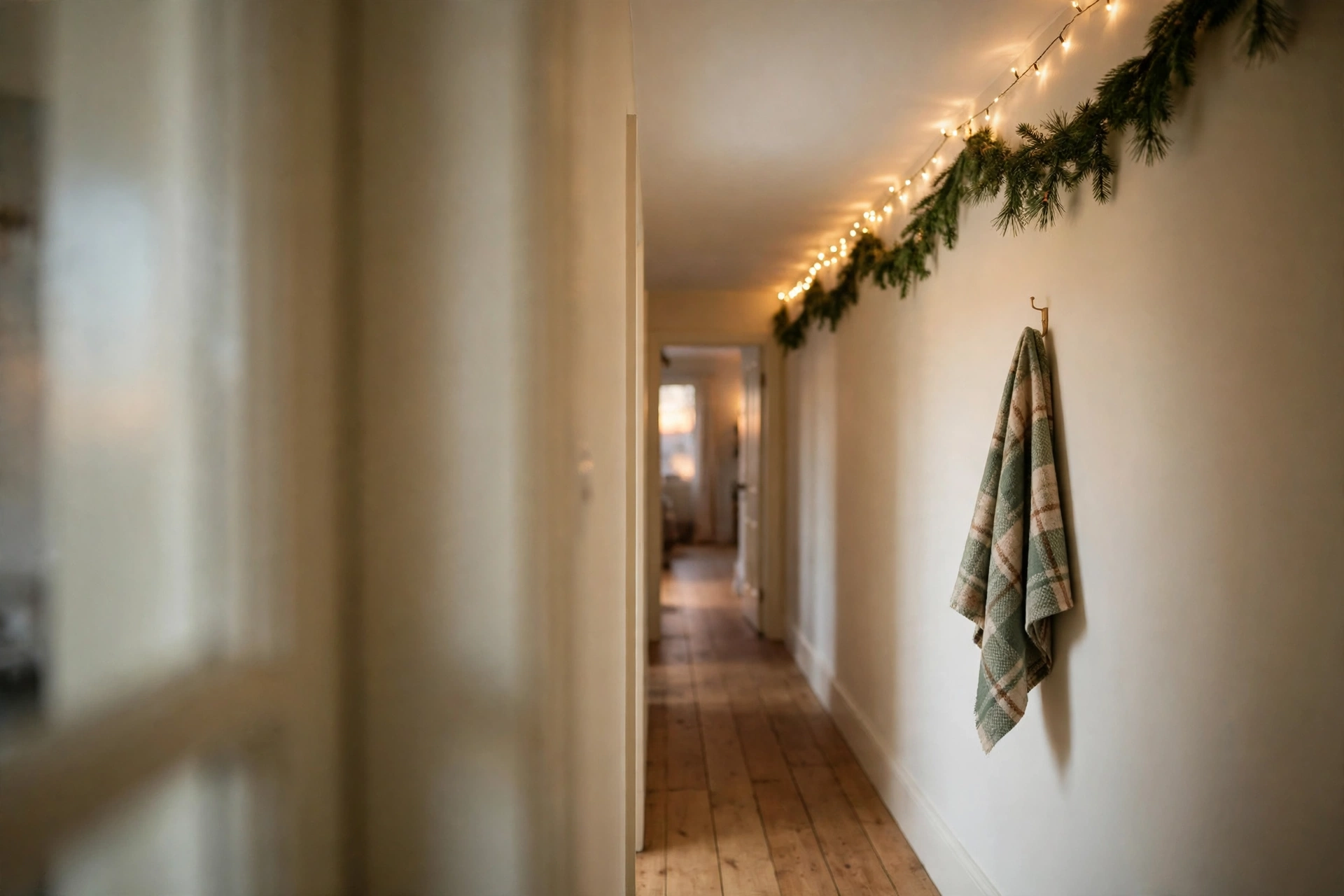
1. Run a Slim Garland Along One Wall, Not Both
A full, thick garland on both sides of a hallway will eat up precious width and brush against every shoulder that passes. Instead, run a single slim garland along one wall only, at about 7 feet high or along the top of a chair rail. In a standard 36- to 42-inch-wide hallway, this leaves the full walkway open while still giving you that lush, green line that says Christmas the moment you step in.
Choose a garland that is 4 to 6 inches deep rather than a chunky 10-inch one, and secure it with small adhesive hooks or removable clips every 18 to 24 inches. If your hallway has a picture rail, that is an ideal anchor — no holes, no damage, and easy removal. Fluff the branches outward toward the room, not into the walkway, and tuck the ends neatly at door frames so nothing dangles at face height.
For a more finished look, weave in a few pinecones, dried orange slices, or small wooden ornaments, but keep them flat against the wall. Anything that sticks out more than a couple of inches becomes a snag hazard for sleeves, bags, and curious little hands. If you have a long corridor, you can break the garland at each doorway and restart it on the other side, which looks intentional and makes takedown much easier.
2. Line the Ceiling Edge With Battery Fairy Lights
Overhead fairy lights are the easiest way to make a hallway feel magical without taking up a single inch of floor or wall space. Run a single strand of warm-white, battery-operated fairy lights along the ceiling edge or crown molding, keeping them at least 7 feet above the floor so no one walks into them. In most homes, one 20- to 33-foot strand covers a standard hallway, and a second strand handles a longer corridor or an L-shaped passage.
Battery lights solve the biggest hallway problem: outlets. Most corridors have no outlet at all, or one tucked behind a door. A battery pack can hide on top of a door frame, behind a garland, or inside a small decorative box on a high shelf. Look for a pack with a built-in timer — six hours on, 18 hours off is a common setting — so the lights come on every evening without you remembering to switch them on.
Keep the strand to a single warm color temperature, around 2700K, for a cozy glow rather than a carnival mix. If your hallway is very narrow, avoid lights that hang down in loops; instead, clip the wire tight to the molding so the walkway stays clear and the light reads as a soft, continuous line above you.
3. Hang a Row of Small Wreaths on Hallway Doors
If your hallway is lined with bedroom or closet doors, you already have a ready-made gallery. Hang one small wreath — 12 to 16 inches across — on each door, centered at eye level or a little higher. The repetition is what makes it work: three or four matching wreaths down a corridor look far more polished than one large wreath competing for attention in a tight space.
Use over-the-door hooks or adhesive hooks rated for the wreath’s weight, and check that each door still opens and closes fully without the wreath catching on the frame. This is especially important for closet doors that get opened daily. Lightweight faux greenery wreaths are ideal here because they will not shed needles onto your floors, and they survive being bumped far better than fresh ones.
You do not have to make every wreath identical. Keep the same size and greenery base, then vary one small detail — a red bow on one, a wooden star on another, a few pinecones on a third. That small variation keeps the row from looking like a store display while still feeling coordinated. For more inspiration on dressing the space where guests first arrive, see these Christmas entryway decor ideas, which pair beautifully with a decorated corridor just beyond the front door.
4. Lay Down a Festive Runner That Fits the Walkway
A runner rug is the fastest way to warm up a hallway, and it also protects your floors from December foot traffic. Measure first: leave 4 to 6 inches of bare floor showing on each side of the runner so the hallway does not feel narrower than it is. For a 36-inch-wide hallway, a 24- to 28-inch-wide runner is usually right; for a wider landing, you can go up to 30 inches.
Choose a low-pile, flat-weave runner in a festive but forgiving pattern — deep red and cream, plaid, or a simple stripe with a holiday color. Low pile matters because hallway doors often swing over the rug, and a thick rug can catch, bunch, and become a tripping hazard. Add a non-slip rug pad underneath, cut to size, and check the edges weekly through December; a curled corner in a dark hallway is an accident waiting to happen.
If you have pets or kids, pick a washable runner or one you can shake out easily. Snow, salt, and pine needles all end up in hallways, and a rug you can clean in January without a professional bill is worth far more than a delicate one you have to tiptoe around.
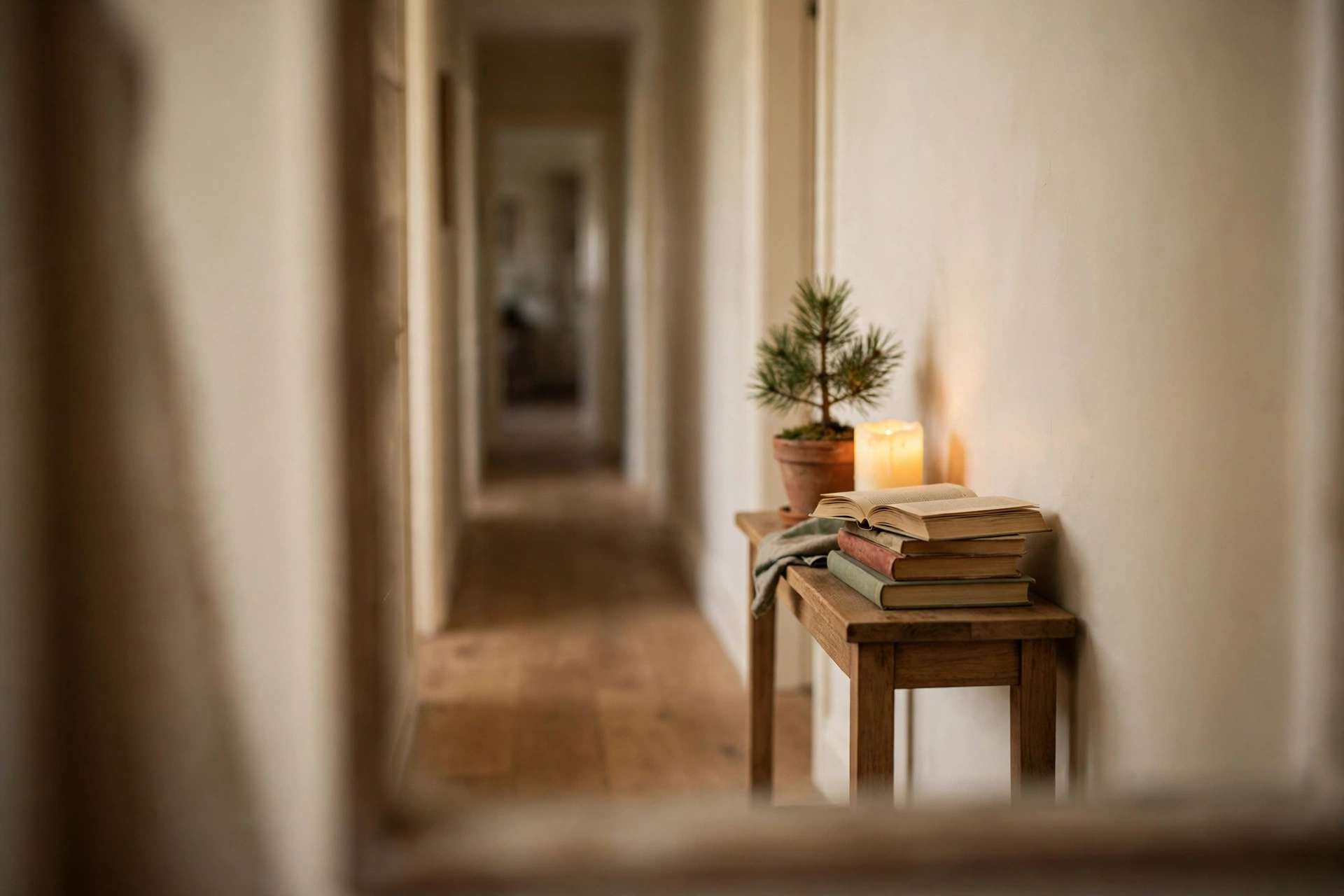
5. Style a Narrow Ledge or Console Without Blocking the Path
Many hallways have a shallow ledge, a built-in niche, or just enough room for a console table that is 10 to 12 inches deep. That is plenty for a Christmas vignette, as long as you respect the walkway. The rule of thumb is simple: after the table is in place, you should still have at least 32 to 36 inches of clear walking width. If you do not, skip the table and use the wall instead.
On a ledge or narrow console, build in layers: a small stack of books or a wooden tray at the back, a flameless candle or a small potted pine in the middle, and one personal touch in front, like a framed family photo in a holiday frame. Keep everything at least 2 inches back from the front edge so elbows and bags do not knock it off. Battery-operated candles are the safer choice here, especially in a passage where people brush past.
Resist the urge to fill every inch. In a narrow space, three well-chosen pieces look intentional and calm, while ten small ornaments look like clutter and invite breakage. Leave breathing room around your vignette, and let the hallway itself — its light, its rug, its garland — do part of the work.
6. Dress the Stair Railing, Not the Stair Treads
Stairs are part of many hallways, and they are also where safety matters most. Decorate the railing and the banister, never the treads themselves. A garland wrapped loosely around the handrail, secured with soft ties every 12 to 18 inches, looks beautiful and keeps both hands free to grip the rail. Never place candles, lanterns, or loose ornaments on stair steps, where a foot can catch them in the dark.
If you add stockings to a stair railing, hang them on the outside of the banister — the side facing the open stairwell or wall — rather than on the walking side, and keep them above knee height so they do not swing into anyone’s path. Small, lightweight stockings work best; heavy, stuffed ones can pull a garland down or swing into the stairwell. For a landing at the top of the stairs, a small basket of pinecones or a single lantern on a side table is safer than anything on the floor near the top step.
Lighting on stairs should help, not distract. A strand of battery fairy lights woven through the railing garland gives a soft glow that actually improves visibility at night, which is a real benefit on dark December evenings. Just keep the lights on the rail, not draped across the steps, and use a timer so they are on when people are most likely to use the stairs. If you are also dressing the front of your home, these Christmas porch decor ideas show how to carry the same warm, welcoming style from the porch right through to your hallway.
7. Hang Paper Stars or Snowflakes From the Ceiling
Ceiling-hung decorations use the one part of a hallway nobody walks through: the air above head height. Paper stars, wooden snowflakes, or lightweight felt ornaments hung from the ceiling at staggered heights create a sense of wonder, especially for children, without narrowing the walkway at all. The key is height — hang nothing lower than 7 feet in a main passage, or 6 feet 8 inches at the very lowest in a home with lower ceilings.
Use clear fishing line or thin white thread so the decorations appear to float, and vary the lengths by 4 to 8 inches so they do not form a flat, uniform line. Three to five stars spaced along a hallway is plenty; a dense cluster overhead can feel oppressive in a narrow space and makes dusting a chore. Secure each line to a small ceiling hook or adhesive ceiling clip, and test that a tall guest can walk the full length without ducking.
This is a wonderful renter-friendly idea because paper stars are light, cheap, and leave no marks when the adhesive clips come down. It is also one of the easiest decorations to involve kids in — let them fold and cut the stars, then hang their favorites where they can admire them every time they walk to their bedroom.
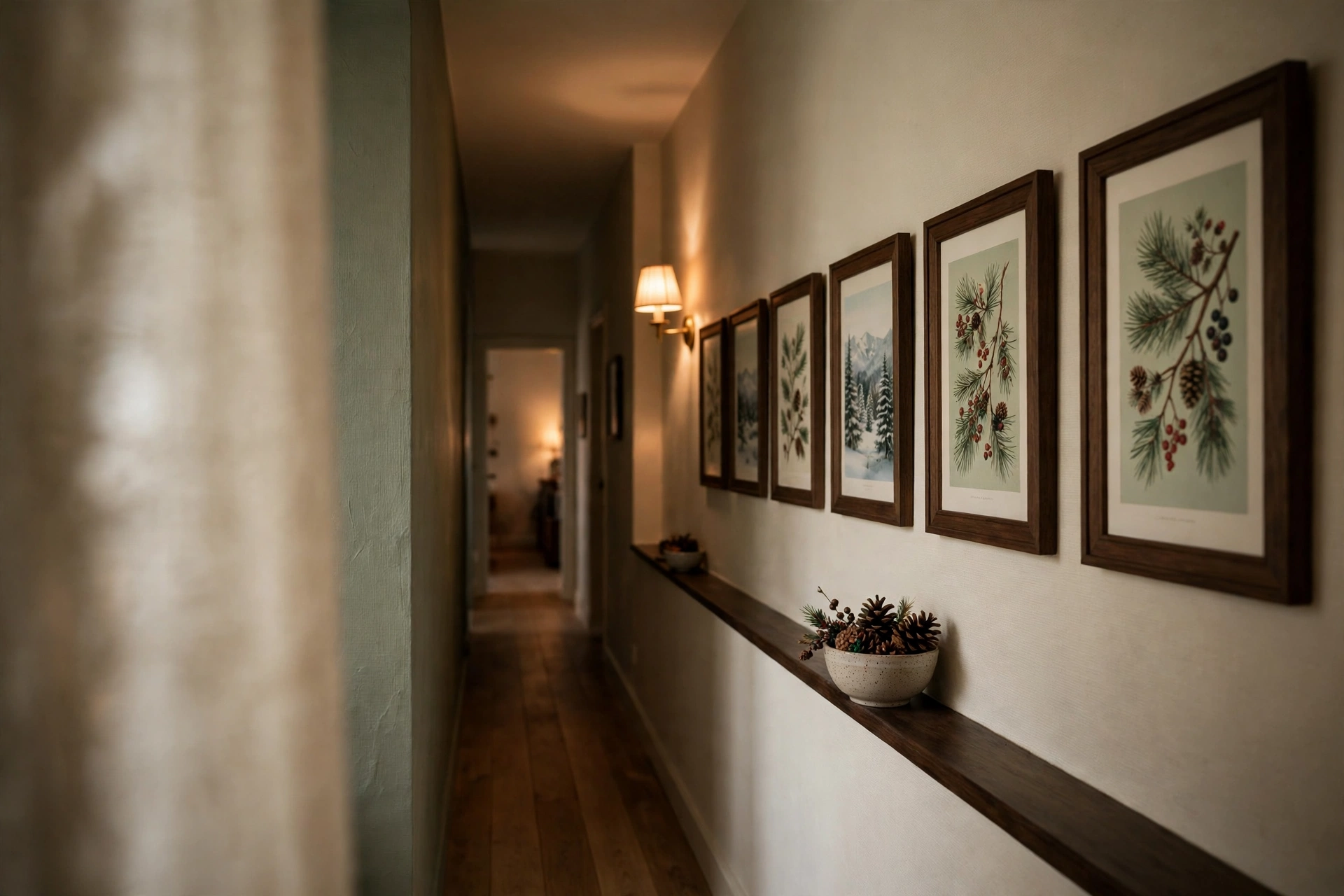
8. Swap Hallway Art for Seasonal Prints
Most hallways already have framed art, family photos, or mirrors on the walls. Instead of adding more frames to a narrow space, simply swap what is already there for the season. Replace two or three existing prints with Christmas-themed art — a winter landscape, a vintage-style holiday print, or a simple botanical print of pine and berries — in the same frames you already own. No new holes, no new clutter, just a seasonal refresh.
Keep the frames at the same height and spacing as before, usually with the center of each frame around 57 to 60 inches from the floor. That consistency is what makes the swap look deliberate rather than haphazard. If you have a gallery wall, swap only the two or three easiest frames and leave the rest; a hint of Christmas among year-round photos feels more personal than a wall that suddenly looks like a holiday store.
When January comes, swap the originals back in and store the seasonal prints flat in the same frames’ boxes or behind the year-round art. This rotation system means you never have to find storage for extra frames, and your hallway never feels over-decorated — a common problem when holiday decor is layered on top of everyday decor instead of replacing it.
9. Place Battery Lanterns Along the Wall Edges
Lanterns bring a warm, old-fashioned glow to a hallway, but only if they are placed where no one will trip over them. Set them flat against the wall, in corners, or in the recess beside a door frame — never in the center of the walkway and never near the bottom of a staircase. One lantern every 8 to 10 feet is enough; a hallway lit by a row of lanterns on both sides quickly feels like an obstacle course.
Always use battery-operated or flameless candles inside hallway lanterns. Real flames in a narrow passage, near garlands, curtains, and passing coats, are a fire risk that is simply not worth it. Modern flameless candles flicker convincingly, run for days on a set of batteries, and many come with timers and remote controls, so you can light the whole hallway from the living room.
Choose lanterns with a stable, wide base and a handle that lies flat or hooks to the wall, so they cannot be easily knocked over by a pet, a stroller, or a vacuum cleaner. In a home with small children, place lanterns on a high ledge or a wall shelf instead of the floor, and save floor lanterns for adult-only passages like a primary-bedroom hallway.
10. Add Pine Sprigs and Scent to High Ledges
Smell is a powerful part of Christmas, and a hallway is the perfect place for it because everyone passes through and gets a breath of pine, cinnamon, or clove on their way somewhere else. If you have a high shelf, a transom ledge, or the top of a door frame, tuck a few fresh pine or cedar sprigs there in a small, narrow vase or a simple jar. The scent drifts down gently without any decor sitting at hand height.
Keep scented decor high and out of reach of pets and toddlers, and avoid strongly scented potpourri or plug-in diffusers in a narrow, poorly ventilated hallway, where the fragrance can become overwhelming. A few real sprigs, a cinnamon stick bundle tied with twine, or a single unscented flameless candle beside the greenery gives you scent without a chemical cloud.
Refresh the sprigs every week or two, and check for shedding needles on the floor below. A small tray or piece of felt under the vase catches fallen needles and protects painted ledges from moisture rings. When the sprigs dry out, they still look beautiful for a few more days — just move them to a wreath or garland rather than leaving dry, brittle greenery near a light source.
11. Create a Mini Vignette on the Stair Landing
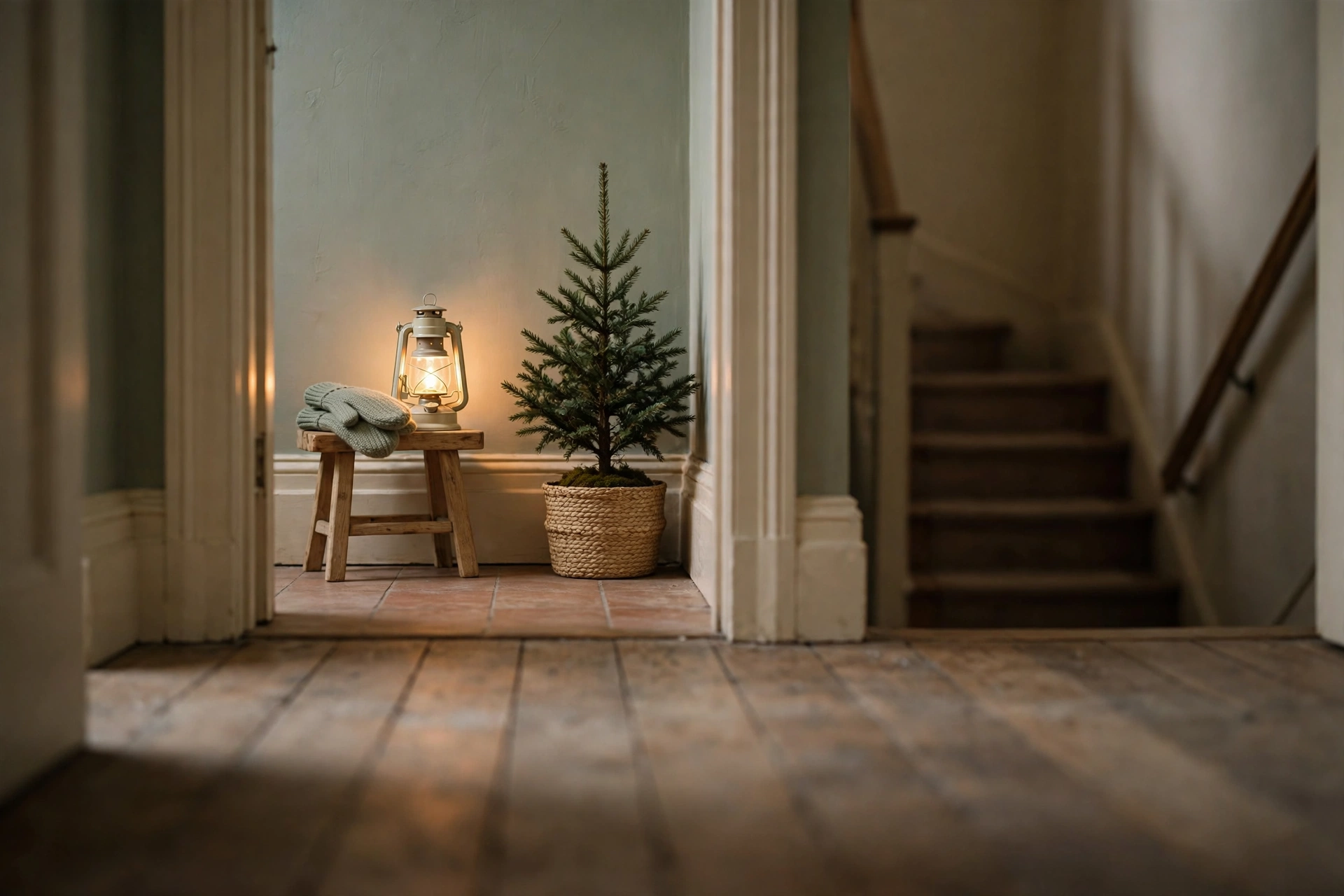
A stair landing is often the widest, most forgiving spot in a hallway system, and it deserves a little more attention than a narrow corridor. If your landing is at least 4 feet by 4 feet, you can create a true vignette: a small potted tree (2 to 3 feet tall), a basket of wrapped empty boxes or pinecones, and a single lantern or flameless candle on a small stool or side table pushed against the wall.
Keep the vignette in one corner of the landing, and leave a clear path at least 36 inches wide to every door and to the next flight of stairs. Measure the path, do not just eyeball it — landings feel bigger than they are until you try to carry laundry through them. A small tree on a landing also benefits from being away from heat vents and exterior doors, which dry out real trees quickly.
This is also the ideal spot for a personal touch that would get lost in a narrow hall: a favorite holiday book, a small nativity figure, or a framed Christmas card from a loved one. One meaningful piece on a landing reads as a story; a dozen small pieces read as storage. Let the landing be the pause point in your hallway, the place where someone stops for a second and smiles. A similar focal-point approach works beautifully over a fireplace, as these Christmas mantel decor ideas show — one strong, well-placed arrangement beats a crowded shelf every time.
12. Frame Doorways With Garland for a Festive Transition
Doorways are natural transition points, and dressing them turns a plain hallway into a series of festive thresholds. Run garland around the inside of a door frame — up one side, across the top, and down the other — for the doorway between your hallway and your living room or dining room. This frames the view into the decorated room beyond and makes the hallway feel like part of the celebration, not just a route to it.
Use lightweight garland for door frames and secure it with adhesive hooks on the flat trim, not nails in the wall. Check that the garland does not interfere with the door closing, and keep any hanging ornaments above 7 feet or tucked flat against the trim so they do not catch hair or hats. If the doorway has no door, you have even more freedom — you can let the garland drape slightly at the top corners for a softer, more welcoming arch.
Do not dress every doorway in the hallway. Choose one or two key transitions — the living room entrance and perhaps the dining room — and leave bedroom and bathroom doors plain or with just a small wreath. That hierarchy guides the eye toward the rooms where you gather, and it keeps the hallway from feeling like a tunnel of greenery.
13. Use a Mirror and Warm Light to Widen a Narrow Hall
Dark, narrow hallways are the hardest to decorate because anything you add can make them feel smaller. A mirror is the exception: it bounces light, doubles the visual width, and makes a corridor feel twice as open. If you already have a hallway mirror, dress it for Christmas by adding a small swag of greenery across the top corner or a thin strand of battery lights around the frame — never across the reflective surface itself, where it blocks the mirror’s job.
Pair the mirror with a single warm light source, such as a wall sconce, a small table lamp on a console, or a battery candle on a ledge opposite the mirror. The light reflects and multiplies, so one well-placed source does the work of three. Keep the mirror at a height where it reflects the decorated wall or the lights, not just the ceiling, and clean it before December so the reflection is crisp.
If you do not have a hallway mirror, a large, lightweight leaning mirror in a landing or at the end of a corridor can serve the same purpose, as long as it is secured to the wall with a safety strap. Never lean an unsecured mirror in a passage where children run or where a door could swing into it.
14. Let Kids Own One Stretch of Hallway Wall
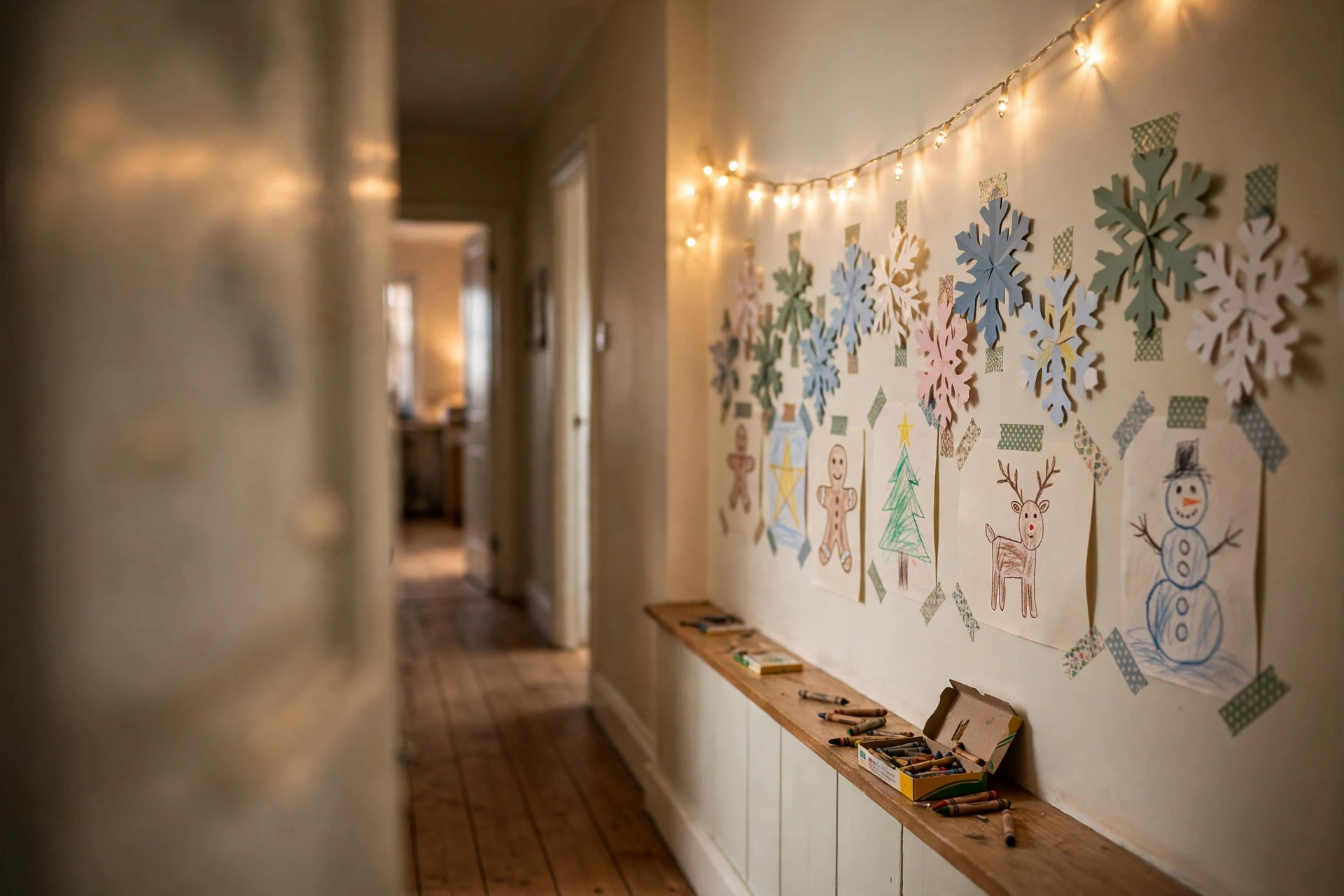
A hallway is the perfect gallery for children’s Christmas art because it is seen every day but does not have to match the rest of your decor. Dedicate one stretch of wall — between two doors, or along the corridor to the kids’ bedrooms — to their creations: handprint reindeer, paper snowflakes, drawings of Santa, or a simple advent countdown they can update each morning. Use washi tape, magnetic strips, or a clip rail so the art goes up and comes down without damaging paint.
Keep the display at child height for the pieces they made, roughly 36 to 48 inches from the floor, and frame the whole stretch with a simple garland or a string of paper snowflakes above it so it reads as an intentional display, not random clutter. A clip rail or a length of twine with clothespins lets kids swap their own art in and out through December, which keeps the display fresh and gives them ownership of the hallway.
This idea also solves a common December problem: where to put all the holiday crafts that come home from school. Instead of the kitchen counter, they get a place of honor in the hallway, where grandparents and guests will see them on their way to the living room. Rotate the pieces weekly, photograph favorites before recycling them, and take the whole display down together in January as a little closing ritual.
15. Plan a Two-Minute Takedown From the Start
The best Christmas hallway decor is the kind you can take down quickly, because hallways are also the spaces you need fully clear again in January. Before you hang anything, decide how it will come down. Adhesive hooks peel off, over-door hooks lift away, battery lights coil into a box, and swapped prints slide back into their frames. If an idea requires nails, screws, or a ladder you dread climbing, it is probably not worth it for a passage you walk through a hundred times a day.
Label a single storage bin “Hallway Christmas” and pack everything from this space together — garland, runner, wreaths, stars, and the battery packs with their remotes. Store the runner rolled, not folded, so it lies flat next year, and keep a small bag of spare adhesive hooks and batteries in the same bin. Next December, you will be able to rehang the whole hallway in under an hour, without hunting through mixed holiday boxes.
Finally, do a New Year safety check as you take things down: look for scuffed paint behind adhesive hooks, check that no garland ties are still wrapped around railings, and make sure stair handrails are completely clear and easy to grip. A hallway that returns to its everyday self cleanly is a hallway that will be just as easy — and just as joyful — to decorate again next year. For the space just beyond your front door, these entryway decor ideas offer year-round styling that transitions smoothly once the holiday pieces come down.
Products to Consider
These generic item types cover almost everything in the ideas above, with no need for specialty purchases:
- Battery-operated warm-white fairy lights with a timer
- Slim faux pine garland, 4 to 6 inches deep
- Small faux wreaths, 12 to 16 inches across
- Low-pile washable hallway runner rug with a non-slip pad
- Flameless candles and battery-operated lanterns
- Removable adhesive hooks and clips for walls, doors, and ceilings
- Paper stars, wooden snowflakes, and felt ornaments for ceiling displays
- Small potted pine tree, 2 to 3 feet tall, for a stair landing
Frequently Asked Questions
How do I decorate a very narrow hallway for Christmas without blocking it?
Stick to the walls, ceiling, and existing ledges. Use one slim garland on a single wall, lights along the ceiling edge, and wreaths on doors. Keep at least 32 to 36 inches of clear walking width at all times, and avoid floor decor in a hallway narrower than 42 inches.
Are battery-operated lights safe to leave on in a hallway?
Yes, when you use quality battery lights with a timer and keep them away from real flames and heat sources. Battery fairy lights and flameless candles run cool, which makes them far safer than plug-in lights or real candles in a narrow passage. Replace batteries as needed and never leave damaged wires in place.
Can I decorate a rental hallway for Christmas without damage?
Absolutely. Adhesive hooks and clips, over-door hooks, washi tape, and swapped prints in existing frames all come down cleanly. Avoid nails and screws, test one adhesive hook in a hidden spot first, and remove hooks slowly following the manufacturer’s instructions to protect paint.
What is the difference between hallway decor and entryway decor?
An entryway is the arrival space just inside the front door, with room for coats, shoes, and a first impression. A hallway is the corridor beyond it — the passage to bedrooms, stairs, and other rooms. Hallway decor should be slimmer, higher, and more focused on keeping the walkway clear than entryway decor, which can include larger furniture and storage pieces.
When should I put up and take down hallway Christmas decor?
Most American homes decorate hallways in late November or the first week of December, alongside the rest of the house. Because hallway pieces are lightweight and renter-friendly, takedown is quick — plan to remove them in the first week of January and store them together in one labeled bin for next year.
Final Thoughts
A decorated hallway does not need to be elaborate to be effective. One slim garland, a line of warm lights overhead, a festive runner underfoot, and a few personal touches on the walls are enough to turn an overlooked passage into one of the warmest parts of your home at Christmas. The secret is choosing ideas that respect the space: keep the walkway clear, light it safely with batteries, and hang things in ways that come down without a trace.
Start with just two or three ideas from this list — perhaps the ceiling lights and the runner, plus a row of small wreaths — and live with them for a few days before adding more. You will quickly see what your hallway can handle and what feels like too much. That restraint is what separates a hallway that feels festive from one that feels crowded, and it is what will make you want to decorate the same hallway again next year.