Your entryway is the first room your guests actually experience at Christmas, and it sets the tone for everything that follows. It does not need to be large, expensive, or perfectly styled to feel festive. It needs to feel warm, intentional, and easy to move through — a place where coats have a home, shoes do not pile up by the door, and the first thing someone sees is something beautiful rather than clutter.
The best Christmas entryways work in layers. Start at the door, then move inward: a wreath or garland at the threshold, a rug underfoot, one solid piece of furniture to anchor the space, and a few thoughtful details at eye level. Keep the walkway clear, choose warm light over bright light, and repeat just two or three colors so the whole space feels calm instead of crowded. The 21 ideas below follow that order, from the front door to the last finishing touch, so you can use one idea or work through the whole list over a weekend.
Before you buy anything, take a quick photo of your entryway from the front door, the way a guest would see it. That one photo will tell you more than an hour of browsing: where the eye lands first, what looks empty, and what is already doing too much. Then pick the ideas that fix what you actually see, not just the ones that look good in someone else’s house.
1. Choose a Wreath Sized to Your Door
A wreath should look generous without swallowing the door. As a practical rule, choose a wreath about one-half to two-thirds the width of your door, and hang it at eye level so the center sits roughly where a guest naturally looks. A standard front door can usually carry a 24-inch wreath comfortably, while a wider double door or a tall entry may need 28 to 30 inches to avoid looking lost. If your door has a window, a smaller, flatter wreath often sits better and will not block light.
Fresh evergreen wreaths smell wonderful and look lush, but they dry out, especially on a sunny south-facing door or in a heated entry. Faux wreaths cost more up front and last for years, and the better ones now mix pine, cedar, and eucalyptus for a realistic shape. Whichever you choose, fluff the branches outward, step back, and check the shape from the sidewalk as well as from inside. A wreath that looks round from three feet away can look lopsided from the street. For more wreath styles and hanging tips, see our guide to Christmas wreath ideas.
2. Frame the Doorway With Garland
Garland is the fastest way to make an entryway feel like Christmas, because it frames the exact spot everyone walks through. Drape it along the top of the door frame and let the ends fall a little lower on each side, rather than cutting it off sharply at the corners. That soft, draped shape looks more natural than a stiff rectangle, and it gives you a place to tuck in pinecones, dried orange slices, or a few ornaments.
If you only have one garland, use it inside the front door where you will see it every day, and let the outside stay simple with just the wreath. If you have two, run one outside and one inside for a finished look from both sides. Secure garland with removable hooks or wire rather than nails in a rental, and test the door swing before you finish: nothing ruins the effect faster than garland that catches every time the door opens. Keep the walkway clear at the bottom, and trim any branches that hang into the path at head height.
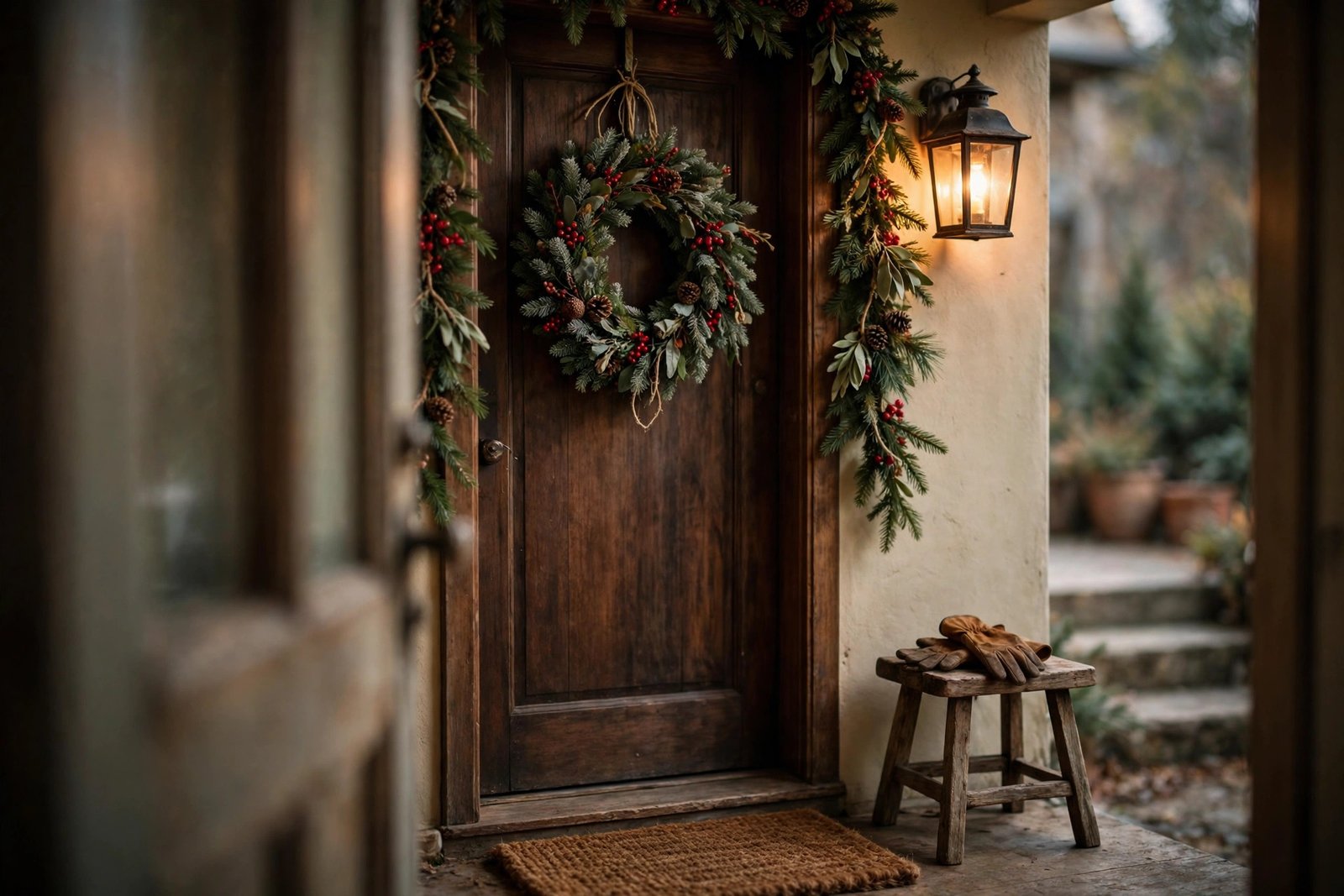
3. Layer a Rug Over a Larger Mat
Winter entries take a beating, and one thin doormat rarely survives December. Layering solves both the practical problem and the decorating one. Start with a larger, flat outdoor rug or a durable woven mat that catches dirt and melting snow, then place a smaller coir doormat or a patterned indoor rug on top, slightly off-center so the layers read as intentional rather than accidental.
Choose materials you can shake out or wipe down, especially if your household tracks in snow, salt, or mud. Avoid thick, plush rugs right at the threshold, where they can catch the door or become a tripping hazard. A low pile works best, and a rug pad underneath keeps everything from sliding on wood or tile floors. In the United States, where many homes have a hard-surface entry, this layered look also adds warmth underfoot without hiding a beautiful floor entirely.
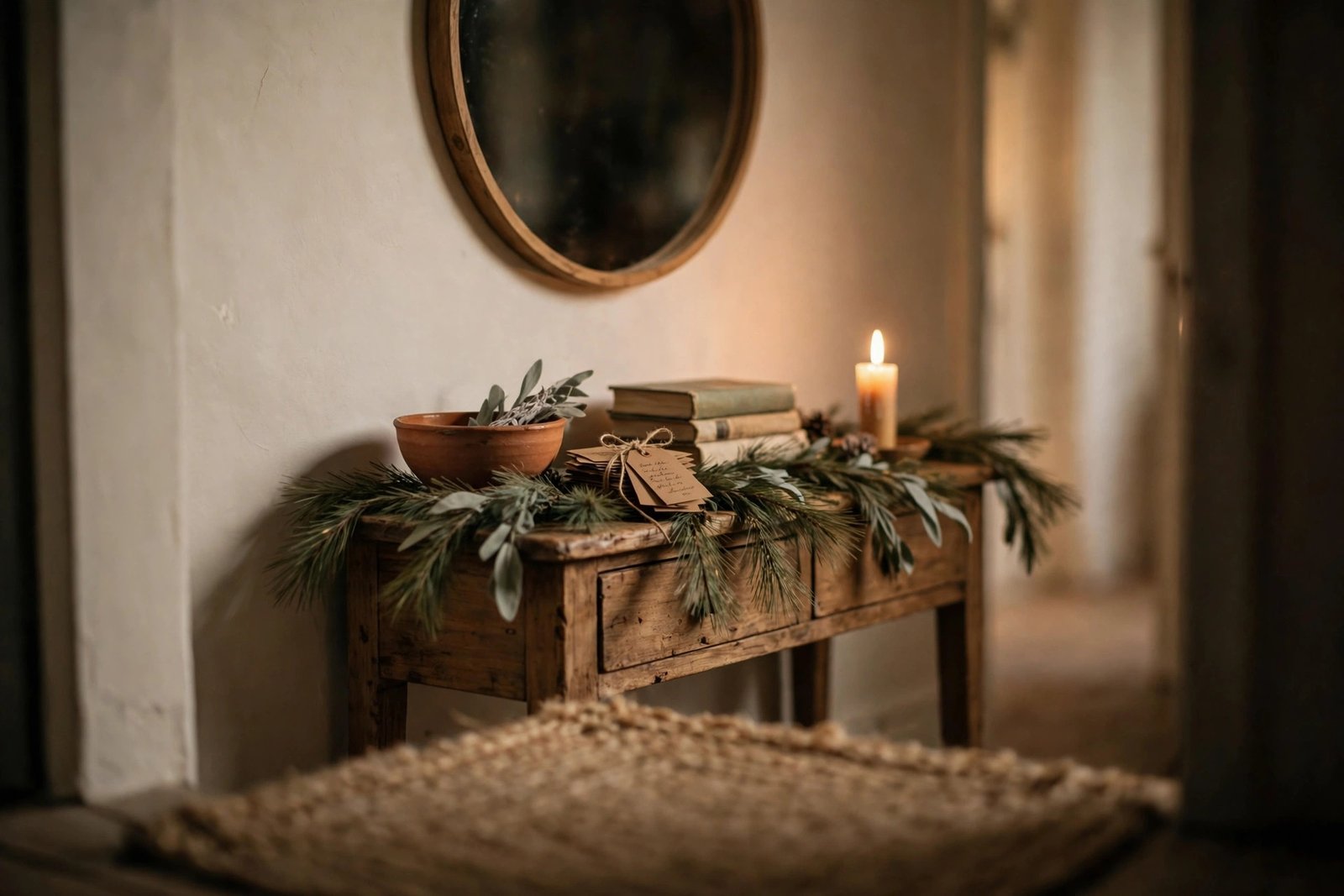
4. Anchor the Space With a Console Table
Every entryway needs one workhorse piece, and a console table is usually it. It gives you a place for keys, mail, a candle, and seasonal decor, and it anchors the wall so the space stops looking like an empty hallway. Measure first: leave at least 36 inches of clear walkway in front of the table, and choose a table narrow enough that guests are not squeezing past it with coats and gift bags.
If you do not have a console, a slim bench, a small chest, or even a wall-mounted shelf can do the same job in a tight space. The point is not the furniture itself but the landing zone it creates. Once that zone exists, decorating gets easier, because you have one defined surface to style instead of trying to decorate an entire wall. If you are starting from an empty entry, our broader entryway decor ideas will help you plan the furniture before you add the Christmas layers.
5. Add a Mirror to Bounce Light Around
Entryways are often the darkest spot in a house, especially in December when the sun sets early. A mirror is the simplest fix. Hang it above the console or on the wall opposite a window or a light source, and it will reflect both daylight and lamplight back into the space, making a small entry feel larger and brighter without any rewiring.
Choose a mirror that fits the wall: a round mirror softens a narrow entry, while a rectangular mirror suits a long console. Hang it at a height where most adults can see their face comfortably, usually with the center around 57 to 60 inches from the floor. Keep the frame simple — wood, brass, or black — so it works year-round, then let the Christmas garland and ornaments around it do the seasonal work. Wipe the glass before guests arrive; a dusty mirror shows up fast in entryway light.
6. Style the Console in Three Layers
A console looks styled, not cluttered, when it has three layers: something tall at the back, something medium in the middle, and something low in front. The tall layer might be a mirror, a framed print, or a pair of candlesticks. The middle layer could be a stack of books, a small plant, or a bowl. The low layer is where the Christmas details live: a short garland along the front edge, a few pinecones, or a small dish for keys.
Work in odd numbers where you can — three books instead of four, one candle instead of a matched pair on each side — and leave some empty space on the surface. That breathing room is what keeps a styled console from looking like a store display. Step back to the front door and check the whole arrangement from there, since that is the angle your guests will see. If one item blocks the mirror or crowds the edge, move it or take it out. Less, placed well, almost always looks more expensive than more, squeezed in.
7. Add a Bench Guests Can Actually Use
A bench is one of the most useful things you can put in an entryway at Christmas, because guests need somewhere to sit while they take off boots or set down bags. Choose a bench that fits the wall without blocking the door swing, and keep the seat mostly clear. A bench buried under decor is decoration, not furniture, and guests will quietly avoid it.
Style the bench lightly: one folded throw at one end, a cushion if the seat is hard, and baskets underneath for shoes or scarves. If space is tight, a small stool or a narrow upholstered bench can offer the same function in a smaller footprint. The test is simple. Sit down, take off your shoes, and stand back up without moving anything else. If you can do that easily, the bench is working. If you have to clear the seat first, it is time to edit.
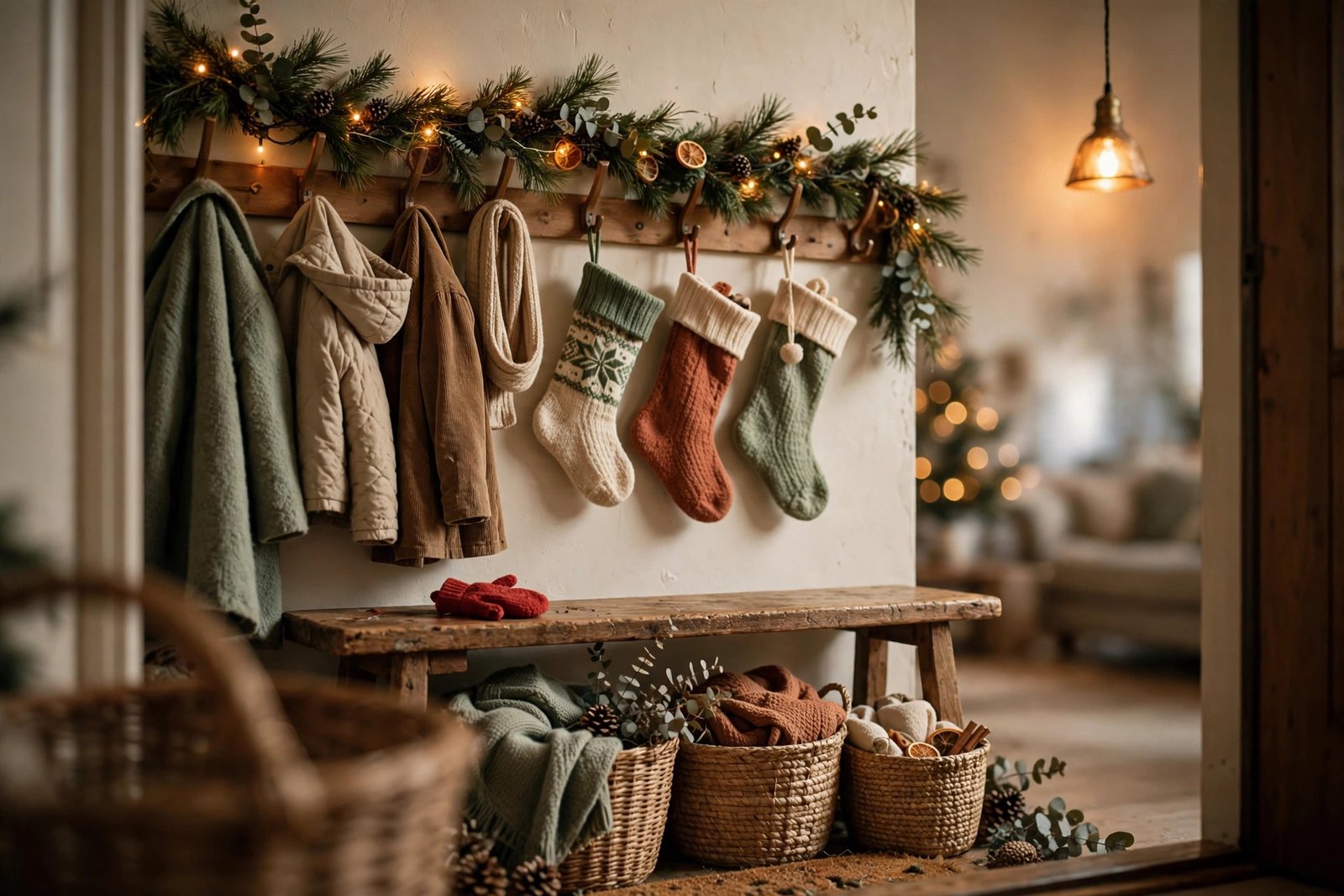
8. Make Coat Hooks Look Intentional
Coats are going to end up in the entryway in December whether you plan for them or not, so plan for them. A row of sturdy hooks, a wall-mounted rack, or a small coat stand keeps jackets off the bench, off the floor, and off the back of a dining chair. Space hooks about eight to ten inches apart so bulky winter coats do not overlap into one shapeless mass.
Hang hooks at two heights if children use the entry, with lower hooks they can reach themselves. Keep one or two hooks free for guests, and resist the urge to hang every coat your household owns in the entry at once. Store out-of-season coats elsewhere, and the hooks you keep will look tidy even on a busy evening. A few wooden or brass hooks also add warmth on their own, before any garland goes up.
9. Use Baskets for Boots, Scarves, and Gifts
Baskets are the entryway’s best hiding place. A large woven basket by the door swallows scarves, gloves, and hats. A pair of smaller baskets under a bench keeps shoes corralled. A lidded basket can even hold small wrapped gifts or gift wrap supplies without looking like storage at all.
Choose baskets that match each other in material, even if the sizes differ — all seagrass, all wicker, or all woven cotton — so the group reads as a set. Label nothing; in a home entry, labels tend to look like a pantry. Instead, give each basket one job and keep it to that job. Boots in one, winter accessories in another, and dog-walking gear in a third, if you need it. When baskets have a clear purpose, they stay tidy longer, because everyone in the house knows where things belong.
10. Tuck a Slim Tree or Potted Evergreen in the Corner
Not every entryway can hold a full Christmas tree, and it does not need to. A slim pencil tree, a small tabletop tree on the console, or a potted evergreen in a basket brings the same festive shape into a corner without blocking the walkway. A potted Norfolk pine or a small spruce can also live in the entry after Christmas, which makes it a practical choice for smaller homes and apartments.
Decorate a small entry tree simply: warm white lights, a handful of ornaments in one or two colors, and a simple topper or none at all. Over-decorating a small tree makes it look crowded fast. Place it where it will be seen from the front door but not bumped by coats, bags, or the door itself, and keep the cord tucked along the wall or behind furniture. If your entry is very narrow, a tall, narrow evergreen in a corner by the mirror often works better than any tree on the floor.
11. Create a Stocking and Hook Drop Zone
Stockings do not have to live only on the fireplace mantel. In an entryway, a row of hooks dressed with stockings turns a practical wall into a Christmas focal point, especially in homes where the fireplace is in another room or already crowded. Hang stockings on sturdy hooks, not on adhesive hooks meant for light items, and keep them clear of the door swing and of any candle or heat source.
Mix stocking styles that share a color palette — cream, sage, and terracotta, for example — rather than trying to match them exactly. Different textures, like knit, felt, and linen, add interest without clashing. If children hang stockings in the entry, keep small items and treats out of reach of pets, and avoid hanging anything heavy enough to pull a hook off the wall. When the season ends, the hooks stay useful year-round, which makes this one of the easiest ideas to keep.
12. Dress the Staircase Banister if You Have One
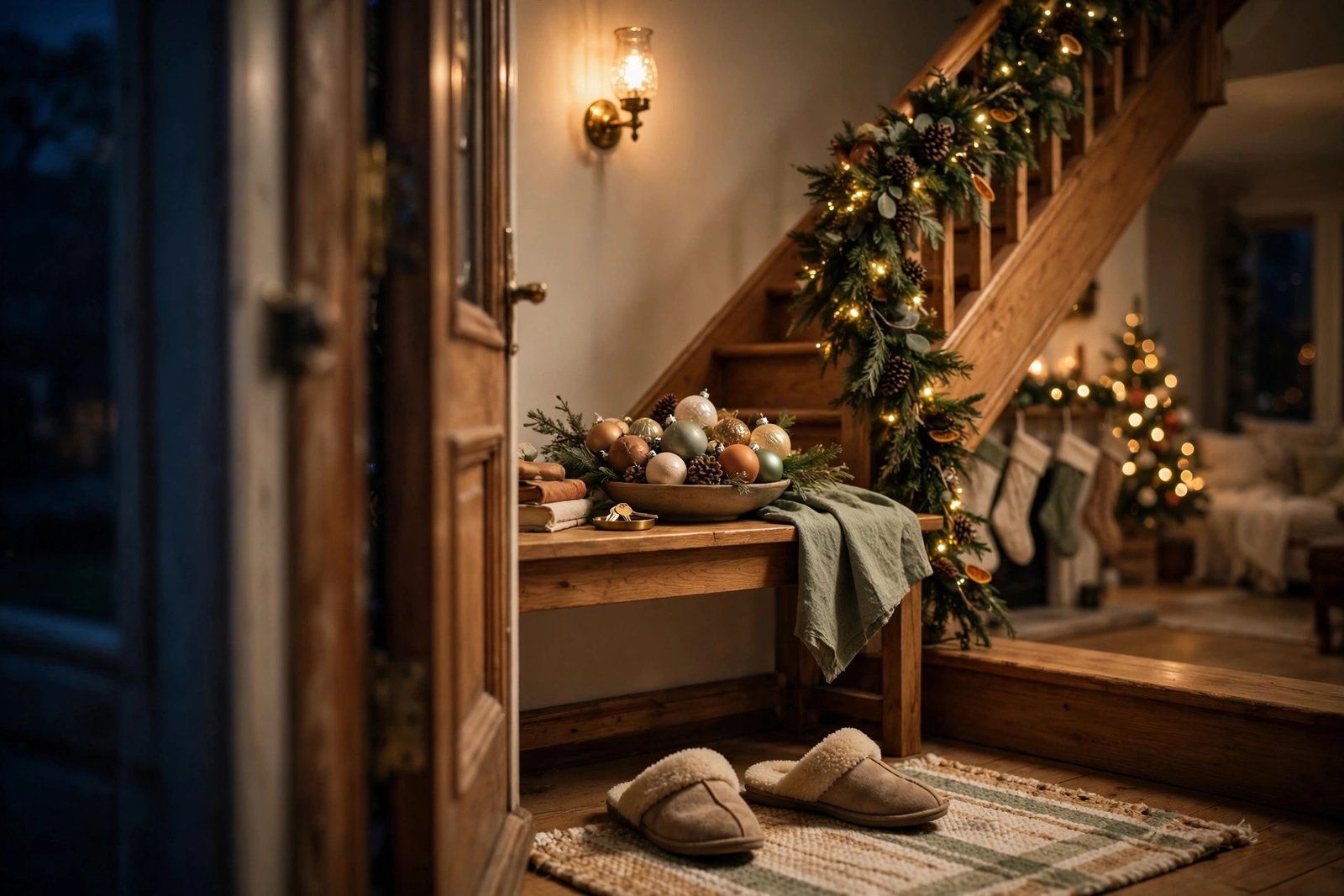
If your entryway opens onto a staircase, the banister is a gift. Garland draped along the handrail draws the eye upward and connects the entry to the rest of the house, making the whole space feel decorated even if you have only styled one wall. Start at the bottom newel post, secure the garland loosely, and let it drape in gentle swags rather than wrapping it tightly around every spindle.
Safety matters here more than style. Keep garland off the handrail grip itself so hands can still hold the rail, and use ties or wire rather than anything that slips. Avoid heavy ornaments at head height on a narrow staircase, and keep lights on a timer so you are not reaching behind the banister every night. In homes with small children, skip long ribbons or dangling pieces that could catch little hands on the stairs.
13. Add Scent Without an Open Flame
A Christmas entryway should smell like the season the moment the door opens, but the entry is also where coats, paper, and dry garland meet — not the best place for an unattended flame. Use safer options: a simmer pot on the stove before guests arrive, a reed diffuser on the console, dried orange slices and cinnamon sticks in a bowl, or a pine-scented sachet tucked into a basket.
Keep scent subtle. One source is enough, and a strong fragrance in a small, enclosed entry can overwhelm guests, especially anyone sensitive to scent. If you do use a candle in the entry, choose a flameless candle for the look of light without the risk, and save real candles for a supervised room where you will actually be sitting. A lightly scented entry that greets guests gently will always feel more welcoming than one that hits them at the door.
14. Swap in Warm Light for December
Light changes everything in an entryway, and December is the month to get it right. Swap cool white bulbs for warm white ones, around 2700K, in the entry fixture, and add one smaller warm light source — a lantern, a table lamp, or a string of fairy lights — so the space glows rather than glares. Warm light flatters wood, greenery, and skin tones, which is exactly what you want when guests arrive in the evening.
Put entry lights on a timer or a smart plug so the house looks welcoming when you come home, not just when you remember to switch them on. Check the entry at night from outside, too: the glow through a window or a glass door panel is part of the welcome. If your entry has no overhead light, a plug-in wall light or a battery-operated lantern on the console can fill the gap without an electrician. Keep cords out of the walkway, and avoid draping lights across the floor where they can trip someone carrying gifts.
15. Add One Personal Touch Guests Will Notice
The entries people remember are not the most decorated ones; they are the ones with something personal in them. A framed family photo from a past Christmas, a child’s handmade ornament on the console, a small chalkboard with a welcome message, or a bowl of candy canes by the door all tell guests this home is lived in, not staged. Choose one personal touch, not five, and give it a clear spot.
Keep personal items practical as well as pretty. A welcome note works better on a small easel than taped to the door, where it peels in winter weather. Children’s artwork looks best in a simple frame rather than stuck to the wall with tape that will damage paint. And if you display anything fragile or sentimental near the door, place it where coats and bags will not knock it over. Personal does not have to mean precious, and the safest personal touches are the ones guests can enjoy without worrying about breaking them.
16. Dress the Entry Mirror With Garland
A mirror already earns its place in the entry by adding light and space. At Christmas, a garland around its frame turns it into a focal point with very little effort. Drape a short, flexible garland across the top of the mirror and down one side, rather than framing all four sides, so the mirror stays useful and the reflection stays clear. Tuck in a few small ornaments or pinecones, and keep the bottom of the frame clear so the console below it does not look crowded.
Use a lightweight garland here, and attach it with small removable clips or wire tied to the frame, not adhesive that can damage the finish. Test the arrangement from the front door: you should see greenery first and your reflection second, not a wall of branches. If the mirror is round, a garland swag across the top alone is often enough. This is a good idea for renters, too, because it adds a lot of Christmas feeling without a single hole in the wall.
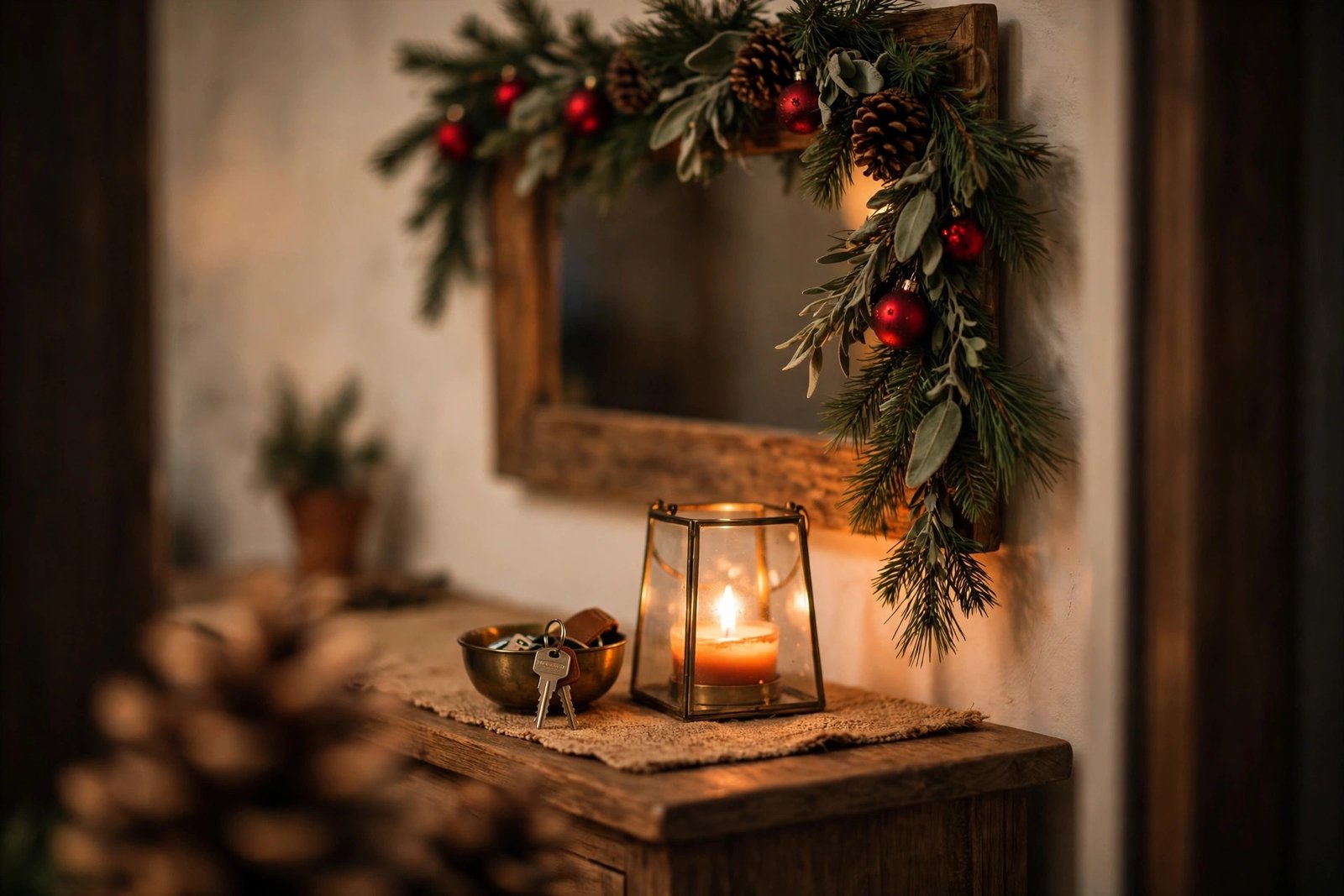
17. Build a Small Tray Vignette for Everyday Items
Keys, sunglasses, mail, and loose change tend to collect in the entry no matter what you do, so give them a beautiful place to land. A tray on the console corrals those everyday items into one defined spot, and a few Christmas details on the same tray — a pinecone, a small ornament, a sprig of greenery — make the practical look festive without extra effort.
Choose a tray that fits the console with room to spare, in wood, brass, or woven material that matches the rest of the entry. Keep the tray to one layer of items; stacking mail, keys, and decor on top of each other defeats the purpose. Empty the tray once a week in December, when catalogs, cards, and packages pile up fastest. A tray that stays clear is a small daily win, and guests notice a tidy entry even if they cannot say exactly why it feels calm.
18. Dress the Sidelights and Windows, Not Just the Door
Many American front doors have sidelights or a transom window above them, and those glass panels are often left bare while the door gets all the attention. A simple treatment — a small wreath on each sidelight, a garland across the transom, or a battery-operated candle in each window — balances the whole doorway and looks lovely from outside at night.
Keep window decor light and low-profile so it does not block daylight or the view of who is at the door. Suction-cup hooks work well on glass, and removable window clings can add a festive pattern without any adhesive residue. Avoid hanging anything heavy on glass, and skip window treatments that cover the peephole or a video doorbell. The goal is a doorway that looks finished as a whole, not a door with empty glass on either side.
19. Set Up a Small Gift Corner by the Door
December means gifts coming and going, and a small, defined gift corner keeps them from taking over the entry. A basket, a low stool, or one end of the bench can hold outgoing gifts, a few gift bags, and tissue paper, ready to grab on the way out. Incoming gifts can go in the same spot until they are put away, rather than stacking up on the console.
Keep this corner small and time-limited. If it grows past one basket, it has become storage, and the entry will feel cluttered again. Wrap or bag gifts ahead of time where you can, and keep scissors, tape, and tags in a small pouch inside the basket so the corner stays self-contained. On party days, clear the gift corner entirely and let it hold guests’ coats or bags instead. Flexibility is the point; the entry has to work for real life, not just for photos.
20. Keep the Entry Safe and Easy to Walk Through
Beautiful entries still have to be safe, especially in December when guests arrive in the dark, carrying bags, with wet shoes. Keep the main path at least 36 inches wide and completely clear of baskets, boots, and decor. Secure rugs so they do not slide, and wipe up tracked-in snow or water promptly, since wet tile and wood floors get slippery fast.
Choose flameless candles near the door, keep real flames away from garland, paper, and coats, and never place a candle where a coat could brush against it. If you have pets, avoid toxic plants and small ornaments at pet height, and keep chocolate and treats out of reach. If children visit, secure heavy items like mirrors and tall trees so they cannot tip. A safe entry is a welcoming entry, because guests relax when they are not watching where they step.
21. Do a Nighttime Walk-Through Before Guests Arrive
The final idea is not a decoration at all; it is a check. One evening before guests arrive, walk up to your front door from outside, then walk in the way a guest would. Look at the porch, the door, the rug, the console, and the light, all in evening light, because that is when most holiday visits happen. This walk-through catches things daylight hides: a burned-out bulb, a garland that blocks the doorbell, a dark corner, or a rug that slides.
Fix the small things you notice — straighten the wreath, plug in the fairy lights, clear the bench, wipe the mirror — and then stop. A finished entry does not need one more item; it needs to be walked through, lit, and lived in. For ideas that carry the welcome beyond the front door, see our Christmas porch decor ideas for the outside and our Christmas living room decor ideas for the rooms guests will gather in next.
Products to Consider
These are the kinds of items that make the ideas above easier, without any need to buy everything at once. Start with what your entry actually lacks, and add one piece at a time.
- A fresh or faux evergreen wreath sized to your door, with a sturdy removable hook for hanging
- A flexible pine or cedar garland, plus removable hooks or wire for securing it without damage
- A low-pile layered rug set: a larger durable mat with a smaller coir or patterned doormat on top
- A slim console table or bench that leaves a clear walkway, with baskets underneath for shoes and accessories
- A wall mirror in wood, brass, or black, hung above the console to reflect light
- Warm white string lights or a flameless lantern for safe, warm evening light in the entry
- Woven baskets in one matching material for boots, scarves, gloves, and small gifts
- A small tray for keys and everyday items, plus a few pinecones or dried orange slices for scent and texture
Frequently Asked Questions
How do I decorate a small entryway for Christmas without making it feel crowded?
Choose three focal points and leave the rest alone: the door, one piece of furniture, and one light source. A wreath, a styled console or bench, and warm lights will make a small entry feel festive without filling every surface. Keep the walkway clear, use vertical space like hooks and a mirror, and skip floor decor that narrows the path. In a small space, editing matters more than adding.
Should Christmas entryway decor match the rest of my house?
It should feel related, not identical. Repeat one or two colors from your living room or tree — for example, sage green and terracotta, or red and gold — in the entry, and keep the overall style similar, whether that is rustic, modern, or traditional. The entry can be simpler than the main rooms. A shared palette is enough to make the whole house feel connected when guests walk in.
When should I put up Christmas entryway decor?
Most American households decorate the entry in late November or the first weekend of December, often the weekend after Thanksgiving. That timing gives you the full season to enjoy it without the decor feeling tired by Christmas Day. If you use fresh greenery, wait until early December so it stays fresh longer, and keep it watered or misted if it is indoors. Faux garland and wreaths can go up earlier without any worry.
How do I keep an entryway tidy when guests arrive with coats and gifts?
Plan for the mess before it happens. Clear one or two hooks and a basket for guests, keep the bench seat mostly empty, and set out a small tray or basket for gifts. A quick five-minute reset before guests arrive — shoes in baskets, mail cleared, rug straightened — makes more difference than any decoration. After the visit, return items to their baskets right away so the entry resets for the next day.
Are real candles safe in a Christmas entryway?
Real candles can be used safely in an entry only if they are supervised, kept away from garland, coats, paper, and curtains, and placed on a stable, heat-safe surface. In most entries, flameless candles are the better choice, because the entry is a high-traffic spot where people pass with coats and bags and may not notice a flame. Use real candles in a room where you will be sitting and can watch them, and use flameless light by the door.
Final Thoughts
A Christmas entryway does not need to impress anyone; it needs to welcome them. Start at the door, add one layer at a time, and keep the path clear and the light warm. The ideas that work best are usually the simplest ones: a wreath that fits, garland that frames rather than crowds, a bench guests can use, and a console that holds the everyday things beautifully.
Pick two or three ideas from this list for this weekend, live with them for a few days, and then add more only if the entry still feels unfinished. Your guests will remember how the house felt when they walked in — warm, calm, and ready for Christmas — far longer than they will remember any single decoration. That feeling is the whole point, and it starts right here, at the front door.