Your bedroom walls carry more visual weight than almost anything else in the room. They are the largest uninterrupted surfaces you see from the bed, and they set the mood the moment you walk in. Yet wall decor is often an afterthought: a single small frame hung too high, or nothing at all. The result is a bedroom that feels unfinished even when everything in it is new.
The good news is that walls are the easiest part of a bedroom to transform. You do not need to repaint the whole room or buy new furniture. Most of the ideas below take an afternoon or less, cost little or nothing if you shop your own home first, and work in rentals as well as owned homes. The guiding principle is simple: treat the wall as part of the room’s design, not as a blank backdrop. A large piece of art hung at the right height, a mirror placed to catch morning light, or a wall of woven baskets can change how the entire room feels.
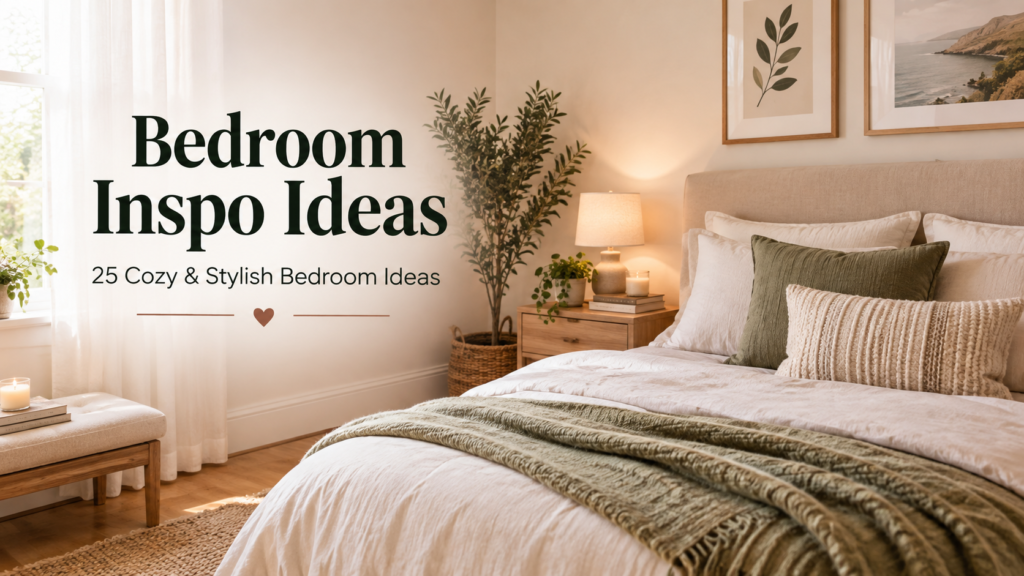
Before you start, stand in your bedroom doorway and look at each wall the way a guest would. Notice which wall gets the most light, which one you face when you wake up, and where your eye lands first. Those are your priority walls. If you are starting from scratch, browse these bedroom inspiration ideas to settle on a color direction first, because your wall decor will look far more intentional when it echoes the palette already in your bedding and rugs.
1. Hang One Oversized Piece Above the Bed
Nothing changes a bedroom faster than one big piece of art above the headboard. It anchors the bed, fills the largest wall in the room, and gives your eye a single calm focal point instead of visual clutter. The key is scale: most people hang art that is far too small. A good rule of thumb for US bedrooms is to choose a piece that spans roughly two-thirds to three-quarters of your bed’s width. For a queen bed, that means artwork somewhere between 40 and 48 inches wide. For a king, aim for 50 to 60 inches.
Hang the bottom of the frame 6 to 8 inches above the top of the headboard. Any higher and the art floats disconnected; any lower and it crowds the headboard. If you do not have a headboard, the art itself becomes the headboard substitute, and you can hang it a little lower, with the bottom edge around 54 to 57 inches from the floor, which is roughly eye level for most adults.
Subject matter matters in a bedroom because it is the last thing you see at night and the first thing you see in the morning. Abstract landscapes, soft botanical studies, and calm color-field pieces work better than anything busy or high-contrast. Shop secondhand first: thrift stores, estate sales, and flea markets are full of large framed pieces that cost a fraction of retail, and a coat of matte paint on a dated frame can make a $20 find look custom. If you buy a print, a simple wood or thin black frame keeps the look modern and lets the art speak.
2. Paint a Bold Accent Wall
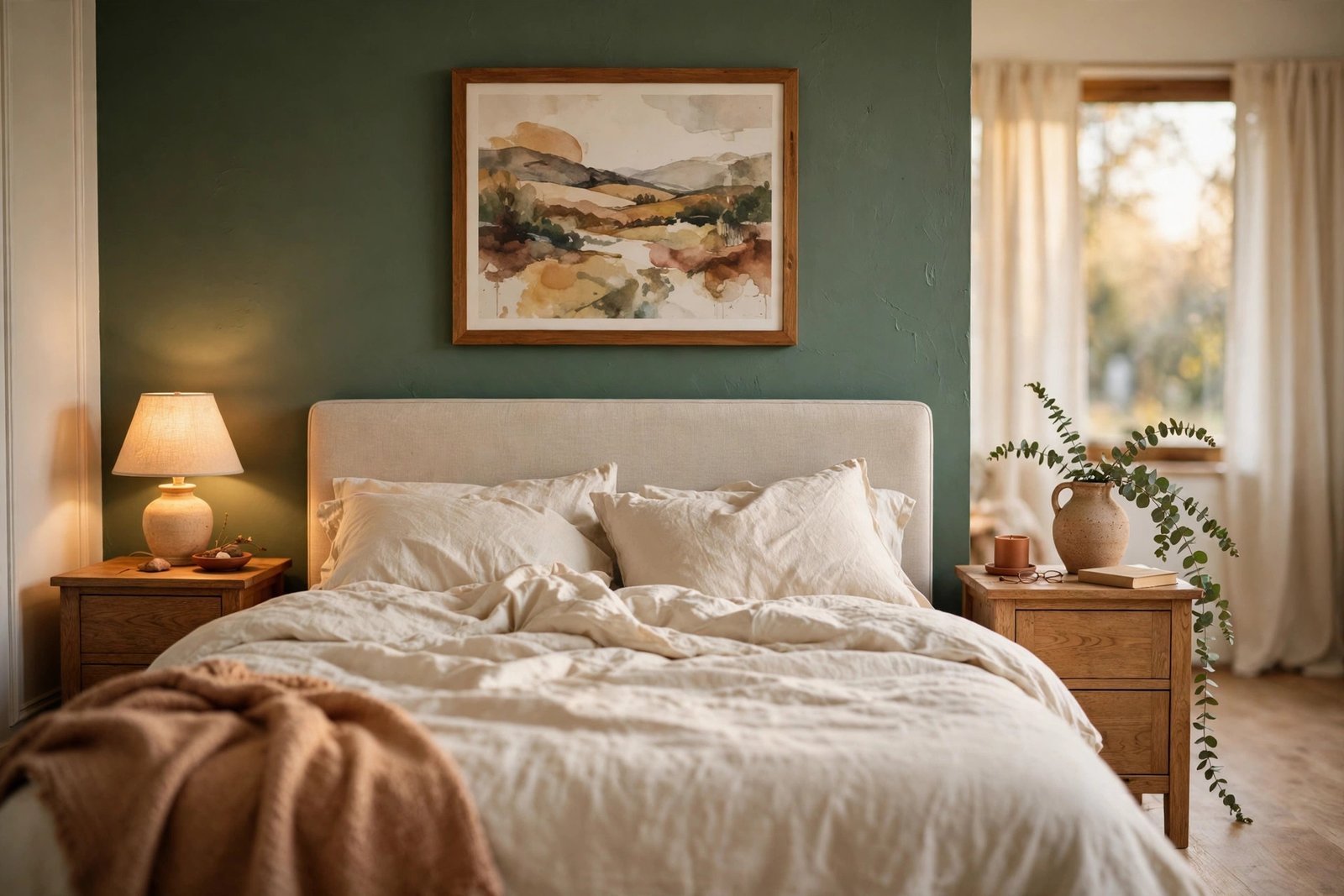
Paint is the cheapest square-foot transformation in decorating, and one wall is all it takes. Choose the wall the bed sits against, since that is the natural focal wall. Deep, restful colors work beautifully in bedrooms: sage green, warm clay, inky navy, or a rich charcoal. These shades make bedding and wood furniture pop in a way that white walls simply cannot, and they photograph beautifully too.
Before committing, paint large test swatches directly on the wall and live with them for at least two days. Color shifts dramatically between morning light and lamplight, and what looks like a soft sage in the store can turn gray-green under cool LED bulbs. Most paint retailers sell small sample pots, and a quart of sample paint costs less than a takeout dinner. Paint two coats on a 2-foot square, then observe it morning, noon, and night.
Prep matters more than paint. Wash the wall with a damp sponge, fill nail holes with lightweight spackle, and use painter’s tape only along the ceiling and trim, pressing it down firmly with a putty knife for crisp lines. Two coats of quality interior paint in an eggshell or satin finish will wear well and clean easily. If your ceilings are low, consider extending the accent color across the ceiling as well; a fully enveloped wall-plus-ceiling nook feels intentional and cozy rather than cave-like.
3. Add Texture With Wood Slats or Paneling
Flat painted walls can feel lifeless no matter how good the color is. Texture fixes that. Vertical wood slats, installed floor to ceiling behind the bed, add rhythm, warmth, and a designer look that costs far less than it appears to. Pre-cut slat panels are sold at most US home-improvement stores, and they mount with construction adhesive and a few finish nails into studs, so the project is very doable in a weekend.
For a softer look, try board-and-batten: thin vertical boards over a painted wall, spaced evenly and topped with a horizontal rail. Painted the same color as the wall, it reads as subtle architectural detail; painted in a contrasting shade, it becomes a statement. A 10-foot wall typically needs a day of work and costs less than a new piece of furniture.
Renters can get the texture effect without permanent changes. Peel-and-stick slat panels and self-adhesive molding strips have improved enormously in recent years, and many are genuinely removable without damaging paint. Always test one strip in a hidden spot first, and follow the weight limits on the package. If adhesive panels feel risky, a large piece of textured wallpaper hung like art (see idea 11) gives you the same dimensional interest with zero commitment.
4. Hang a Large Mirror to Double the Light
A mirror is the hardest-working piece of wall decor you can buy. It bounces natural light deeper into the room, makes a small bedroom feel twice its size, and acts as a finished decorative object in its own right. Placement is everything: hang or lean your mirror where it reflects something beautiful, ideally a window, so it doubles daylight, or the bed’s styled side, never a cluttered corner or the closet doors.
Size and shape guide the effect. A full-length arched mirror leaning against the wall beside a dresser adds height and softness. A large round mirror above the dresser echoes the curves of lamps and plants and feels calmer than a rectangle. For a true focal piece, an oversized rectangular mirror, at least 30 by 40 inches, above the headboard or opposite the window creates a dramatic light-catching moment.
Safety is non-negotiable with heavy mirrors. Anything over about 20 pounds should hang on studs or with proper wall anchors rated for the weight, not on simple picture hooks. Many US homes have drywall over studs spaced 16 inches apart; a stud finder is a $20 tool that earns its keep here. Leaning a full-length mirror? Secure the top to the wall with anti-tip hardware, especially if you have kids or pets.
5. Style Floating Shelves With Curated Objects
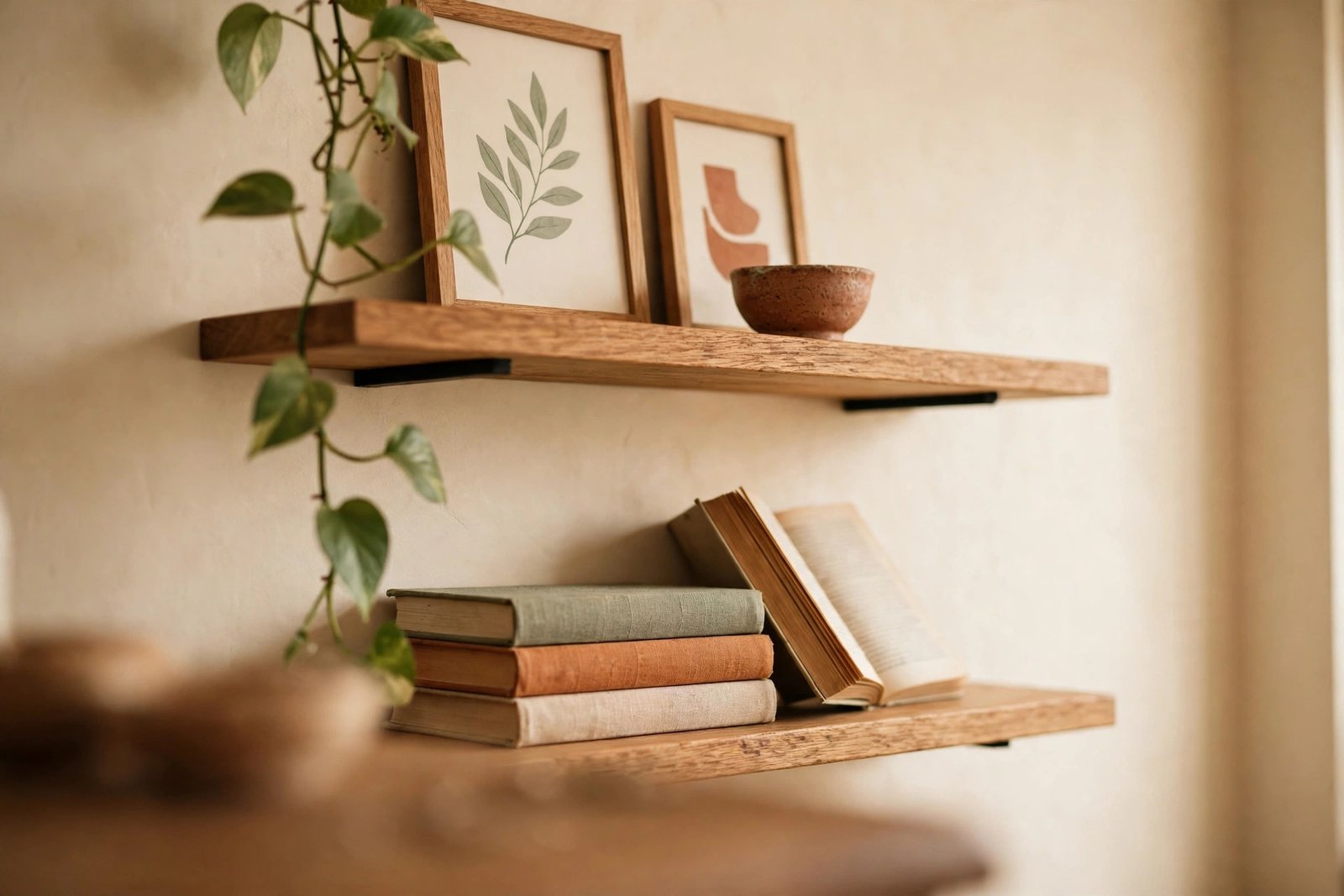
Floating shelves turn an empty wall into a display you can refresh in minutes. They work especially well on walls that are too narrow for large art, like the stretch beside a window or above a desk. The secret to shelves that look styled rather than cluttered is breathing room: leave at least a third of each shelf empty, and vary the height and shape of what you place on them.
Build each shelf like a little still life. Start with something tall at one end, a framed print or a small vase with stems. Add a horizontal stack of two or three books in the middle, which gives smaller objects a stage to sit on. Finish with something organic at the other end, a trailing plant or a woven basket. Odd numbers of objects read as intentional; even numbers tend to look like a lineup. Step back and squint at the shelf from across the room: if no single object dominates, the balance is right.
Mount shelves into studs whenever possible, since books get heavy fast. A standard 24-inch shelf loaded with books can weigh 30 pounds or more. Use a level, mark both studs, and drill into solid wood; toggle bolts are your backup in drywall. Height matters too: shelves above a desk sit about 18 to 20 inches above the desktop, and shelves meant for display alone look best with their center around eye level, roughly 57 to 60 inches from the floor.
6. Paint an Arch or Color-Blocked Shape
You do not need to paint a whole wall to get the drama of paint. A large painted arch behind the bed acts like a headboard made of color, framing the bed and adding architecture where there is none. It is one of the most renter-friendly bold moves, since it is just paint, and one of the cheapest: a single quart usually covers it.
Drawing a clean arch is easier than it looks. Mark the center point of your arch on the wall, then tie a string to a pencil at the radius you want. Hold the string at the center and swing the pencil in a half circle, keeping the string taut. Connect the ends of the arc with straight vertical lines down to wherever the shape should end, fill the inside with your color, and peel painter’s tape while the second coat is still slightly tacky for the crispest edge.
Color-blocked rectangles and half-painted walls work on the same principle. Painting the lower third of a wall in a deep color with a crisp horizontal line adds grounding weight to a room, and a wide stripe running behind the bed and up over the ceiling creates a cozy cocoon effect. The only rule: keep the edges laser straight. A wobbly line ruins the effect instantly, so invest in quality painter’s tape and a small level, and press the tape edge down hard before you start.
7. Go Big With a Statement Headboard
A headboard is wall decor that earns its keep twice: it protects the wall behind the bed and gives the room a finished focal point. Oversized and upholstered headboards are having a moment for good reason. A tall headboard, 48 inches or higher, draws the eye up and makes ceilings feel taller, which is a gift in standard 8-foot US bedrooms. Choose linen or velvet in a warm neutral and it will coordinate with almost any bedding you buy for the next decade.
You are not limited to store-bought headboards. A vintage wooden door, a pair of shutters, or a large woven room divider mounted to the wall behind the bed all read as headboards with far more character than anything from a catalog. Reclaimed wood planks, sanded smooth and sealed, make a rustic statement headboard in an afternoon. Just make sure any DIY headboard is sanded to remove splinters and sealed so it does not snag bedding.
Mounting matters for both looks and safety. Freestanding headboards that attach to the bed frame are the sturdiest option. Wall-mounted headboards should be secured to at least two studs with heavy-duty brackets, since you will lean against them. A tall upholstered headboard that is properly secured also absorbs sound, which makes the bedroom noticeably quieter, a genuine bonus if you live on a busy street.
8. Layer a Tapestry or Fabric Hanging
Fabric on walls brings a softness that framed art cannot match. A large tapestry, quilt, or woven hanging absorbs sound, adds pattern without permanence, and costs far less than a painting of the same size. It is also the ultimate rental-friendly wall decor: a single dowel rod and two hooks, and the whole thing comes down in minutes when you move.
Scale is the difference between a tapestry that looks bohemian-chic and one that looks like a dorm room. Choose a piece at least as wide as your nightstands span, and hang it so its center sits at eye level. Above the bed, a tapestry should clear the headboard by a few inches. Hang it from a wooden dowel or a slim brass rod threaded through a sewn sleeve at the back, never with bare nails through the fabric, which will tear the weave over time.
Quilts make stunning wall art, especially vintage or handmade ones with visible stitching. A quilt hung on a wall becomes a textile sculpture, and the texture reads beautifully in lamplight. Rotate your fabric pieces seasonally: a light cotton hanging for summer, a heavier wool weave for winter. The change takes ten minutes and makes the room feel new twice a year, a trick interior stylists use constantly.
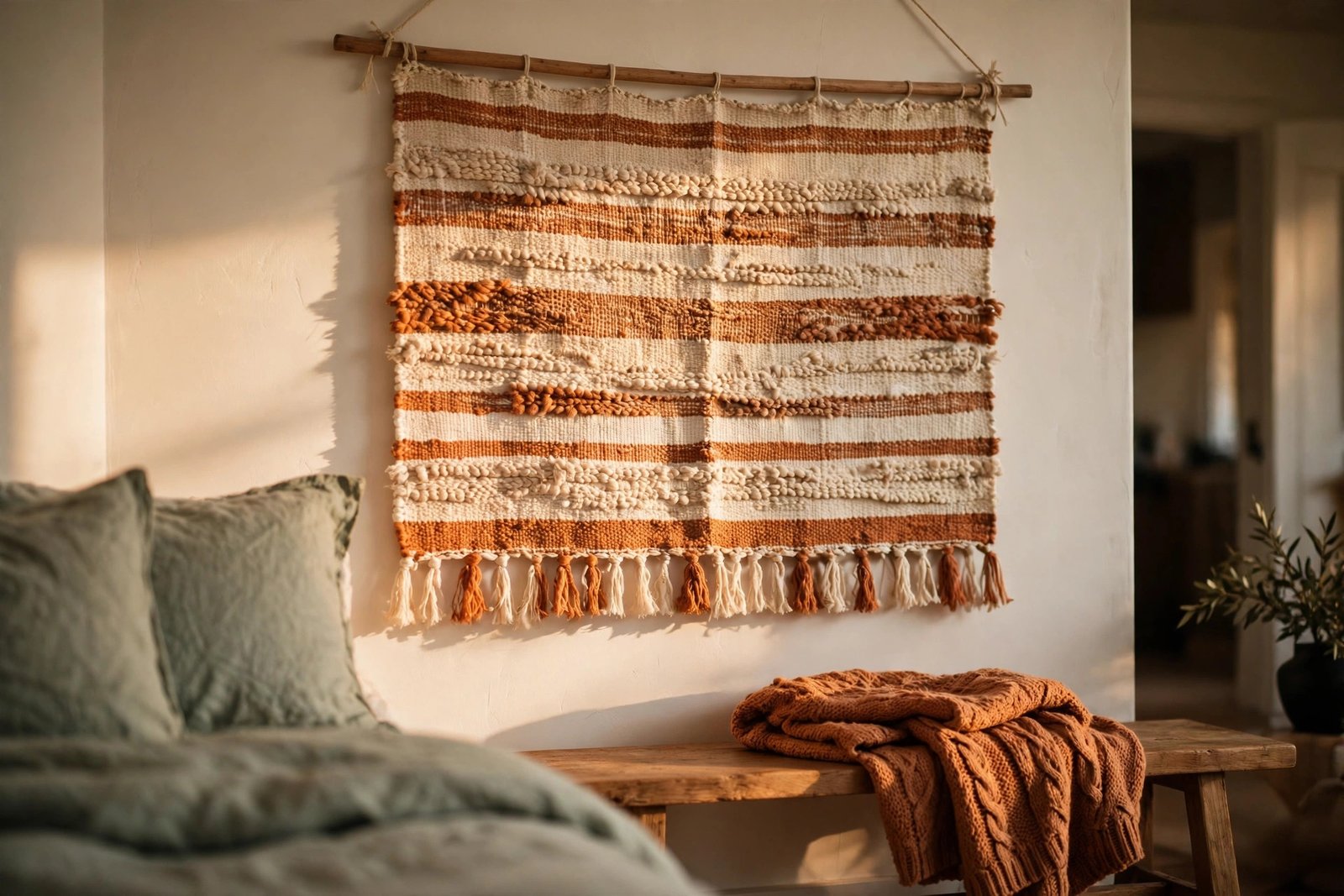
9. Create a Photo Ledge for Rotating Art
Picture ledges are the commitment-phobe’s answer to wall art. A slim shelf with a lip holds framed prints, small canvases, and even leaning mirrors without a single nail per frame. You can swap the entire display in minutes, which means your walls evolve with your taste instead of freezing in place the day you hang them.
Install two or three ledges in a staggered arrangement on one wall, or run a single long ledge the width of the bed. Overlap frames of different sizes, leaning larger ones at the back and smaller ones in front, and mix in one three-dimensional object like a small plant or a ceramic figure to keep the display from feeling flat. Start with your biggest piece off-center and build around it.
The rotating part is where ledges really shine. Swap in black-and-white family photos for a personal touch, seasonal prints when holidays approach, or new art finds from markets and trips. When December rolls around, these Christmas bedroom decor ideas pair beautifully with a refreshed ledge display. Because nothing is permanently hung, experimenting costs nothing, and a ledge wall never looks dated the way a fixed arrangement can.
10. Use Sconces or Picture Lights as Wall Decor
Lighting is wall decor that works after dark. A pair of brass sconces flanking the bed frees up nightstand space, adds a jewelry-like gleam to the wall, and gives you perfect reading light. Plug-in and battery-operated sconces have come a long way; many look identical to hardwired versions, and modern rechargeable models hold a charge for weeks, which makes them a genuine option for renters.
Picture lights deserve the same attention. A slim brass or black picture light mounted above a framed piece turns your art into a gallery moment every evening. Battery-operated picture lights with remote controls make this a ten-minute project with no electrician. Position the light so it washes evenly across the art, usually centered above the frame and tilted slightly forward.
When placing sconces, height is the detail that separates polished from awkward. The center of the shade should sit about 55 to 60 inches from the floor, roughly shoulder height when you are sitting up in bed reading. If your sconces have exposed bulbs, choose warm 2700K bulbs to keep the bedroom’s evening glow restful. Cool white bulbs in a bedroom fight the cozy atmosphere you are trying to build, no matter how pretty the fixture is.
11. Frame Wallpaper Panels Like Art
Wallpaper is expensive to install wall-to-wall, but you only need a few rolls, or even remnants, to create framed panels that look like custom art. Buy a bold patterned paper you love, frame large cuts of it in simple frames, and hang the panels as a series. Botanical prints, chinoiserie scenes, and abstract geometrics all work beautifully, and the pattern scale can be far bolder than you would ever commit to across a whole wall.
The professional version of this idea uses molding. Have thin picture-frame molding installed directly on the wall in a grid of rectangles, paint the wall, then fill the inner rectangles with wallpaper. The result looks like expensive paneled wallpaper at a fraction of the cost. Measure carefully so the panels are evenly spaced, and use a level for every line. Slightly uneven molding is the one thing that will give away the DIY.
This approach also lets you test-drive wallpaper commitment-free. Hang one framed panel and live with the pattern for a month. If you still love it, you can go bigger with confidence. Remnant rolls from wallpaper showrooms and online sellers cost a fraction of full rolls and are often exactly the right size for a framed panel or two.
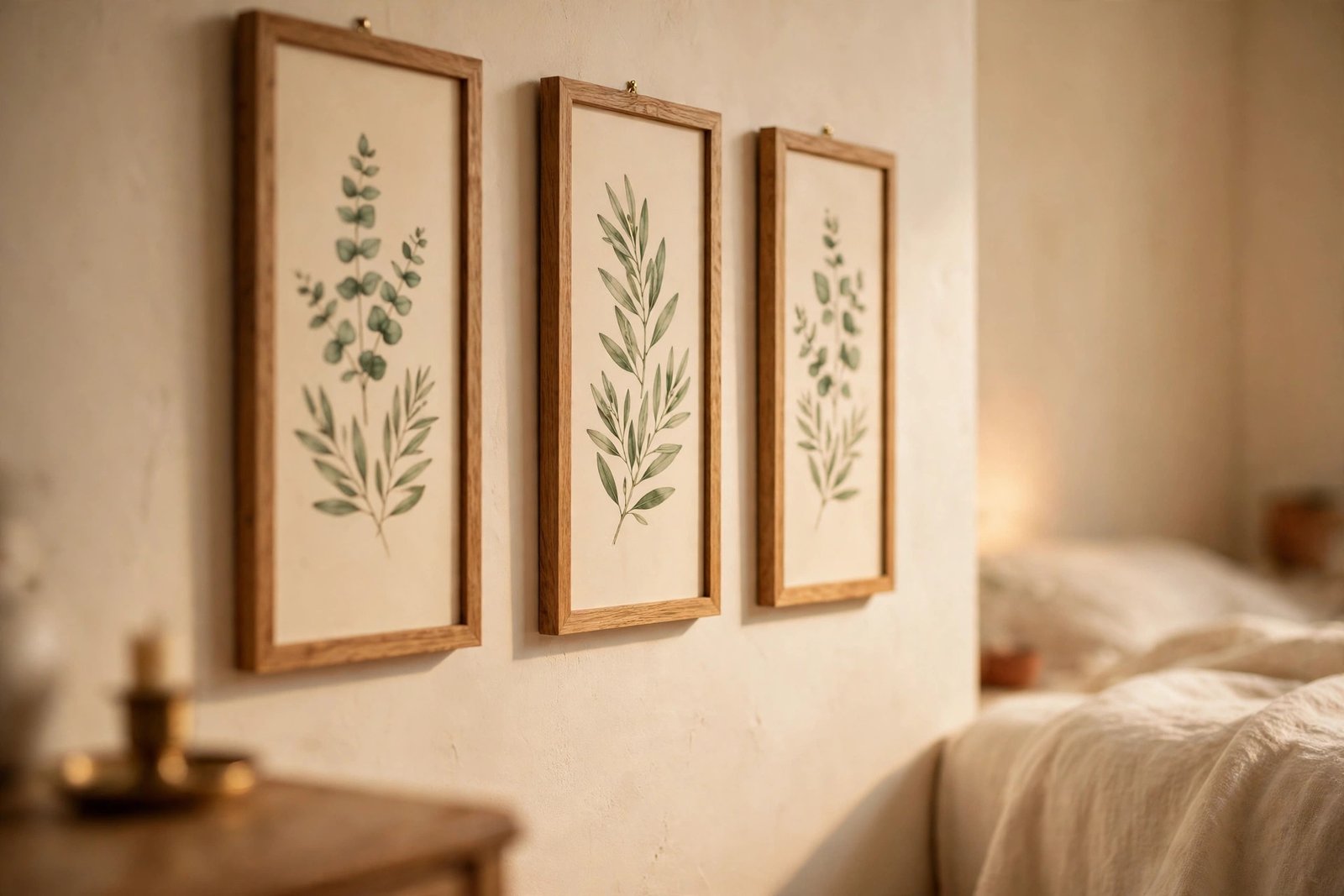
12. Hang a Small Curated Grid of Prints
A tight grid of small matching frames is one of the most reliably elegant wall arrangements. Unlike a sprawling gallery wall, a grid is controlled and symmetrical, which suits bedrooms because it reads as calm. Choose four, six, or nine frames, all identical in size and finish, and hang them with equal spacing, 2 to 3 inches apart, aligned like a windowpane.
Content inside the frames can be anything cohesive: black-and-white travel photos, a series of botanical illustrations, abstract prints in a shared palette, or even pages from a vintage book. The matching frames are what make it work; they turn varied images into one unified piece.
Hang the grid so its center sits at eye level, about 57 inches from the floor, and treat the whole grid as one piece when sizing it to the wall. If you want to go bigger and more eclectic with a full salon-style arrangement instead, this gallery wall guide walks through spacing, mixing frame styles, and planning the layout on the floor first. The grid is the safe, polished entry point; the gallery wall is where you go when you are ready to play.
13. Add Wainscoting or Molding for Instant Architecture
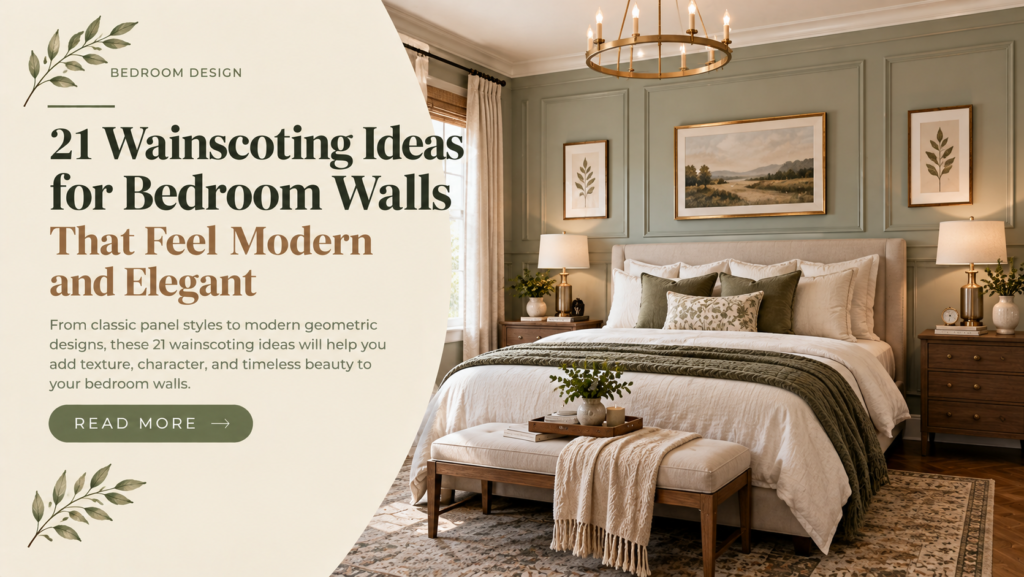
Some bedrooms feel unfinished because the walls are completely flat. Wainscoting and applied molding fix that by adding the architectural detail that older homes have and newer builds often lack. A chair rail with molding boxes below it, painted the same color as the wall, adds quiet dimension. Painted in a contrasting deep shade on the lower half, it becomes a dramatic two-tone moment.
This is a more involved project than hanging art, but it is squarely in weekend-DIY territory. Pre-primed molding strips from any home-improvement store, a miter box or miter saw, construction adhesive, and paint are the whole supply list. Measure twice, cut once, and caulk every joint before painting. Caulk is the difference between a professional look and an obvious DIY, so do not skip it.
Before you start, it helps to see the full range of what wainscoting can do in a bedroom, from classic beadboard to modern geometric paneling. These wainscoting ideas for bedrooms cover styles, paint colors, and height choices in detail. The key decision is height: traditional wainscoting tops out around 32 to 36 inches, while taller paneling that reaches two-thirds up the wall feels more current and dramatic.
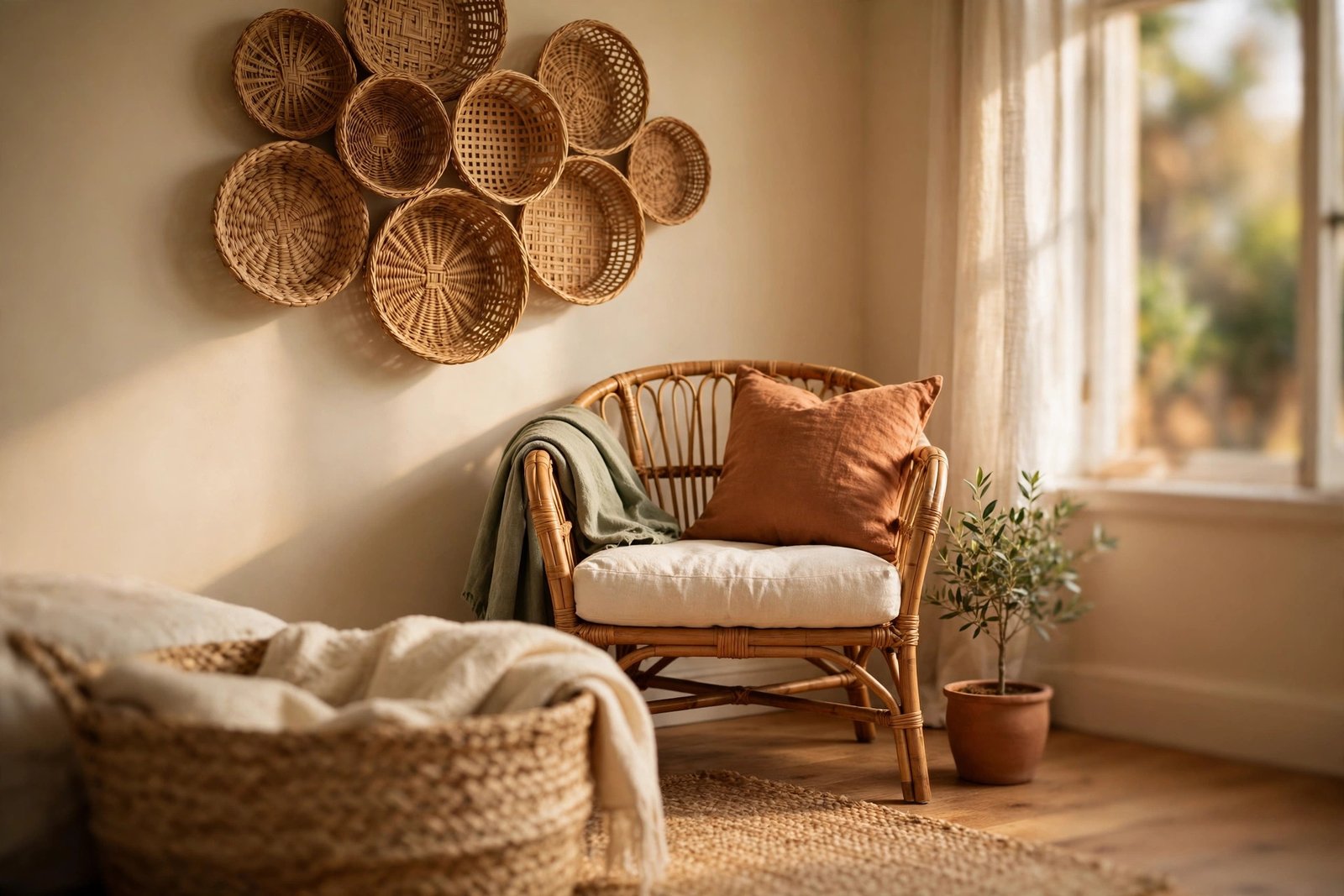
14. Go Three-Dimensional With Baskets and Objects
Walls do not have to be flat to be decorated. A cluster of woven baskets, hung in a loose organic arrangement, adds texture, warmth, and shadow play that no framed print can match. Seagrass, rattan, and jute baskets in graduated sizes work best; gather them from thrift stores and markets, aiming for a mix of flat and shallow bowls so the arrangement has real depth.
Lay the arrangement out on the floor first. Start with the largest basket slightly off-center, then build outward with smaller pieces, keeping the overall shape roughly oval or round. Photograph the layout from above before you hang anything. Hang the pieces with a single nail each, stepping back after every third basket to check the balance. The arrangement should feel scattered but intentional, like it grew there.
Baskets are just the beginning of dimensional wall decor. Ceramic plates in a shared palette, a collection of straw hats, carved wooden masks from travels, or even a cluster of small wall-mounted planters all bring a wall to life in three dimensions. The unifying rule: stick to one material family or one color story so the collection reads as curated rather than random.
15. Keep One Wall Quiet on Purpose
Here is the idea nobody expects on a decor list: leave one wall alone. Not every surface needs to be decorated, and a bedroom with all four walls shouting feels restless. Choose the wall you face when you wake up, or the one behind the door, and let it breathe. A single quiet wall makes the decorated walls look more intentional by contrast.
Quiet does not mean unfinished. A freshly painted wall in a warm white or soft neutral, with clean baseboards and nothing hung on it, is a design choice, not an oversight. If the bare wall still bothers you, add one whisper of interest: a single small framed print, a slim floating shelf with one object, or a soft wash of color. The point is restraint.
This is also the smartest strategy for small bedrooms. Visual clutter shrinks a room faster than almost anything else. One calm wall gives your eye a place to rest, which makes the whole room feel larger and more peaceful. Decorate three walls with confidence and let the fourth do the quiet work of balance.
Products to Consider
- Oversized abstract canvas print in warm neutral tones
- Simple oak or thin black picture frame set
- Peel-and-stick wood slat wall panels
- Large arched full-length leaning mirror
- Pair of plug-in brass wall sconces with fabric shades
- Battery-operated brass picture light with remote
- Solid oak floating shelf pair with hidden brackets
- Handwoven cotton wall tapestry with wooden dowel
- Set of matching wood picture ledges
- Botanical wallpaper remnant roll for framed panels
- Stud finder and assorted picture-hanging hardware kit
- Woven seagrass wall basket set in graduated sizes
Frequently Asked Questions
How high should I hang art above the bed?
Hang the bottom of the frame 6 to 8 inches above the top of your headboard. If you do not have a headboard, aim for the center of the artwork to sit at about 57 inches from the floor, which is average eye level. Art hung too high is the most common bedroom decorating mistake; when in doubt, hang it lower than your instinct says. Step back to the doorway after hanging and check that the art feels connected to the bed below it rather than floating near the ceiling.
How big should wall art be for a bedroom wall?
For the wall above the bed, choose art that spans roughly two-thirds to three-quarters of the bed’s width. That means about 40 to 48 inches wide for a queen and 50 to 60 inches for a king. For other walls, the art should fill about two-thirds of the available wall space, measured between furniture edges or architectural breaks. One large piece almost always looks better than several small ones scattered across a big wall, because small pieces get visually lost.
Can I decorate bedroom walls in a rental without drilling?
Yes, and you have more options than ever. Adhesive hanging strips hold lightweight frames securely and remove cleanly. Peel-and-stick wallpaper and slat panels add texture without permanent changes. Leaning a large mirror or framed art against the wall needs no hardware at all. Tapestries hang from a tension rod or removable hooks. Always check your lease, test adhesives in a hidden spot first, and respect the weight limits printed on the package. When you move out, a little warmth from a hair dryer softens most adhesives for clean removal.
What colors work best for bedroom wall decor?
Bedrooms reward calm, enveloping color. Deep sage, warm clay, soft terracotta, inky navy, and warm charcoal all create a restful backdrop that makes bedding and wood tones glow. If you prefer light walls, choose warm whites and creams over stark bright white, which can feel clinical under bedroom lighting. Whatever you choose, repeat the color at least twice in the room, in bedding, a rug, or accessories, so the wall decor feels connected to the whole space rather than pasted on.
How do I hang heavy frames and mirrors safely?
Anything over about 20 pounds should be anchored into wall studs or hung with wall anchors rated for the actual weight, never on basic picture hooks alone. Use a stud finder to locate solid wood behind drywall; studs in most US homes sit 16 inches apart. For very heavy pieces, use two anchor points to distribute the load. Anti-tip straps secure leaning mirrors at the top. If you are unsure about your wall type, especially with plaster or concrete, a handyman can hang a heavy piece in under an hour, and it is money well spent for safety.
Final Thoughts
Bedroom walls do not need a renovation budget or a design degree. They need one good decision at a time: the right scale of art above the bed, a mirror placed to catch the morning light, a little texture where the wall feels flat. Start with the wall you see first when you walk in, finish it properly, and live with it for a week before moving to the next one.
The bedrooms that feel the most restful are rarely the ones with the most stuff on the walls. They are the ones where every piece earned its place: hung at the right height, sized to the wall, and chosen to make mornings calmer. Pick the two or three ideas from this list that suit your space and your budget, and your walls will stop being blank background and start being part of the room.