
A mudroom is the hardest-working room in most American homes — and usually the least loved. Shoes pile up, coats migrate to chair backs, backpacks land wherever gravity wins. The good news: you do not need a big renovation to fix it. A few smart mudroom ideas, applied with a little intention, can turn that chaotic landing zone into a tidy, welcoming entry that actually makes your mornings easier.
Whether you have a dedicated room off the garage, a sliver of hallway by the back door, or just a corner you are pretending counts as an entry, these 15 mudroom ideas cover layout, storage, materials, and styling. Pick three or four that fit your space and your family, and you will feel the difference by the end of the week.
One thing to know before you start: mudroom organization is a different skill from regular decorating. Pretty matters — a space you enjoy looking at is a space you will maintain — but function has to come first. Every idea below is chosen because it works on a rainy Tuesday in February, not just in a photograph. Start with storage and systems, then layer in the style.
1. Anchor the Room with a Storage Bench
Every great mudroom starts with one hero piece, and nine times out of ten that piece is a bench with storage. It is where you sit to pull on boots, where kids toss backpacks, and where the bottom half hides the visual clutter — shoes, mittens, reusable grocery bags — that makes entries feel chaotic.
Look for a bench about 18 to 20 inches tall (standard seat height, so sitting to tie shoes is comfortable) and at least 36 inches wide for one person, 48 inches for two. Cubbies or open shelves underneath beat closed cabinets here, because open storage means things actually get put away. Closed doors in a mudroom tend to become mystery boxes of forgotten gear.
Styling matters too. A simple wooden bench with cubbies reads warm and classic; a painted bench in a deep green or navy adds personality. Add a washable cushion on top and you have instantly made the mudroom feel like part of the home, not a utility zone. This is the single highest-impact mudroom organization upgrade for the money.
Products to consider: a sturdy wooden bench with cubbies, a washable bench cushion with ties, woven storage baskets that fit the cubby openings.
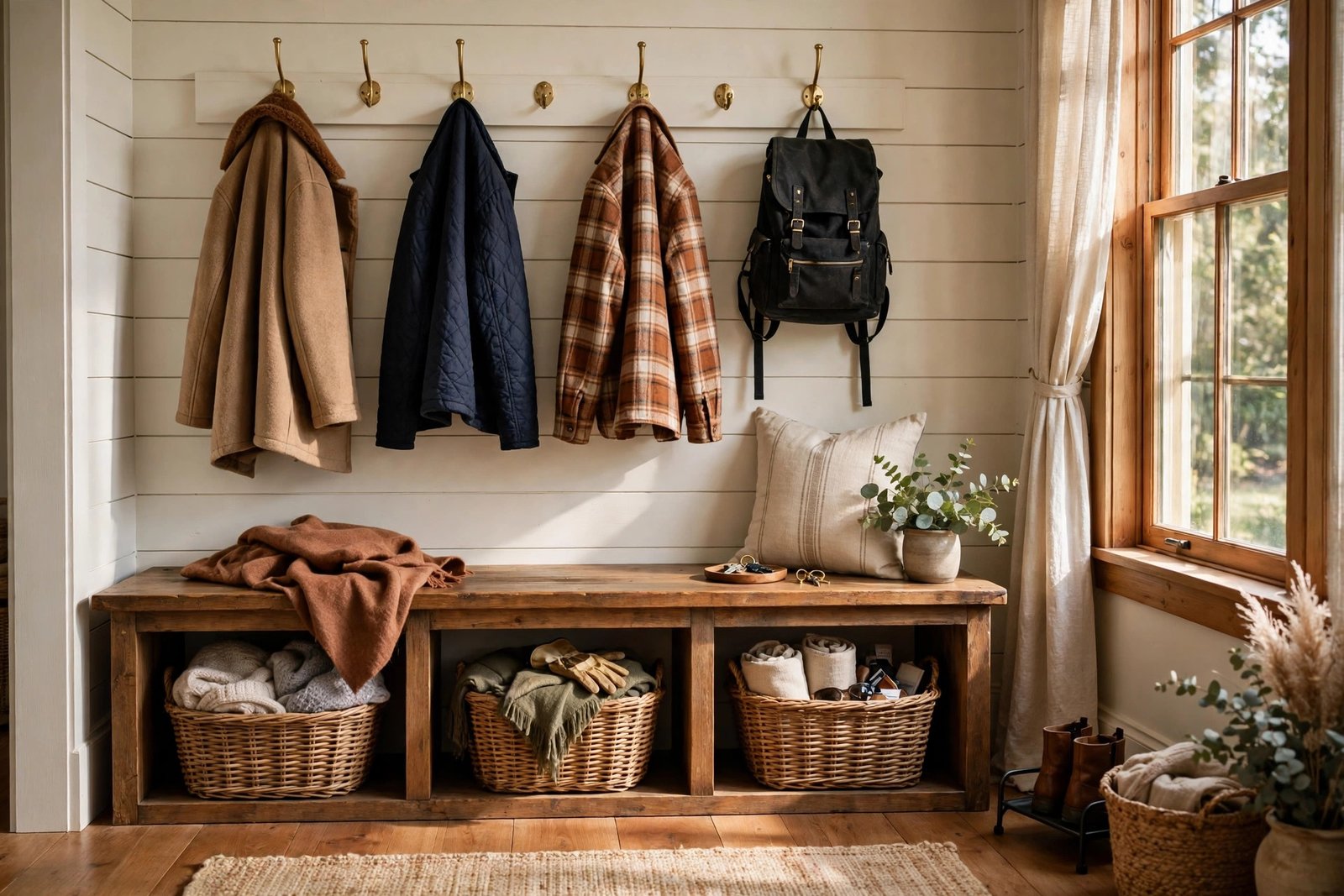
2. Give Every Family Member Their Own Cubby
The number-one reason mudrooms turn chaotic is shared storage. When everything belongs to everyone, nothing has a home. Assign each person a vertical “locker” — their own column of hooks, shelf, and floor space — and suddenly accountability does half the cleaning for you.
Plan on roughly 24 to 30 inches of wall width per person. Within each column: two hooks at different heights (about 40 inches for kids’ coats and 60 inches for adults’ longer garments), one shelf at eye level for hats and gloves, and a clearly defined patch of floor or a basket for shoes. Labels or small tags with names — or colors for little kids — turn it into a system even a five-year-old can follow.
This works just as well for households of two as for households of six; it just scales. If you are short on wall space, stack the columns floor-to-ceiling and let the top shelf hold out-of-season gear. The psychological shift is real: people stop dropping things “in the mudroom” and start putting things “in my spot.”
Products to consider: wall-mounted cubby units, chalkboard or wooden name tags, color-coded storage bins.
3. Hook Up the Walls — Hooks in Rows, Not Just One
Hooks are the single most underrated mudroom hardware. They are cheap, they install in minutes, and they hold an absurd amount of gear — coats, leashes, tote bags, hats, umbrellas, tomorrow’s work bag. The mistake most people make is installing two or three hooks and calling it done. Go bigger: a full row changes the equation.
Mount a horizontal hook rail with a hook every 8 to 10 inches. Better yet, double them up — a high row at about 60 inches for adult coats and a lower row at 36 to 40 inches for kids, dog leashes, and backpacks. Double hooks (two prongs on one base) are worth hunting for, because one hook can hold a coat and a bag together.
Choose sturdy metal hooks rated for at least 15 to 20 pounds each; winter coats and loaded school bags are heavier than you think. Brass or matte black finishes look intentional and elevate the whole wall. Pro tip: leave one empty hook per person on purpose. A system with zero slack falls apart the first time someone brings home something new.
Installation is a 20-minute job: find the studs with a stud finder, mount a 1×4 or 1×6 board as a rail, and attach the hooks to the board rather than directly to drywall. The board spreads the load and gives you a clean, finished look — plus it makes rearranging hooks later far easier than patching holes. If you rent, heavy-duty removable hooks rated for 7-plus pounds each can hold light jackets and bags without a single screw, and they come off cleanly when you move.
4. Think Vertical in a Small Mudroom
No dedicated mudroom? Most of us do not have one. Small mudroom ideas are really about borrowing vertical real estate: the 4 feet of wall above your head and the 12 inches of floor along the baseboard are usually all you need for a fully functional entry zone.
Stack your storage. A tall, narrow bookcase or a wall-mounted cabinet above a slim bench can hold hats, sunscreen, dog supplies, and cleaning cloths without eating floor space. Floating shelves at 66 to 72 inches high keep daily items reachable while leaving room below for a full-height mirror or a row of hooks. A wall-mounted fold-down bench is a clever trick for very tight spots — up when you need floor space, down when someone needs to sit.
The guiding rule for a small entryway mudroom is restraint: every item needs a reason to live there. If you only have room for six hooks, they belong to the six most-used items. Off-season gear goes to a closet elsewhere — and if your space is always threatening to overflow, take a page from our guide on small living room decorating mistakes: overcrowding a small space is the fastest way to make it feel cluttered rather than cozy.
Products to consider: a tall narrow open shelf unit, a wall-mounted fold-down bench, slim stackable shoe racks.
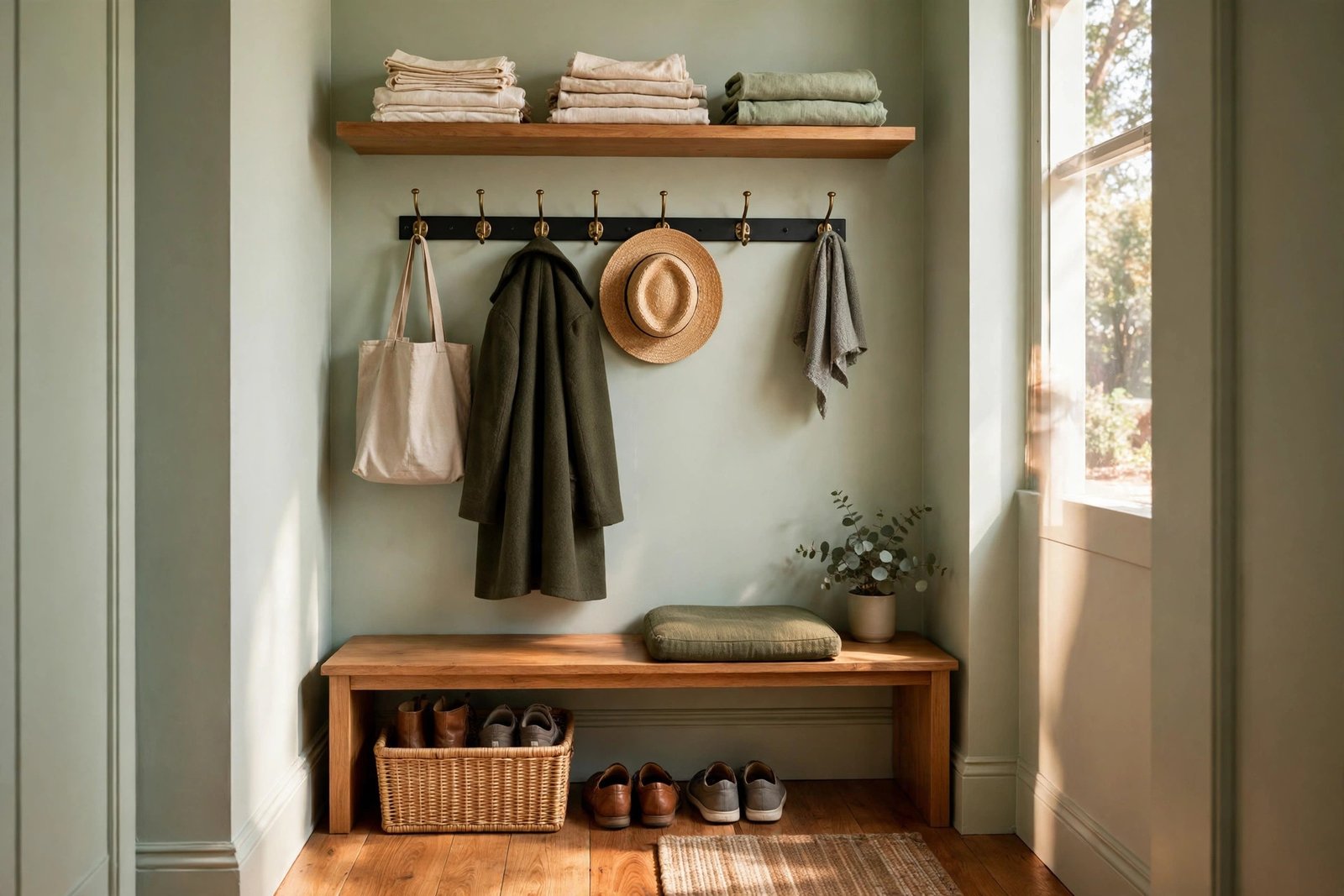
5. Shoe Storage That Ends the Pileup
Shoes are the visible half of mudroom chaos. The fix is not willpower; it is a system with enough capacity and zero friction. A good rule of thumb: plan for three pairs per person in daily rotation, plus one pair of boots per person in winter states. Anything beyond that belongs in bedroom closets.
Open shelves beat closed shoe cabinets for daily use — you can see every pair, and putting shoes away takes one motion instead of two. Slanted shoe racks fit more pairs per square foot, and tiered boot trays with raised edges catch melting snow and mud before it reaches your floor. In households with lots of rain or snow, dedicate a waterproof tray per person by the door for wet footwear, with dry storage one step behind it.
Measure your tallest boots before buying anything; many “shoe organizers” are designed for sneakers and leave boots homeless. About 16 inches of clearance handles most rain boots; tall winter boots may need 20 inches or more. And put the most-used pairs at the easiest height — knee to hip level. If the daily sneakers live on the bottom shelf behind the holiday boots, the system will lose.
6. Corral the Clutter with Baskets and Labeled Bins
Open storage only works if there is a container discipline behind it. Baskets and bins are what turn cubbies and shelves from organized-looking into actually organized. One basket per category: gloves and scarves, dog supplies, sunscreen and bug spray, reusable bags, umbrellas, the ever-growing collection of charging cables.
Labels are the secret weapon. A label maker, chalk tags, or simple wooden tags turn “the basket system” from a nice idea into something guests and kids can follow without being told. Group by season as well as by category — one basket labeled “winter” and one labeled “summer” makes the seasonal swap in idea 12 nearly effortless.
Stick to natural materials — woven seagrass, rattan, or sturdy cotton bins — which look warm and hide dust better than white plastic. Make sure whatever you buy fits your actual openings: measure cubby interiors before ordering, and leave a finger’s width on each side so baskets slide in and out without a fight.
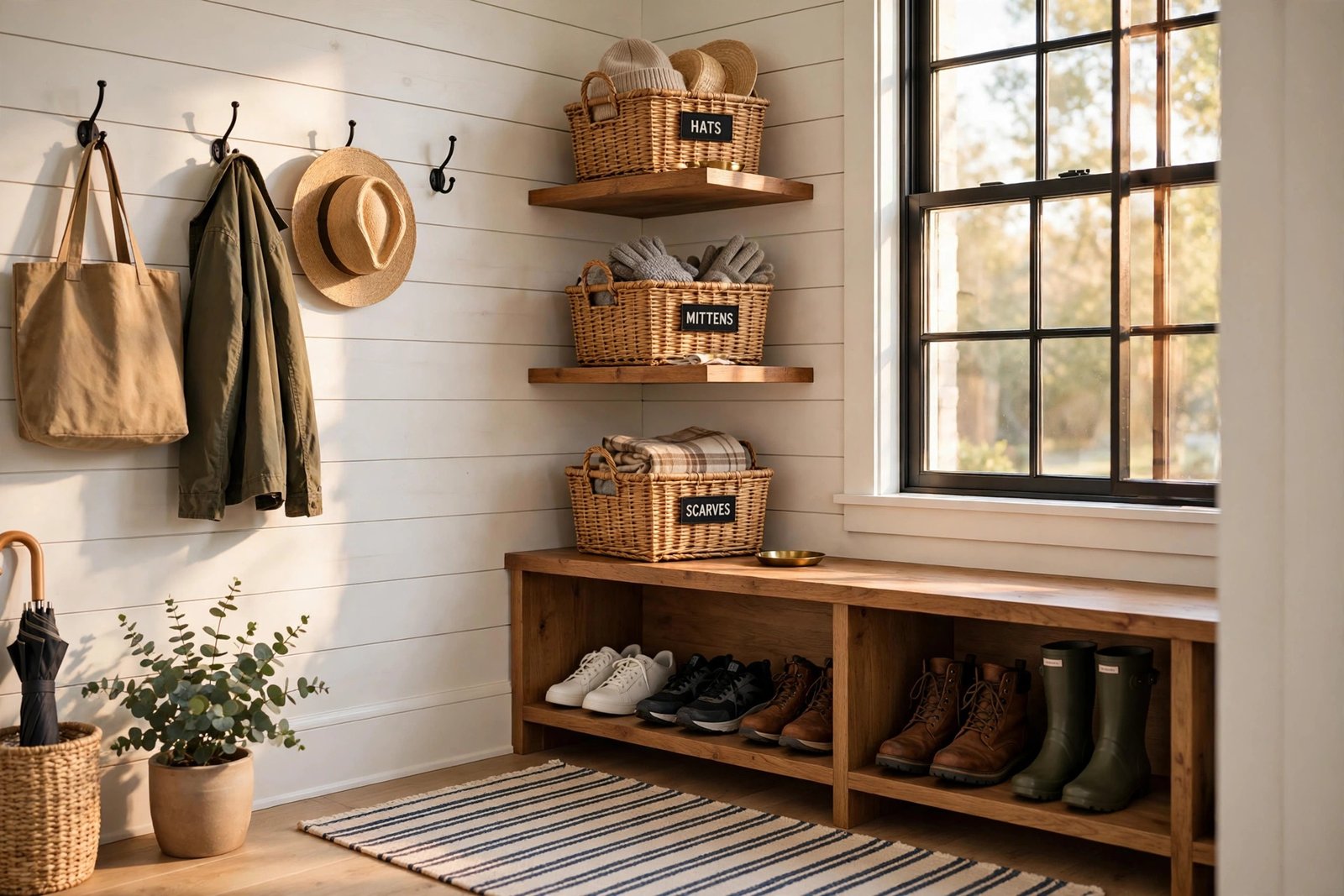
7. Create a Grab-and-Go Command Station
The mudroom is where mornings succeed or fail, so give it a command station: one compact spot for keys, wallets, sunglasses, the mail, and a phone charging shelf. When these things live anywhere else in the house, you spend every morning hunting. When they live by the door, you just grab and go.
A small floating shelf or the top of a narrow console at about 42 to 48 inches high works perfectly — high enough that toddlers cannot reach the keys, low enough to use without thinking. Add a wall-mounted key holder or a shallow tray per adult, a slot or basket for incoming mail, and a power strip with short cables for charging two devices overnight.
If you work from home, this little zone can double as your leaving-the-house ritual — and it pairs naturally with a real workspace inside. Our home office ideas cover how to set up a productive desk area, so the mudroom handles the transition and the office handles the focus. Keep the command station minimal: it should hold only what leaves the house with you, never become a junk drawer with a view.
Products to consider: a wall-mounted key holder with shelf, a slim mail sorter, a compact multi-device charging station.
8. Choose Floors That Can Take a Beating
Mudroom floors live a hard life: wet boots, muddy paws, road salt, gravel, and the occasional spilled sports drink. This is the one room where flooring should be chosen for durability first and looks second — although the good news is you no longer have to choose between the two.
Porcelain tile is the gold standard: waterproof, nearly indestructible, and available in looks from classic checkerboard to warm wood-look planks. Luxury vinyl plank is a strong budget alternative — waterproof versions handle real wet-mudroom abuse and the click-lock install is a realistic weekend DIY. Whatever you choose, look for a textured or matte finish rather than polished, because wet polished floors are a slip hazard.
Two practical extras make the floor work harder: a washable runner down the main walking path (it catches 80 percent of the dirt and goes straight in the washing machine), and a dark grout color if you go with tile. Light grout in a mudroom is a maintenance promise you will regret within a month. Carry the same flooring into an adjacent laundry or garage entry if you can — fewer transitions mean fewer dirt-trapping edges.
Do not overlook the threshold and the door mat, either. A coarse outdoor mat scrapes the worst of the mud before it ever enters, and an absorbent indoor mat handles the rest. Two mats — one outside, one inside — is the cheapest mudroom upgrade there is, and it roughly halves the dirt that reaches your nice flooring. Shake both out weekly and hose them down monthly, and your floors will thank you for years.
9. Carve Out a Pet Corner
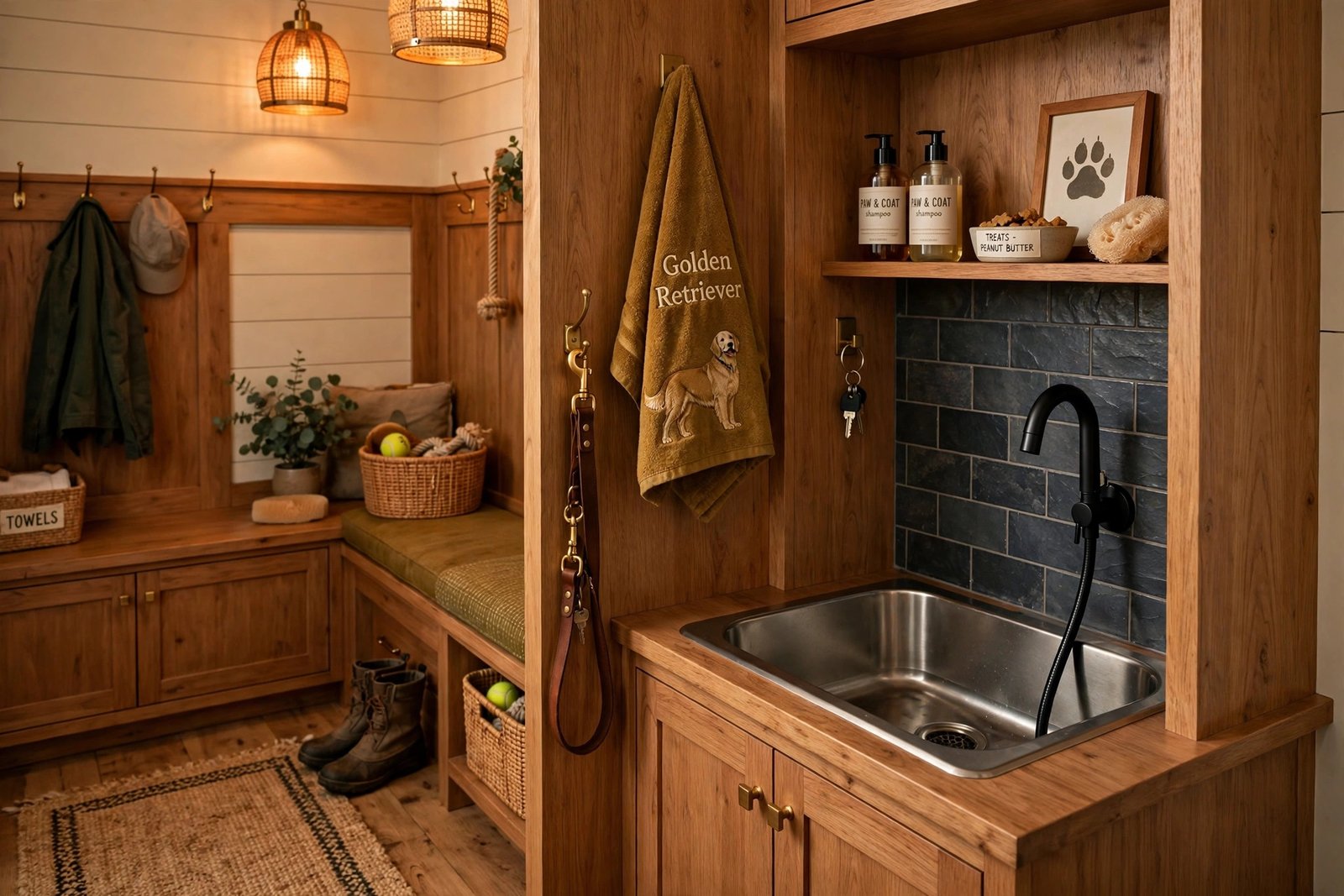
If your household includes a dog, the mudroom is the natural place for their gear — and possibly a wash station that saves your bathtub. A compact pet corner needs surprisingly little: a raised-edge mat for muddy paws, hooks for the leash and harness, a lidded bin for food or treats, and a stack of old towels within arm’s reach of the door.
For frequent mud-season hikers and hunters, a small utility sink or a handheld shower sprayer on a low tiled wall is a genuine quality-of-life upgrade. It does not need plumbing heroics — many people repurpose an existing laundry-adjacent wall — but if you are renovating anyway, roughing in a drain here is cheap insurance. Even without plumbing, a deep basin tucked under a counter handles paw rinses on the worst days.
Keep the pet corner at the end of the mudroom traffic flow, near the door, so a wet dog does not have to cross the whole room. A washable rug runner and a wall-mounted treat jar finish the zone. This is one of those mudroom ideas guests notice and remember — and one your dog will learn to love faster than any training treat.
10. Layer in Warm, Bright Lighting
Mudrooms are often interior, windowless, or tucked beside the garage — which means they default to one sad ceiling bulb. Lighting is what separates a mudroom that feels like a closet from one that feels like a room, and it is one of the cheapest upgrades on this list.
Start with a proper overhead fixture: a flush-mount or small pendant that throws light in every direction, in a warm color temperature around 2700K to 3000K. Cool daylight bulbs make wood tones look gray and skin look tired; warm light makes the same room feel like evening instead of a warehouse. If the space is long and narrow, two smaller fixtures beat one big one for even coverage.
Then layer. A small plug-in wall sconce or a battery-powered picture light over the mirror or artwork adds depth. LED strip lights tucked under floating shelves or above lockers make the storage glow and help you actually find things in dark cubbies. And if you have any natural light at all, keep window coverings minimal — a mudroom benefits from every lumen it can get. Motion-sensor switches are a small luxury worth every penny here: hands are almost always full in a mudroom.
11. Paint It Like You Mean It
Mudrooms are small, separate, and low-stakes — which makes them the perfect place to be braver with color than you would be in the living room. A rich, saturated paint color turns a pass-through space into a destination and hides scuffs far better than white ever will.
Deep greens, inky navies, and warm charcoals are mudroom classics for a reason: they look intentional, they make wood tones pop, and they disguise the daily wear that would show on a pale wall. If you prefer light and airy, choose a warm white or pale sage rather than a stark white — the warmth keeps the room from feeling clinical. Either way, use a satin or semi-gloss finish: it wipes clean with a damp cloth, which in a mudroom is not a luxury but a necessity.
One practical approach: paint the lower half (or the built-ins) a deep color and keep the upper walls light. You get the drama and the scuff-hiding where it matters, plus the brightness where your eyes go. If you are decorating the rest of your entry on a budget too, our budget home accents roundup is full of affordable pieces that punch above their price in small spaces like this.
12. Build a Seasonal Gear Rotation
The average mudroom fails not in October but in January, when summer hats are still on the hooks, sandals still on the shelf, and winter gear is piled on top of everything. A seasonal rotation — swapping gear twice a year — keeps the room matched to the weather instead of slowly drowning in it.
The system is simple: keep one clearly labeled bin per person (or per family) for out-of-season gear, stored in a closet, basement, or garage shelf. In October, winter gear moves in and summer gear moves out; reverse it in April. While you are at it, do a 10-minute audit — donate the outgrown boots, replace the dead flashlight batteries, toss the single gloves.
Time the swap to something you will remember: the first frost warning, the spring clock change, the start of school. Tie it to a calendar event and it becomes a habit instead of a chore. This one habit does more for long-term mudroom organization than any single piece of furniture, because it keeps the storage matched to what is actually being used.
While you rotate, keep a running “replace” list on your phone: the gloves with holes, the boots the kids outgrew, the umbrella that inverts in wind. Seasonal swaps are the natural moment to spot what needs replacing, and buying replacements before the season starts — rather than in a panicked February run — saves money and stress. A mudroom stocked for the weather you actually have is a mudroom that works.
13. Style a Mirror-and-Console Moment
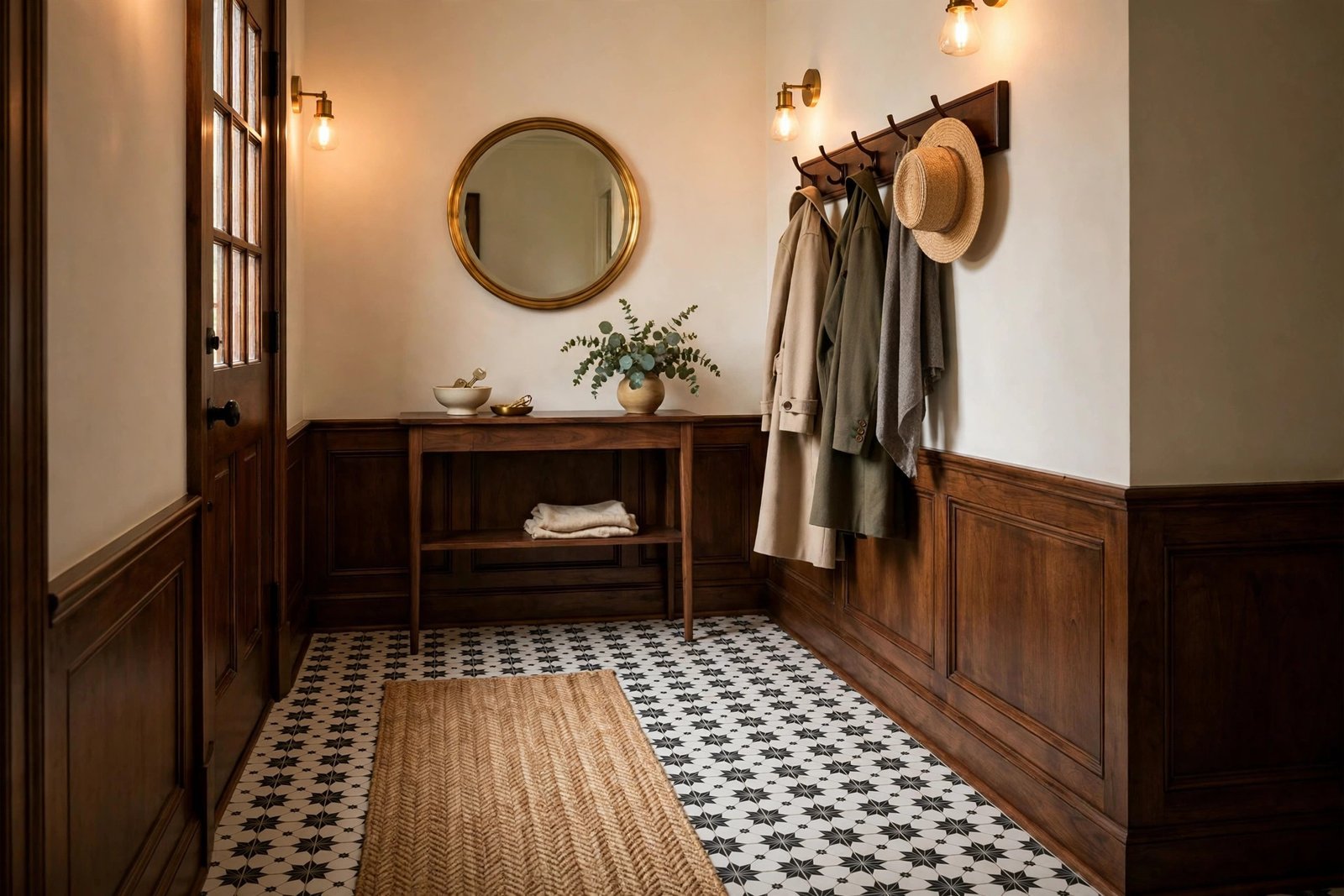
A mudroom does not have to be purely functional — one styled moment makes the whole space feel designed rather than merely equipped. A mirror above a slim console (or above your bench, if the layout allows) does triple duty: it bounces light around, lets you check your look before heading out, and makes a small entry feel twice as big.
Keep the console styling simple and hardworking: a tray for keys, a small vase with eucalyptus or seasonal stems, a candle or a small lamp, and one framed print or family photo. That is it. The moment should look curated but stay clear enough to function — this is still the room where backpacks land.
A round mirror softens all the hard lines of cubbies and shelves; a brass or black frame ties into your hook hardware for a pulled-together look. If your entry flows directly into the rest of the house, echo the style of your entryway decor ideas so the two spaces read as one continuous welcome rather than two different rooms.
14. Kid-Proof the Whole Setup
Adults will adapt to almost any system; kids will not. If you want a mudroom that stays organized with children in the house, design it for the shortest user first. Low hooks at 36 inches, open cubbies they can reach without a step stool, and shoe spots at floor level remove every excuse for the floor-dump.
Visual cues beat verbal reminders. Color-coded bins (one color per kid), picture labels for pre-readers, and a clearly marked “launch pad” spot for the school bag and tomorrow’s shoes turn the routine into something kids can run themselves. A small step stool tucked under the bench helps younger kids reach mid-level hooks, and it doubles as a boot-removal aid — sitting on the bench while a parent pulls is a nightly ritual in most families.
Build in forgiveness. Kids will forget, rush, and occasionally throw things. A system with a little slack — that spare hook from idea 3, a “lost and found” bin for single gloves — survives real family life. The goal is not a showroom; it is a room that recovers in two minutes instead of two hours.
Products to consider: low-mounted double hooks, colorful open bins for kids’ gear, a sturdy step stool.
15. End the Day with a Two-Minute Reset
Here is the unglamorous truth behind every tidy mudroom you have ever admired: someone spends two minutes on it each evening. Systems handle the structure; a tiny daily habit handles the drift. Shoes back in cubbies, coats on hooks, mail moved to its real home, one quick shake of the runner outside the door.
Make the reset easy to start by keeping a small basket or tray labeled “put away” near the door — a landing pad for the odd items that do not have a home yet. Once a week, empty it and either find homes for the strays or admit they do not belong in the mudroom at all. Once a month, do the five-minute version of the seasonal audit: anything broken, outgrown, or single goes.
Tie the habit to something you already do — right after the dog’s last walk, while dinner heats up, during the evening news. Two minutes is short enough that it never feels like a chore, and it means you wake up to an entry that welcomes you instead of ambushing you. That feeling, multiplied across a year of mornings, is what a good mudroom is really for.
Frequently Asked Questions
What is the difference between a mudroom and an entryway?
An entryway is the welcoming front door area focused on first impressions; a mudroom is a hardworking transition zone — often off the garage or back door — built for storage, mess, and daily routines. Mudrooms prioritize hooks, benches, washable floors, and gear storage, while entryways lean more toward decor. Many homes blend the two, using mudroom ideas like cubbies and benches in the main entry.
How much space do you need for a mudroom?
You need far less than you think. A functional small mudroom can work in a 4-foot-wide stretch of hallway: a slim bench, a row of hooks above it, and a shoe tray below. Plan roughly 24 to 30 inches of wall width per person for personal cubbies. A dedicated room is wonderful, but most families get 90 percent of the benefit from a well-organized wall.
What is the best flooring for a mudroom?
Porcelain tile is the top choice — waterproof, scratch-resistant, and easy to mop. Waterproof luxury vinyl plank is a strong budget-friendly alternative that handles wet boots well. Whichever you choose, pick a textured or matte finish for slip resistance and a medium-to-dark grout or tone that hides dirt between cleanings.
How do I keep a mudroom from smelling?
Ventilation and washability are the fix. Choose washable runners and cushion covers, wipe down shelves monthly, and keep a small lidded hamper or ventilated bin for sweaty sports gear rather than letting it sit open. Baking soda shaken into shoes overnight, a washable mat under the bench, and cracking a window when weather allows all help. If odors persist, the culprit is usually gear that needs washing, not the room itself.
Can I add a mudroom without renovating?
Absolutely. Most of the ideas in this list — a storage bench, wall hooks, baskets, a boot tray, a washable runner — require nothing more than a free wall and a free afternoon. Freestanding cubby units and wall-mounted rails create a convincing mudroom zone in a hallway, garage corner, or laundry room with zero construction. Start with storage and hooks; add built-ins later only if you love how it works.
Final Thoughts
A great mudroom is not about square footage or a big budget — it is about giving everything a home and making the daily routine frictionless. Start with the anchor pieces (a bench, hooks, shoe storage), add the systems that match your family (personal cubbies, seasonal rotation, the two-minute reset), and finish with one styled moment that makes you smile when you walk in.
You do not need to do all 15 mudroom ideas at once. Pick the three that would change your mornings the most, do them this weekend, and let the rest follow. Your future self — the one who walks out the door on time, keys in hand, shoes easy to find — will thank you.