
There’s nothing quite like turning onto your street on a cold December evening and seeing your own house glowing warm against the dark — the reason strangers slow down as they drive past. Outdoor Christmas decor does more than look pretty; it sets the tone for the whole season, and with 2026’s big push toward bolder, brighter outdoor displays, this is the year to go for it.
The good news? You don’t need a mansion, a ladder crew, or a second mortgage on your electric bill. Today’s LED lights sip power, battery timers handle the scheduling, and a few well-placed pieces of greenery do the heavy lifting. Below are 21 outdoor Christmas decor ideas that work for real houses — with practical tips on weatherproofing, extension-cord safety, timers, HOA-friendly brightness, and the cold-hardy greenery that actually survives December.
Plan Before You Hang: A Quick Outdoor Decor Checklist
An hour of planning saves a weekend of frustration. Before you buy a single string of lights, walk your property at dusk and note what the street actually sees: the roofline, the front door, the walkway, and one or two landscape features. Those four zones are your canvas — everything else is optional. Measure the roofline, the garage door width, and the walkway length with a tape measure, not a guess; “I thought it was thirty feet” is how you end up with three hardware-store runs.
Next, audit your power. Find your outdoor outlets and confirm they’re GFCI-protected (the ones with the little test/reset buttons). A standard 15-amp outdoor circuit handles roughly 1,400 watts, and a full LED display typically draws under 200 — but if the same circuit feeds your garage freezer or holiday inflatables, do the math before you plug in. Buy an outdoor-rated timer or two smart plugs now, plus one heavy-duty outdoor extension cord and a couple of cord connection boxes. Keep all receipts and boxes until January; you will exchange something.
Finally, check two things people always forget: your HOA’s holiday rules (brightness limits, inflatable bans, takedown deadlines) and the weather forecast for installation weekend. Hanging lights in sleet is miserable and dangerous. Pick a dry, calm afternoon, lay everything out on the driveway, test every string, and work from the roofline down so you’re never reaching over finished decor.
1. Outline Your Roofline with Warm LED String Lights
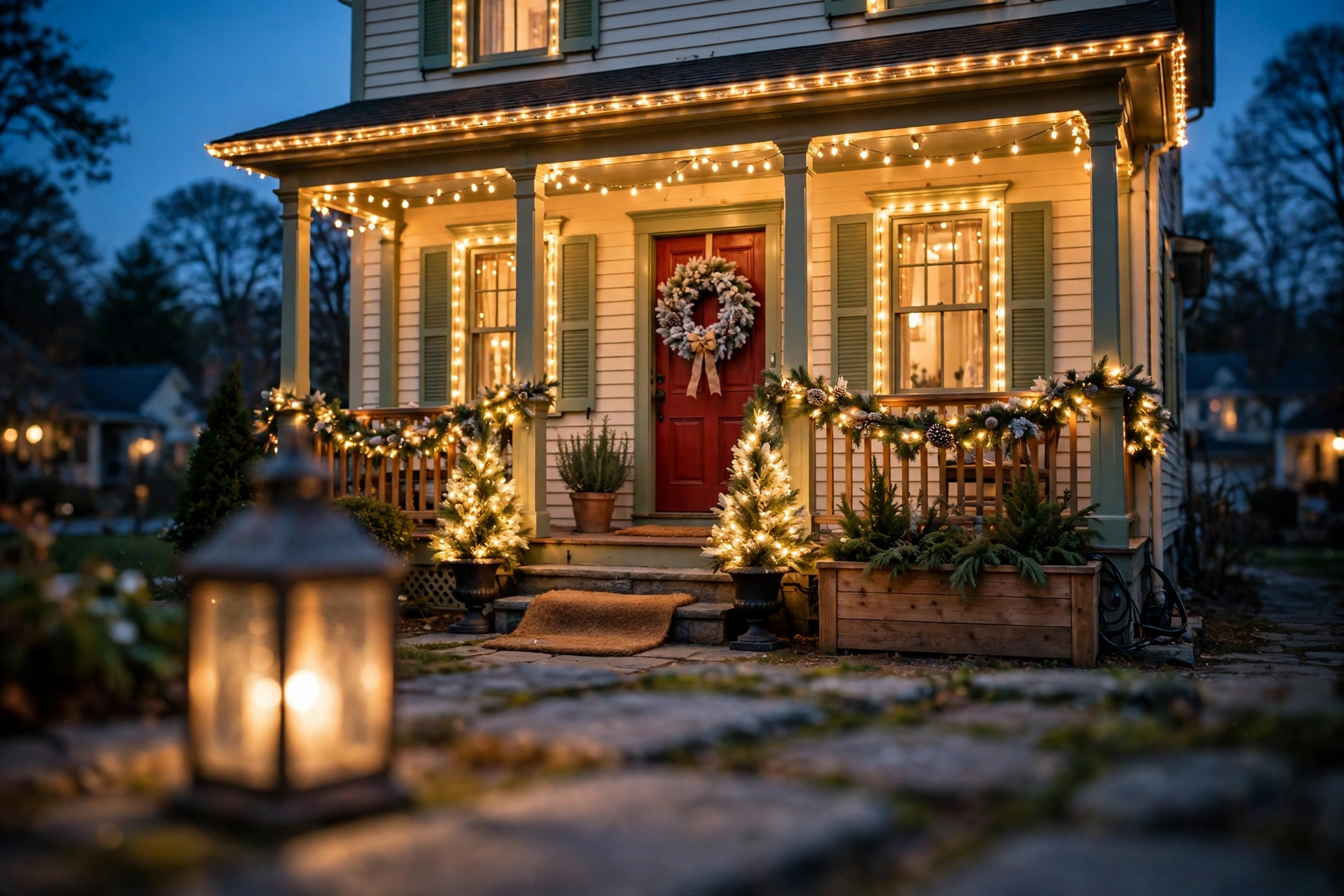
The single most transformative thing you can do is trace your roofline with lights. Warm white (around 2700K) flatters every exterior color and reads “classic Christmas” from a block away, while cool white can look bluish and stark on some siding. Invest in outdoor-rated LED strings — they use a fraction of the power of old incandescents, stay cool, and most are connectable end to end.
Hang them with plastic gutter or shingle clips rather than staples or nails, which void roof warranties and create leak paths. Work in daylight, plug in and test every string before it goes up, and run the cord back to a GFCI-protected outdoor outlet. In snow states, leave a little slack so ice-loaded strings don’t snap tight. Set them on an outdoor-rated timer to run dusk to about 11 p.m. — your neighbors will appreciate the cutoff.
2. Frame the Front Door with Garland and a Showstopper Wreath
Your front door is the face of your house at Christmas, and it deserves a full treatment: fresh or high-quality faux pine garland up both sides of the frame, topped with a wreath at least 24 inches across (bigger doors need 30–36 inches). Weave a strand of battery-operated micro fairy lights through the garland so the whole frame glows without a visible cord.
Hang the wreath from an over-the-door hook or a removable adhesive hook rated for outdoor use and cold — skip nails in the door itself. If you use fresh cedar or fir, mist it lightly every few days and keep it out of direct harsh sun on south-facing doors; a northern exposure keeps it fresh through January. Store faux garland loosely coiled in a breathable bag, never crushed, and it will look new for years.
3. Light the Walkway with Lanterns and Stake Lights
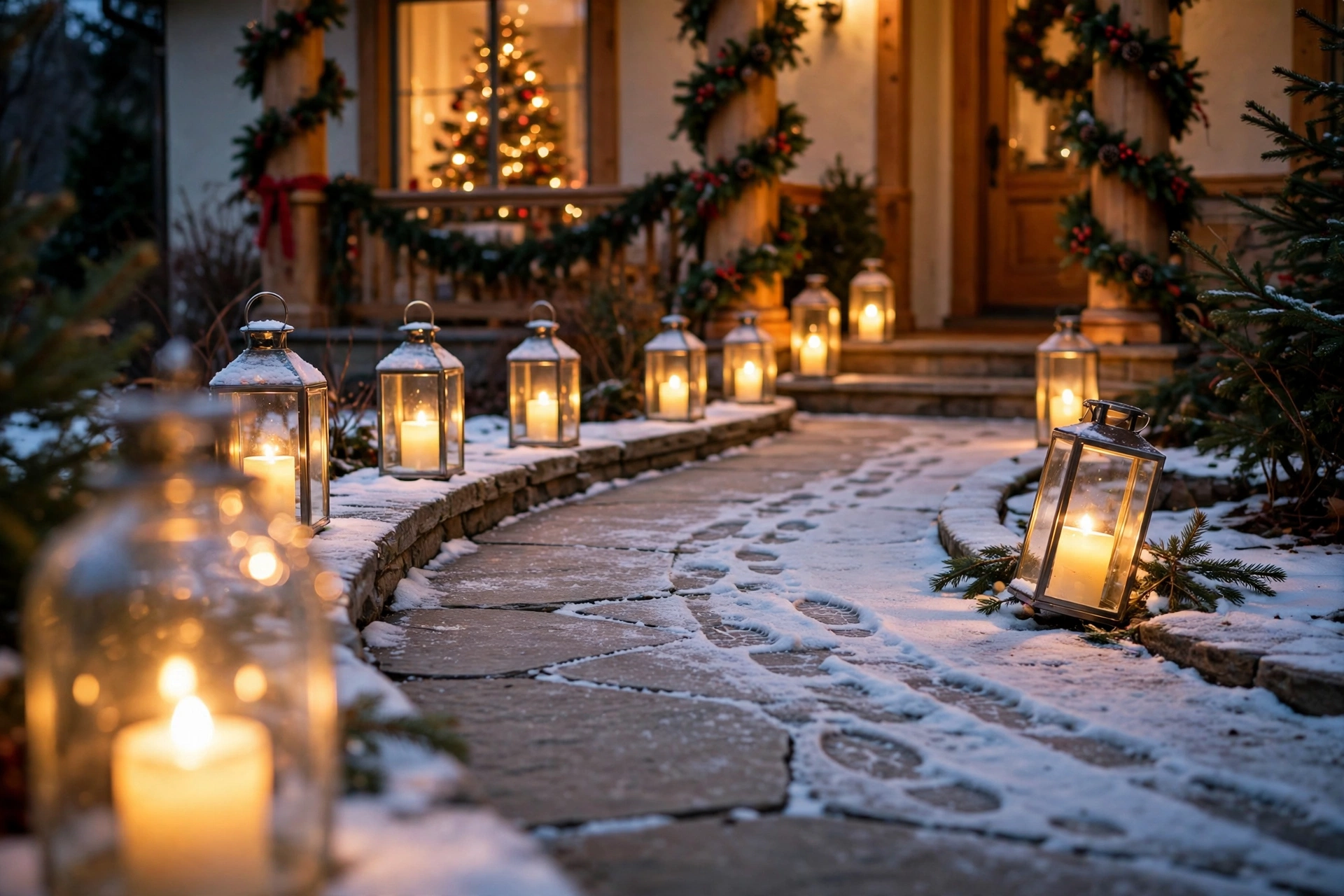
A lit pathway does double duty: it looks magical and it keeps guests from tripping on your steps after dark. Low-voltage LED stake lights every six to eight feet give even coverage without looking like an airport runway. Space them a foot or two back from the walkway edge so mowing and shoveling don’t destroy them.
For a softer look, group glass lanterns with flameless LED candles along the path instead — clusters of three in odd numbers look intentional, not random. Solar lights are tempting but produce weak output in December’s short, cloudy days; wired LEDs on a timer are far more reliable in northern states. Either way, aim the light at the ground, not into your neighbors’ windows.
4. Dress Up the Porch Columns with Greenery and Ribbon
Porch columns are basically giant candy canes waiting to happen. Wrap each column with cedar or pine garland in a loose spiral, securing it behind the column with garden wire or zip ties — never staple into the front face of wood or vinyl posts. Tuck in a weatherproof wired ribbon in a wide burlap or velvet weave, and let the tails hang for movement.
Wind is the enemy here, so anchor the garland at the top, middle, and bottom of each column rather than just the ends. Add one string of warm micro lights woven through the greenery for the evening glow. When the season ends, the garland lifts off in minutes with zero damage — which also makes this one of the most HOA-friendly projects on this list. If your porch already carries fall greenery, our guide to cozy fall front porch decor shows how to layer the transition into winter.
5. Swap in Festive Planters for Instant Curb Appeal
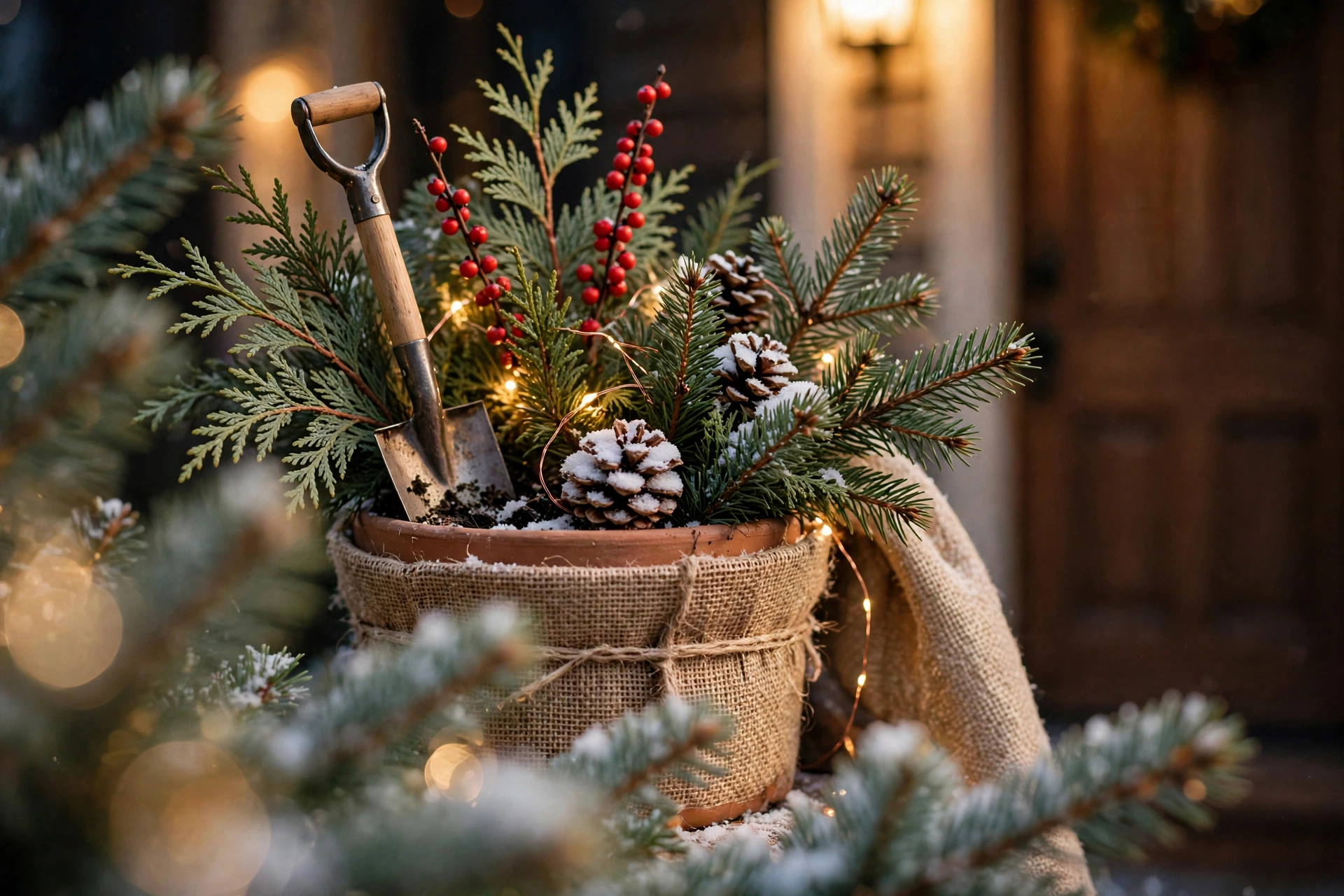
The fastest winter curb-appeal upgrade is restyling your summer planters. The classic formula: a soil or foam ball anchor, then tall birch poles or curly willow branches in the center, evergreen boughs (pine, cedar, spruce) fanned around them, and red winterberry or faux berry stems for color. Top with pine cones and a dusting of artificial snow if you like the frosted look.
Because pots freeze solid, water the planter well after arranging so the soil ball freezes around the stems and locks everything upright through windstorms. Use cold-hardy evergreens, not cut flowers, and skip real berries where pets or deer roam. A small set of battery fairy lights wound through each planter ties the whole entry together after dark — one warm string per pot is plenty.
6. Hang Oversized Wreaths on the Garage Door
The garage door is often the biggest blank surface on a house — treat it like a wall. Hang one oversized wreath centered on each bay (measure to center; eyeballing a double garage almost always lands off-center). Large magnetic wreath hooks work beautifully on steel garage doors and hold surprising weight without a single hole.
Choose lightweight faux wreaths with built-in battery lights so there’s no cord to route around a moving door — critical, since the door flexes and shifts every time it opens. Keep wreaths under the door’s upper track clearance so they never catch. Match the wreath style to your front-door wreath for a pulled-together look: same greenery, same ribbon color, different scale. And if you like a cleaner aesthetic overall, see our minimalist Christmas decor ideas for restraint-first takes on every one of these projects.

7. Flank the Entry with Lit Mini Trees
A pair of small evergreen trees in matching urns on either side of the door is the oldest trick in the curb-appeal book, and it works every December. Live dwarf Alberta spruces look fantastic, but they hate wind and need watering until the ground freezes — artificial mini trees are the zero-maintenance alternative and wrap easily with a net of warm lights.
Anchor everything: a bag of sand or gravel at the base of each urn stops tip-overs in gusts, and a single bungee cord from the urn handle to a porch post adds insurance. Run one short string of lights per tree from the same timer as your door garland so they switch on together. When January comes, the trees go into storage and the urns get winter branches — no waste, no dead plants.
8. Project Holiday Scenes with an Outdoor Projector
If ladders aren’t your thing, an outdoor-rated holiday projector gives you a decorated house in ten minutes: swirling snowflakes, falling snow, or a Santa scene cast across the whole facade. LED (not laser) projectors are the safer pick around kids and pets, and they cost less to run.
Placement matters more than the projector model. Set it back far enough that the image fills the wall rather than landing as a small bright square — usually 15 to 25 feet from the house. Stake it down so wind doesn’t tilt the picture mid-evening, run the cord along a garden bed with a cord cover, and put it on a timer with everything else. Projectors make a big impression in neighborhoods where HOAs limit permanent-looking installations, since they vanish completely in daylight.
9. Glow from the Windows: Candle Silhouettes
Few things read “Christmas” from the street like a single glowing candle in every front-facing window. Battery-operated LED window candles on built-in timers are the modern standard — they switch on at dusk by themselves, never drip wax, and pose zero fire risk near curtains.
The secret is consistency: one candle per window, centered on the sill, all in the same warm white tone. Mixing cool and warm whites across the facade is the most common mistake and it reads instantly. Use the suction-cup or clip holders made for the purpose so candles sit at identical heights. This pairs beautifully with a lit roofline — the house glows from the inside and the outside at once.
10. Wrap the Mailbox in a Festive Ring
Don’t let the mailbox sit out of the party. Wrap the post in a spiral of faux pine garland, top it with a simple bow and a few weatherproof ornaments, and you’ve got a charming little landmark. Keep the address numbers and the flag completely visible — mail carriers and emergency responders need them unobstructed.
Use lightweight materials only; a heavy fresh garland on a wobbly post will lean by Christmas Eve. A spritz of snow spray on the tips photographs beautifully and rinses off in spring. If your HOA has rules about mailbox uniformity, keep the decor removable in under a minute — a single zip-tied garland qualifies, a drilled-in mount does not.
11. Plant a Real Christmas Tree in the Yard
Have a spruce, fir, or pine already growing in your front yard? You’ve got a free seven-foot Christmas tree. Decorate it with shatterproof ornaments only — real weather will eventually claim anything glass — and use outdoor-rated light strings with the plug connections wrapped in purpose-made cord connection boxes to keep rain out.
Hang ornaments a little higher and deeper into the branches than you would indoors; wind whips the outer tips and will strip loosely hung pieces overnight. A single warm-white spotlight staked at the base turns the whole tree into a glowing sculpture even without lights. Anchor any topper firmly — a star that blows off at 2 a.m. is nobody’s idea of festive. For more tree-decorating technique that carries over indoors, our Christmas tree decor ideas cover themes, ribbon work, and ornament balance in detail.
12. Light Up the Lawn with Classic Deer Figures
Lighted reindeer silhouettes are a Christmas-yard classic for a reason: they read clearly from the street, they’re nearly indestructible, and grouping them looks instantly designed. Place them in odd-numbered clusters — a buck, a doe, and a fawn grazing together beats one lonely deer every time.
Stake each figure with the included ground stakes plus one extra per piece if your soil is soft; a deer face-down in the mulch is sad, not festive. LED versions cost pennies to run all season and stay cool enough that kids can touch them. Face the group slightly toward the street at an angle rather than dead-on — the profile silhouette is far more recognizable and photogenic.
13. Dress Balcony and Deck Railings with Garland Lights
Upper railings and deck rails are prime real estate that most people ignore. Swag faux cedar garland along the railing in gentle dips, securing it with dark zip ties or wire twisted to the back side where they disappear. One 9-foot garland per 6-foot rail section gives you those full, generous swags.
Weave a battery-operated light string through the garland and tuck the battery pack inside a nearby planter or a small weatherproof box so it stays dry — this is the number-one fix for “my battery lights died in a week.” Use railing-safe hooks rather than screws on composite or metal rails to avoid voiding warranties. From the street, lit railings add a whole second story of glow to your display.
14. Create a Cozy Fireside Seating Nook
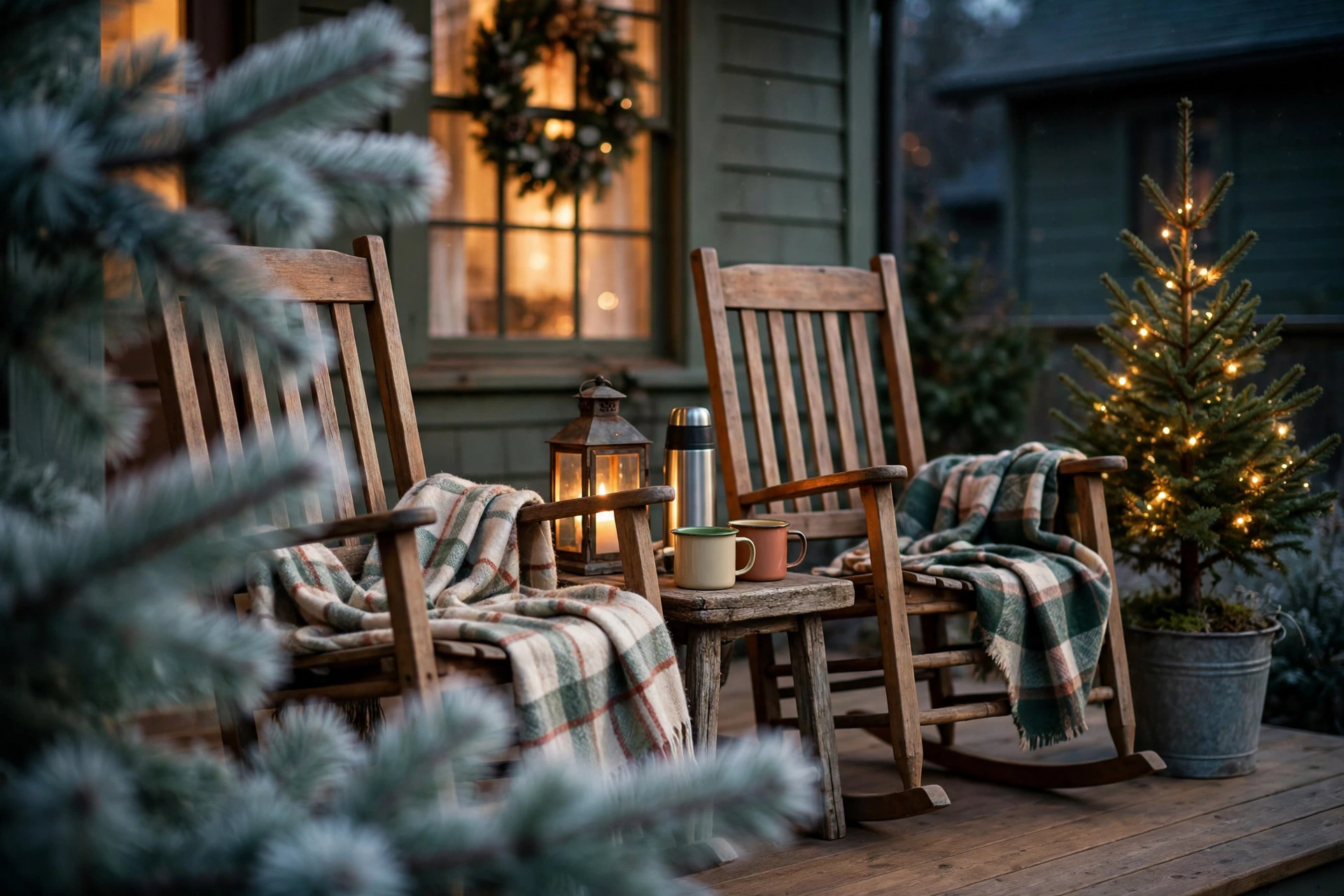
A fire pit surrounded by a few chairs, plaid throws, and lanterns turns your yard into the place everyone wants to be on Christmas Eve. Keep seating at least three feet from the fire bowl, use a spark screen, and never leave a wood fire unattended — standard safety, but worth restating every single year.
Drape inexpensive plaid blankets over chair backs (they’ll get smoky; that’s what they’re for), set a thermos of cocoa and enamel mugs on a side table, and ring the seating area with lanterns rather than string lights for a campfire feel. String lights overhead on shepherd’s hooks mark the zone from the street. Store fabric items indoors between uses — one wet blanket left out in a freeze is ruined.
15. Style a Vintage Sled or Wooden Ladder Display
Lean a vintage-style wooden sled against the porch wall, pile it with a folded plaid blanket and a small frosted wreath, and you have an instant nostalgic vignette. No antique sled? A simple wooden ladder does the same job: hang a wreath from the top rung, drape stockings or mittens from the others, and tuck a small lit tree at its base.
Anchor tall pieces against wind — a bungee to a porch post works and hides easily. If the piece is real vintage wood, bring it under cover during heavy storms; one season of freeze-thaw can crack an heirloom. Reproductions are inexpensive, already weather-treated, and nobody at the curb can tell the difference. Add a single spotlight or a strand of lights so the display reads after dark too.
16. Fill Window Boxes with Mini Evergreens and Fairy Lights
Window boxes are easy to forget once the summer flowers die, but they’re perfect winter real estate. Fill them with small boxwood balls, mini spruce tips, or even inexpensive artificial picks — all cold-hardy, all zero maintenance. Tuck in pine cones and a few red berry stems for color.
A short string of warm fairy lights on a battery timer turns each box into a glowing shelf after dark; the packs hide right in the soil. Water real greens once before the hard freeze and leave them alone. Because window boxes sit high and visible, this small project punches far above its cost — especially on the front of the house where the eye lands first.
17. Pick One Color Story and Commit
The houses that look expensive all share one trait: restraint. Pick a single color story and hold it across everything. Warm white everywhere is timeless and the safest HOA bet. Classic red and green with warm lights is nostalgic and cheerful. Icy blue-white with silver reads modern and crisp — gorgeous on contemporary homes.
What never works is a little of everything: multicolor roofline, red-green pathway, blue-white porch. Decide once, buy within the palette, and your display will look designed instead of accumulated. Pro tip: walk your block before you buy. If every house is warm white, a restrained icy-blue accent makes you stand out; if every house is multicolor, your all-warm-white display becomes the elegant one.
18. Set Out Weatherproof Lanterns with Flameless Candles
Metal and glass lanterns with LED pillar candles are the workhorses of outdoor Christmas styling — they go on steps, beside the door, on the porch table, at the base of trees. Real candles are a non-starter outdoors (wind, wax, fire risk); modern flameless pillars flicker convincingly and many come with dusk timers built in.
Group them in odd numbers and vary the heights: a tall lantern, a medium, and a short pillar reads as a deliberate arrangement, three identical ones read as a store display. Choose lanterns with a latched door and a weighted base so gusts don’t scatter your setup. Stainless or powder-coated metal handles the season; thin painted tin will rust by January.
19. Ice the Path with Icicle and Snowflake Lights
Icicle light strings along the eaves give you that storybook drip of light, and they look best when the drops vary in length — uniform strands read cheap. Hang them from the same gutter clips as your roofline lights, and let them hang freely; pinning each icicle flat ruins the effect.
Snowflake light motifs on a fence, garage wall, or bare tree add sparkle without another roofline project. LEDs keep both affordable to run all season — a full icicle setup typically costs less per month than one old-fashioned incandescent strand used to. Put motifs on the same timer as everything else so the whole house switches on as one scene, not in stages.
20. Build a Kid-Friendly Light-Up Corner
Give the little ones their own corner of the yard: a light-up snowman family, a few glowing gift boxes, or a toy train circling a planter. Kids remember these displays for decades, and they’re the part of your yard that gets photographed most.
Keep everything low-voltage and firmly staked — toddlers will grab, lean, and climb on all of it. Place the corner where it’s visible from the street but set back from the walkway so it doesn’t become a tripping zone. Inflatable characters work too, but tether them with more than the included stakes in windy regions; a snowman rolling down the street at midnight is funny exactly once.
21. Automate It All with Timers and Smart Plugs
The final idea is the one that makes the other twenty effortless: put everything on outdoor-rated timers or smart plugs set for dusk to about 11 p.m. You’ll never trudge out in the cold to flip a switch, your electric bill stays predictable, and the whole display turns on as one coordinated scene.
A few electrical ground rules. Use only extension cords rated for outdoor use, keep connections off the ground in cord connection boxes, and never daisy-chain more than three light strings (check each string’s rating). Plug everything into GFCI-protected outlets — most modern outdoor outlets already are — and don’t overload a single circuit; spread heavy loads across two outlets. Test the full setup one evening before the season starts so you’re troubleshooting in a jacket, not in pajamas on December 23rd.
Products to Consider
- Outdoor-rated warm-white LED string lights (2700K)
- Plastic gutter and shingle light clips
- Outdoor-rated plug-in timer or smart plug
- Battery-operated LED window candles with dusk timers
- Faux cedar or pine garland, 9-foot sections
- Large battery-lit wreath for the garage or door
- Low-voltage LED pathway stake lights
- Weatherproof metal lanterns with flameless pillar candles
- Shatterproof outdoor ornament sets
- Outdoor extension cords and cord connection boxes
- Lighted reindeer or snowflake yard figures (LED)
- Weatherproof storage bins for January takedown
Stick to generic, well-reviewed versions of these basics — the category matters far more than any particular label, and simple pieces last longer.
Frequently Asked Questions
When should I put up outdoor Christmas decorations?
Most US households decorate between the weekend after Thanksgiving and the second week of December, but searches and social buzz start building in late October — and there’s no rule against an early-November start if your HOA allows it. Aim to have everything up and tested by early December so you can actually enjoy it. Plan takedown for the first week of January; many HOAs require removal by mid-January.
How do I keep outdoor lights safe in snow and rain?
Use lights and cords rated for outdoor use, plug everything into GFCI-protected outlets, and keep all connections elevated and dry inside cord connection boxes. Never run cords across walkways where shovels and feet will find them, and take displays down before spring storms if you leave any part up late. LEDs stay cool, which removes the heat risk old incandescents carried.
What’s the best way to hang lights without damaging the house?
Plastic gutter clips, shingle tabs, and removable outdoor adhesive hooks handle nearly every surface without holes. Avoid staples, nails, and screws in roofing, siding, and trim — they void warranties and invite water damage. Magnetic hooks are excellent on steel garage doors and metal railings.
How can I keep the electric bill down?
Switch to LEDs (they use up to 90% less power than incandescents), run everything on timers so lights are only on dusk to about 11 p.m., and skip the all-night setting. A full LED display typically adds only a few dollars a month — far less than one old incandescent strand did.
Will outdoor decorations cause problems with my HOA?
Check your HOA’s holiday rules before you buy anything — many cap brightness, ban roof-mounted inflatables, or set removal deadlines. Warm white lights on a timer with a firm off-time rarely draw complaints. Keep cords tidy, decorations off shared walkways, and take everything down by the stated deadline, and you’ll stay in everyone’s good graces. If you’re working with a small lot, our small backyard ideas show how to make compact outdoor spaces feel generous — the same restraint works for holiday displays.
Final Thoughts
You don’t need the biggest display on the block — you need the most intentional one. A glowing roofline, a dressed-up door, a lit path, and a timer that handles it all will beat a chaotic yard of inflatables every time. Start with the pieces that give you the most glow per dollar (roofline lights and the front door), add one new element each year, and store everything carefully in January so next December starts easy.
Christmas 2026 falls on a Friday, which means the season stretches luxuriously long — plenty of evenings to enjoy the view from the curb with a mug of something warm. Pick your color story, respect your outlets, and make yours the house people slow down for.