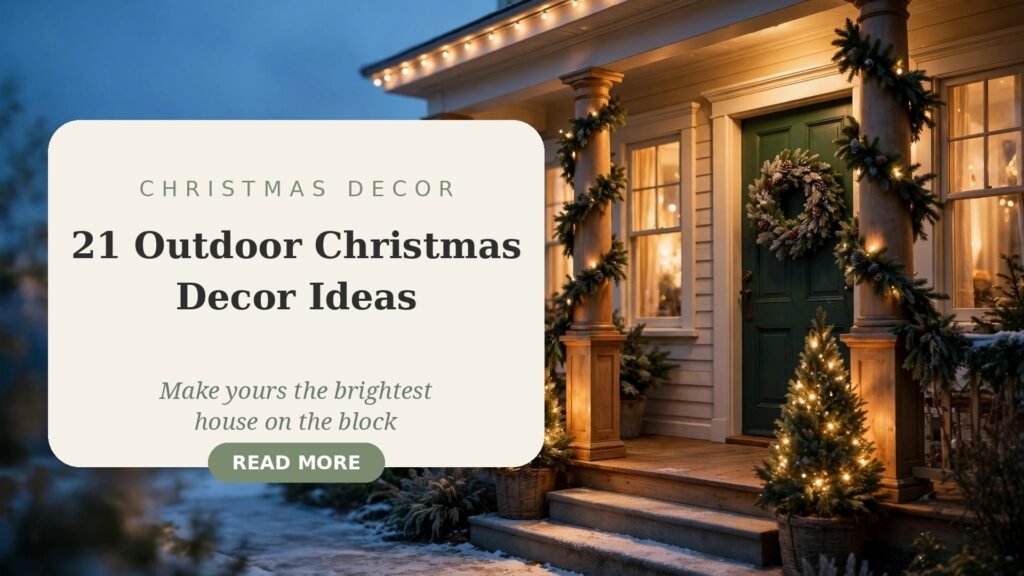
There is no faster way to tell the world you are ready for Christmas than a wreath on the front door. Guests see it before they reach the porch, neighbors clock it on their evening walks, and for your own family it becomes the daily signal that the season has officially started. The good news is that a great wreath does not have to cost a fortune or come from a designer catalog — it just has to feel like your home.
This year’s wreath trends lean natural, tactile, and a little bit wild.
Before you shop, take thirty seconds to look at your door the way a stranger sees it. What color is it? How wide? Does the porch get morning sun or sit in shade all day? The best wreath is the one that works with those answers — a dark wreath disappears on a dark door, sun-faded velvet looks sad by week two, and a dainty hoop gets lost on a 42-inch double door. Match the wreath to the door first, the trend second.
Think asymmetrical rings of mixed greenery, vintage-style brass bells, oversized velvet bows, and forest-floor textures like moss, pinecones, and bark. Minimalists are not left out either: simple gold hoops with a whisper of cedar are everywhere for 2026. Below you will find 21 Christmas wreath ideas that cover every style, from full traditional evergreen to modern and handmade, plus the practical side of things — what size to buy, how to hang one without wrecking your door, how fresh wreaths hold up in real winter weather, and how to store everything so it lasts for years.
1. The Classic Noble Fir
Start with the icon. A full noble fir wreath — deep green, layered branches, red berries peeking through — is the wreath most Americans picture when they think of Christmas, and it earned that place. Noble fir is also one of the longest-lasting fresh greens you can buy: its flat, blue-green needles hold moisture well and drop slowly, even through a few hard freezes.
Sizing tip: for a standard 36-inch front door, a 28 to 30-inch wreath looks balanced. Measure your door before ordering — too small is the most common wreath mistake. Hang it so the center of the wreath sits at eye level, roughly 57 inches from the ground.
Buying tip: order fresh wreaths in late November for the best selection, but hang them the first week of December so they look their best through Christmas Day. Prices climb sharply after mid-December as inventory thins. If you love the noble fir look but dread the annual repurchase, buy a high-quality faux noble fir wreath once — the molded-needle versions available now fool most guests from the curb, and you will break even by year two.
2. Asymmetric Wild Greenery
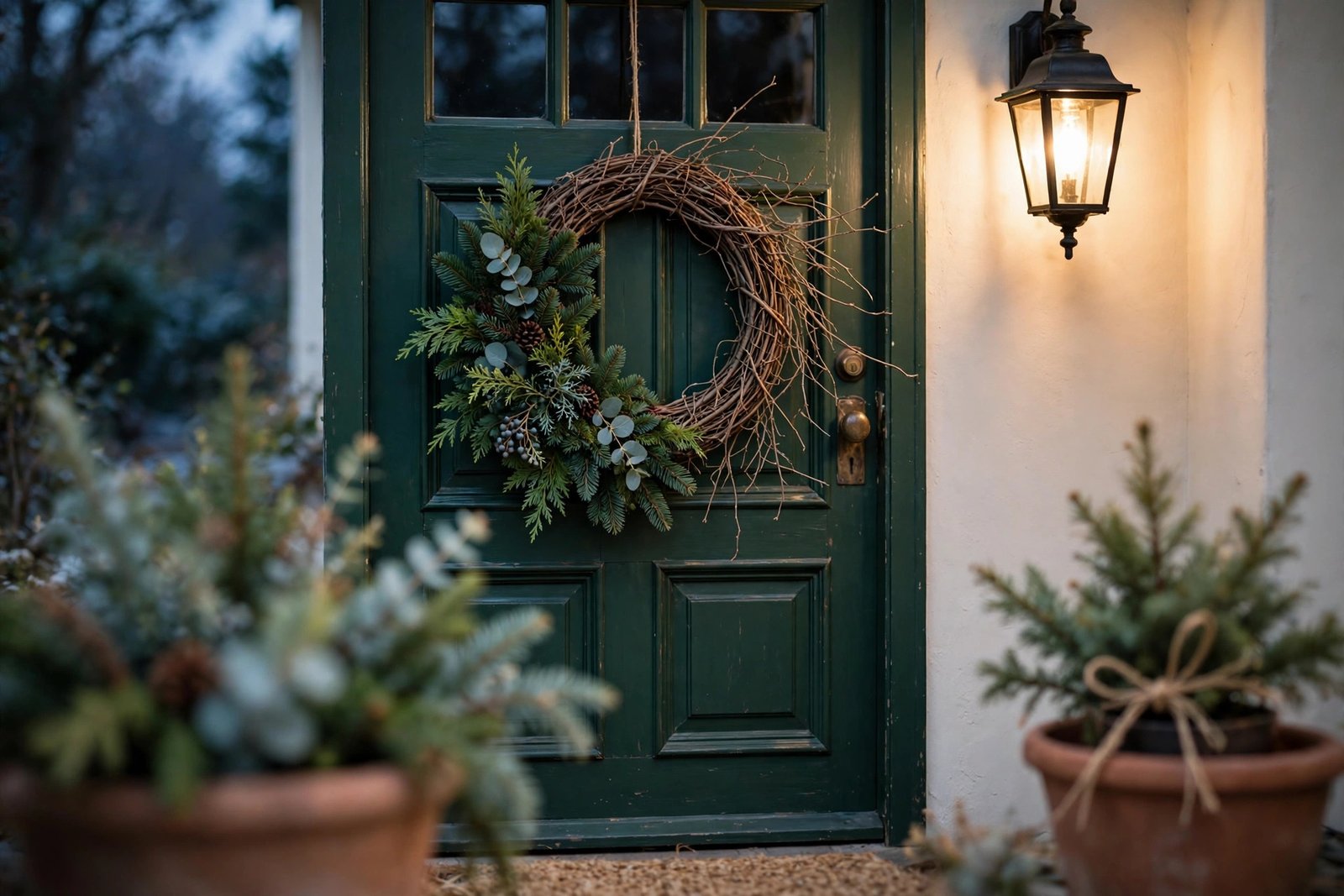
The single biggest wreath trend for 2026 is asymmetry. Instead of a perfectly round, evenly decorated ring, decorators are clustering mixed greenery — cedar, fir, eucalyptus, seeded juniper — on one side of the wreath and letting the bare base show on the other. The effect is organic and a little untamed, like a forest floor frozen mid-motion.
To make one, start with a plain grapevine or plain fir wreath base and wire generous bundles of greenery along the bottom-left quadrant, working outward. Step back often; asymmetry only works when it looks intentional. This style shines on a simple door in a natural finish — the less fuss on the door, the better the wreath reads.
3. Vintage Brass Bells
Bells are having a real moment. A handful of small brass bells wired into an evergreen wreath adds movement, texture, and a soft chime every time the door opens — one of those details guests actually notice. Look for solid brass bells with a brushed or aged finish rather than shiny plastic imitations; the patina is what sells the vintage look.
Practical note: bells add weight, so use a sturdy over-the-door hanger rated for at least 10 pounds, or a removable hook rated for outdoor use if your climate stays below freezing (adhesive hooks can lose grip in extreme cold).
For a fuller vintage effect, pair brass bells with unlacquered greenery and a simple jute or grosgrain hanger instead of a shiny bow. The restraint lets the metal do the talking. And if you have a storm door, mount the wreath on the storm door’s glass with a suction hook — the bells will still chime when the outer door moves, and the wreath stays protected from weather.
4. The Oversized Velvet Bow Statement
Sometimes the wreath is just the canvas and the bow is the star. A huge velvet bow — 8 to 12 inches across, in burgundy, forest green, or classic red — pinned at the top or bottom of a simple fir wreath turns a plain base into a catalog shot. Velvet is the fabric of the season; its matte richness photographs beautifully and never fights with the greenery.
Weather caveat: velvet fades in direct sun, so this is a covered-porch or sheltered-entry idea. If your door gets afternoon sun, choose a faux-velvet ribbon with UV resistance, or move the wreath to an interior door.
To make a bow that actually looks like the catalog photos, you need wired ribbon at least 2.5 inches wide — narrower ribbon won’t hold the dramatic loops. Cut two long tails, notch the ends in a dovetail (a simple V cut), and fluff each loop from the back so it stands proud. A finished oversized bow can be stored flat in a shallow box and reused for years.
5. Forest-Floor Wreath
Lean all the way into the natural trend with a wreath that looks gathered rather than bought: moss, bark curls, pinecones, dried mushrooms, and fern fronds on a twig base. No berries, no bow, no shine. It is the wreath equivalent of a cabin in the woods, and it suits craftsman and rustic farmhouse homes perfectly.
This is one of the easiest wreaths to build yourself from a walk in the woods — just check local rules about foraging first. Spray finished pieces with clear matte sealant so the moss and bark do not shed all over your welcome mat.
This style also transitions beautifully into January: remove nothing, and the forest-floor wreath simply becomes a winter wreath. The absence of obvious Christmas markers — no red, no bells, no bow — means it never looks like you forgot to take decorations down. For families with pets, keep dried mushrooms and seed pods out of reach of curious dogs; some decorative pods are not pet-safe.
6. The Minimalist Gold Hoop
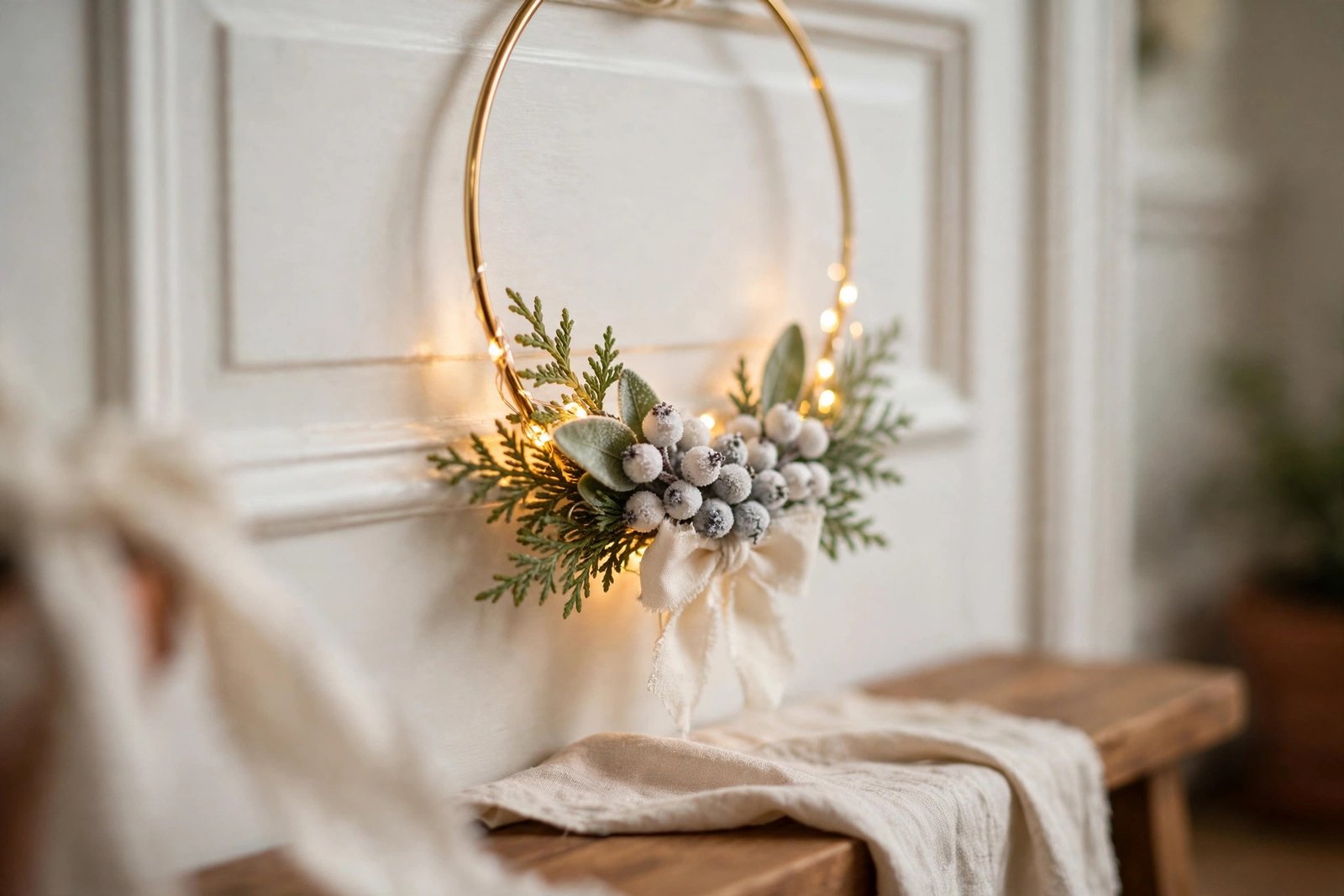
Not every door wants a full evergreen explosion. A slim gold metal hoop — 18 to 24 inches — dressed with a single low cluster of cedar sprigs, white berries, and a small linen bow gives you Christmas without the commitment. It suits modern farmhouse exteriors, white doors, and anyone whose style leans clean and quiet.
For more inspiration on keeping the holidays simple, see these minimalist Christmas decor ideas — the wreath-and-hoop aesthetic pairs beautifully with an uncluttered entryway.
7. Frosted and Flocked
Flocked wreaths — coated in faux snow — bring the look of a fresh snowfall without requiring any actual weather cooperation. They work especially well in warmer southern states where real greenery dries out fast and a green wreath can look slightly out of place against a sunny December.
Keep flocked wreaths under cover or indoors: flocking sheds when wet and clumps after repeated rain.Keep flocked wreaths under cover or indoors: flocking sheds when wet and clumps after repeated rain. Before buying, give the wreath a gentle shake in the store — heavy shedding means a thin flock coat that will look patchy by New Year’s. A light vacuum with a brush attachment once a season keeps a flocked wreath looking fresh, and storing it in its bag right after the holidays prevents the flocking from yellowing in storage. Indoors, one on a mirror or above the mantel reflects light around the room and makes the whole space feel bigger.
8. Dried Orange and Cinnamon
Few wreaths engage more than the senses the way dried-orange-slice and cinnamon-stick wreaths do. The warm citrus-and-spice scent drifts every time the door swings, the deep orange wheels look stunning against dark green fir, and the whole thing costs almost nothing if you dehydrate your own oranges.
How to dry oranges: slice naval oranges a quarter-inch thick, bake at 200°F for 2 to 3 hours, flipping halfway, until fully dry and leathery. Let them cool for 24 hours before wiring them onto the wreath — any residual moisture will spot your door.
Cinnamon sticks can be bundled in threes with twine and wired between the orange slices; star anise pods add a beautiful dark star shape that contrasts with the orange wheels. The scent is strongest in the first two weeks, so if your holiday entertaining peaks late in December, make this wreath your second wave — hang a plain evergreen for early December, then swap in the spice wreath the week before Christmas.
9. Eucalyptus and White Berry
For a softer, more modern palette, build a wreath from silver-dollar eucalyptus, frosted white berries, and pale fir. The silvery-blue tones flatter gray and white exteriors and transitional interiors, and the eucalyptus smells wonderful for weeks.
Eucalyptus dries gracefully — it fades to a soft sage tone rather than turning brown — so this is one fresh wreath you can leave up from Thanksgiving through New Year’s without it looking tired.
This is also an excellent choice for covered entryways in apartments and condos, where a full fir wreath can feel oversized. A 20 to 24-inch eucalyptus wreath has a lighter visual footprint but still reads festive from the hallway. Pair it with a simple coir doormat and a single lantern and you have a complete entry vignette in three pieces.
10. Plaid Ribbon Farmhouse Wreath
Buffalo-check ribbon in red-and-black or cream-and-tan instantly telegraphs farmhouse Christmas. Tie a generous wired-ribbon bow at the top of a mixed-fir wreath, then cut 6-inch ribbon tails and let them cascade down through the branches for movement.
Wired ribbon is non-negotiable here — it holds loops and curls through wind and weather. Unwired ribbon will go limp the first rainy week. If you store ribbons flat instead of folded, they will unroll without creases next year.
Plaid also mixes well with other patterns if you keep the scale consistent — a buffalo check wreath bow pairs beautifully with a matching plaid throw just inside the door. Keep the rest of the entry neutral so the pattern has room to breathe. In farmhouse-heavy neighborhoods where every porch has plaid, differentiate with an unexpected ribbon width or a plaid you don’t see everywhere, like a green-and-cream tartan.
11. Ornament Cluster Wreath
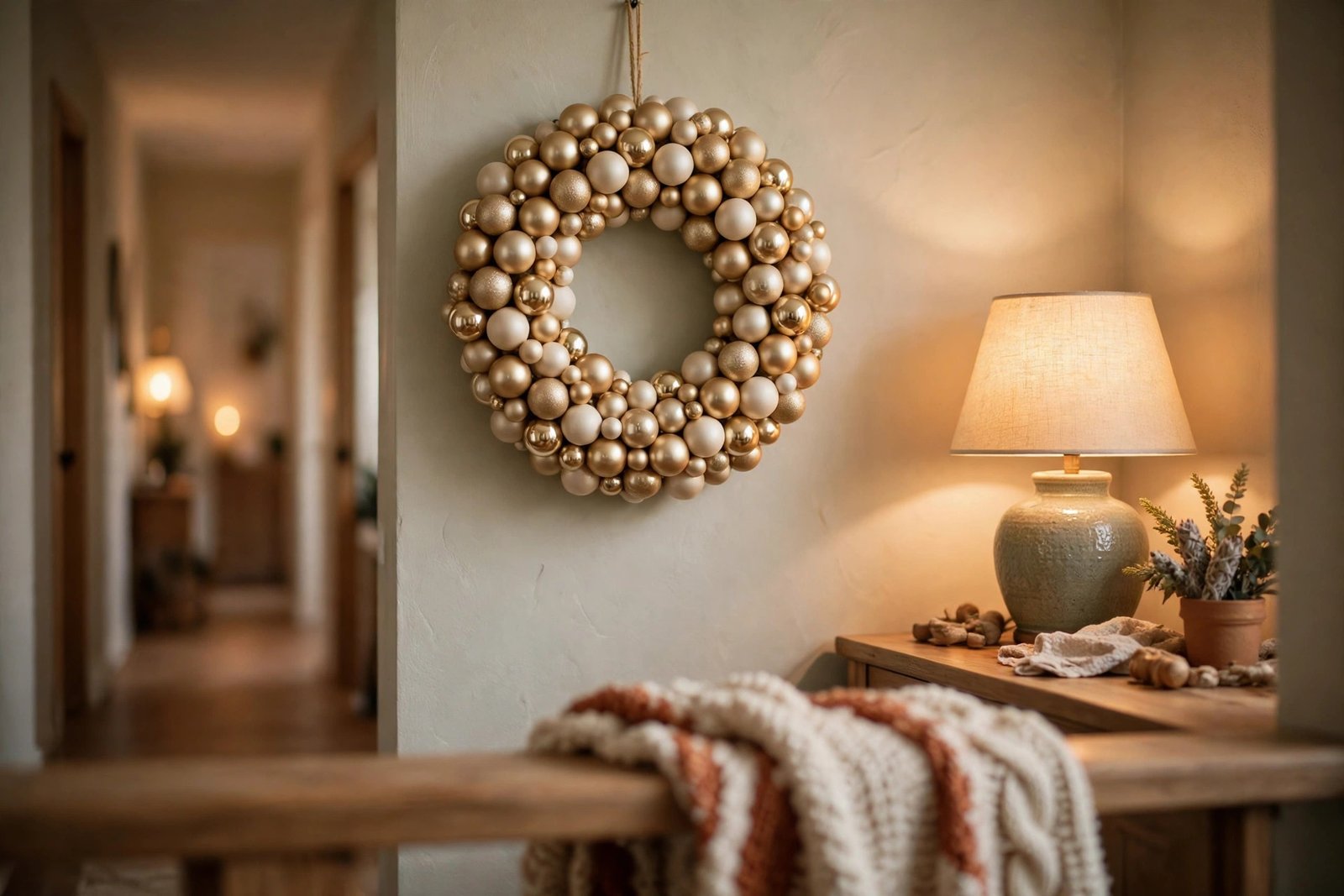
Skip the greenery entirely and cover a foam wreath base edge-to-edge with shatterproof ball ornaments — a mix of sizes in one metallic family (gold, silver, or champagne) with a few matte pieces for contrast. The result is glossy, glamorous, and completely weatherproof when made with plastic ornaments.
How many ornaments? A 20-inch foam base typically needs 40 to 50 ornaments of mixed sizes. Hot-glue the largest ones first around the outer edge, fill in with mediums, and tuck small ones into the gaps.Hot-glue the largest ones first around the outer edge, fill in with mediums, and tuck small ones into the gaps. This is a perfect use for orphaned ornaments — the boxes of mismatched balls every decorator accumulates become a feature instead of a drawer of shame. Stick to one finish family and let size do the varying; too many competing colors at this density reads chaotic rather than glamorous. Hang this style on an interior door or a covered porch — it catches lamplight beautifully at night.
12. Magnolia Leaf Wreath
A Southern classic that keeps growing in popularity nationwide: a full ring of glossy magnolia leaves, their copper-brown undersides showing in the folds, finished with a simple bow. Magnolia leaves are leathery and hold up well, and the two-tone foliage gives the wreath depth without a single berry or bloom.
Faux magnolia wreaths are excellent quality now — look for leaves with painted veining and varied sizes. If you go fresh, mist the leaves lightly with water every few days and keep the wreath out of direct wind, which dries the edges.
Magnolia wreaths photograph exceptionally well, which makes them a favorite for holiday cards and porch portraits. If you go faux, spend a little more — the difference between a $25 and a $60 faux magnolia wreath is entirely in the leaf realism, and you will see it from ten feet away. A fresh magnolia wreath can be dried after the season and kept as a neutral winter wreath through February.
13. Twig and Grapevine Rustic Wreath
A bare grapevine wreath with just a few pinecones, dried seed pods, and a scrap of burlap is proof that restraint works. This style suits rustic porches, log-cabin exteriors, and anyone who prefers texture over color. It is also the cheapest base you can buy — often under fifteen dollars — making it the perfect starting point for a DIY custom wreath.
Dress it further with battery-operated fairy lights for evening glow; the bare branches throw gorgeous shadows on the door behind them. For a full porch scheme built around natural textures, these outdoor Christmas decor ideas pair perfectly with a grapevine wreath as the door anchor.
14. White Winter Woodland
Bleach the palette: a wreath of whitewashed branches, snowy pinecones, silver birch twigs, and white berries reads as pure winter rather than specifically Christmas, which means it can stay up well into January without looking like you forgot to undecorate. It is striking against dark doors — navy, charcoal, or black — where the contrast does all the work.
Keep this one out of direct weather: whitewashed and painted natural materials yellow over time when soaked. A covered porch or interior wall is the right home for it.
For an easy DIY version, start with a plain twig wreath and add white-painted pinecones, a few silver baubles, and sprigs of faux white berries with a hot glue gun — twenty minutes of work, striking results. A light dusting of artificial snow spray over the finished piece unifies everything. Do this project outdoors or in the garage; the overspray gets everywhere.
15. Coastal Christmas Wreath
Beachy doesn’t have to mean tropical Santa. A wreath of eucalyptus, olive branches, and white berries finished with a wide ribbon in a soft coastal blue brings Christmas to a coastal or beach-house door without clashing. Add a couple of small shells or starfish wired discreetly among the greenery for a nod to the shore.
This palette — soft greens, white, and one cool blue accent — photographs wonderfully against white siding and light-colored brick. Keep shell additions minimal; three or four pieces read coastal, twenty read craft-fair.
16. Small Wreaths for Windows
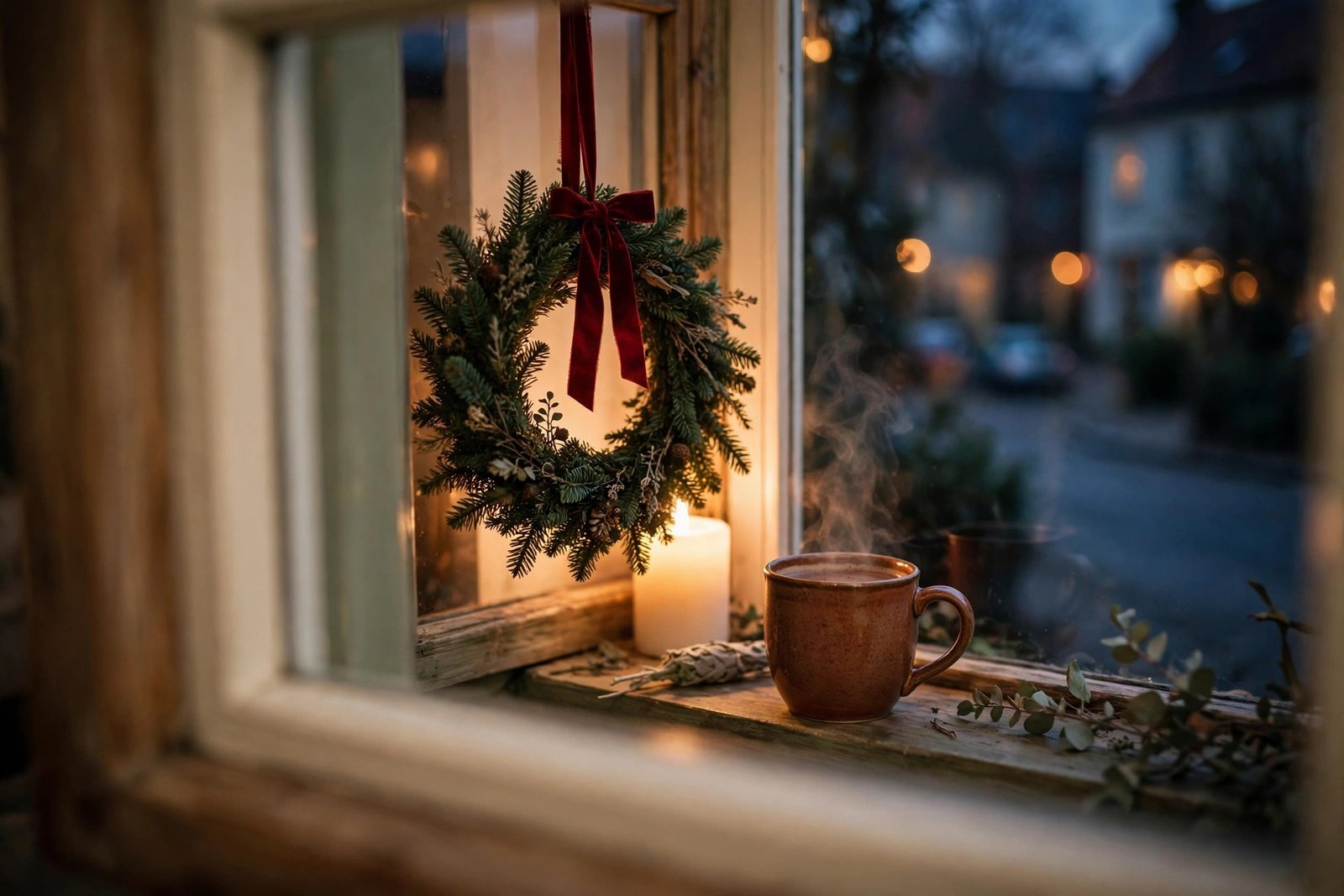
Do not confine wreaths to the door. A set of small 10 to 12-inch wreaths hung on every front-facing window, each tied with the same ribbon, gives the whole facade a unified, expensive-looking treatment for a modest cost. Use suction-cup hooks on the glass or tie ribbon over the top of the sash so it is invisible from the street.
At night, place a battery-operated pillar candle or a single taper behind each wreath inside the window — the wreath becomes a glowing silhouette. It is the simplest way to make the house look decorated after dark.the wreath becomes a glowing silhouette. It is the simplest way to make the house look decorated after dark. For the exterior-facing windows on the second floor, small wreaths hung from simple ribbon loops over the top sash give the whole house a finished look from the street — the kind of detail that makes neighbors slow down. Keep all window wreaths the same style and ribbon for a cohesive facade.
17. Sweater-Knit Wreath
For an indoor wreath with maximum coziness, wrap a foam base in a cable-knit sweater or knit fabric strips and finish with a felt bow. It sounds homey, and it is — in the best way. This is the wreath for a bedroom door, a hallway wall, or the nursery, where weatherproofing doesn’t matter and softness is the whole point.
DIY tip: thrift stores are full of cream and oatmeal cable-knit sweaters for a few dollars each. One sweater covers a 16-inch base. Secure the fabric with a hot glue gun, keeping seams at the back.
18. Scandinavian Sparse Wreath
The Scandinavian take is even more restrained than the minimalist hoop: a plain wooden or brass ring with one small asymmetric grouping of greenery — a few fir sprigs, two pinecones, maybe a single red berry branch. That is it. The negative space is the design.
This style demands good craftsmanship: with so few elements, every stem has to be perfect. Use fresh greenery for the scent and replace it once mid-season — cheap faux stems will betray the look.
19. Double-Door Symmetry
If you have double doors, you have an advantage: hang two identical wreaths, mirrored, one on each door. Symmetry reads instantly as intentional and formal, and it lets a simpler wreath design make a bigger statement than a single fancy one could.
Measure carefully — the wreaths should sit at exactly the same height and width from the center meeting stile. Wreath hangers with adjustable hooks make this easy; hang both, stand at the curb, and adjust until they read as a matched pair.Wreath hangers with adjustable hooks make this easy; hang both, stand at the curb, and adjust until they read as a matched pair. If your doors are glass-paneled, mount each wreath slightly higher than you think — the glass reflects the wreath’s lower half, and centering it optically means hanging the physical center a few inches above true eye level.
20. Grand-Scale Mantel Wreath
Wreaths belong over mantels as much as on doors, and going big indoors pays off: a 36 to 48-inch wreath above the fireplace becomes the room’s focal point and can carry a smaller tree elsewhere. Oversized indoor wreaths work best with artificial greenery — at that scale, fresh wreaths are heavy, expensive, and shed onto the rug.
Match the wreath’s palette to your tree for a pulled-together room: if your tree is warm gold and red, echo those ribbons in the wreath; if it is frosted and silver, echo that.if it is frosted and silver, echo that. An oversized mantel wreath also solves a common problem: the TV-over-the-fireplace mantel, where a traditional garland competes with the screen. A single bold wreath hung to one side or centered above reads as intentional decor without fighting the television for attention. Secure it with a sturdy mantel hook or a removable adhesive hook rated for the weight — a 48-inch faux wreath can weigh eight pounds or more. These Christmas tree decor ideas can help you settle on a palette the wreath can repeat.
21. Plan Your Wreath Beyond the Season
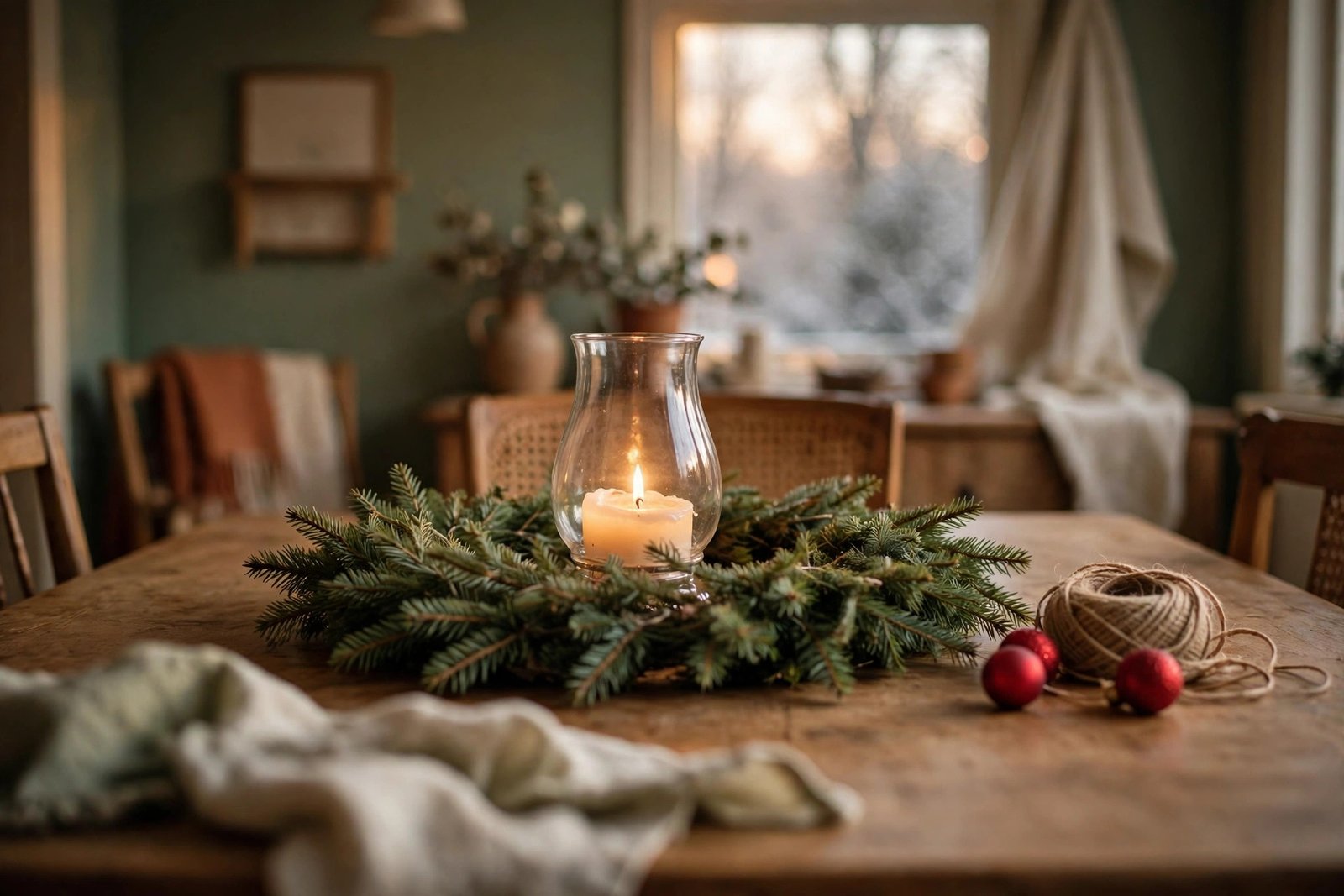
The smartest wreath strategy is choosing a base you can reuse: a good-quality faux evergreen wreath or a sturdy grapevine base works year after year, and you simply swap the ribbon and accents as styles change. When the holidays end, a plain evergreen wreath laid flat on the dining table with a candle lantern in the center becomes an elegant winter centerpiece through January — the same idea behind these Christmas table decor ideas, where one versatile piece does double duty.
Storage rules that save money: store faux wreaths in a dedicated round wreath storage bag (they are inexpensive and prevent crushing); hang ornament-cluster wreaths rather than stacking anything on them; keep everything in a climate-controlled space, not the attic, where heat shortens the life of faux greens and adhesives. A well-kept wreath collection gets better with time — you add one new piece a year and rotate the rest.
Products to Consider
You don’t need much to execute these ideas well — a few quality staples go further than a cart of cheap accessories. Look for these as you shop:
- A real noble fir or mixed-evergreen wreath from a reputable grower (freshest when it smells strongly of fir and the needles resist pulling off)
- A high-quality faux evergreen wreath with molded tips for reuse year after year
- Wired velvet ribbon in seasonal colors — burgundy, forest, cream, or classic red
- Battery-operated warm-white fairy lights on thin wire for evening glow
- A set of small solid brass bells with jingle-free or soft-tone options
- An adjustable over-the-door wreath hanger that fits your door’s thickness
- A round wreath storage bag to protect faux wreaths between seasons
Frequently Asked Questions
How long does a fresh Christmas wreath last?
A fresh evergreen wreath typically lasts three to five weeks when hung outdoors in cold weather, which conveniently covers the season. Noble fir, cedar, and juniper last the longest; pine and spruce drop needles faster. Keep it out of direct sun and wind, and mist it lightly with water every few days to extend its life. If your wreath looks tired by mid-December, a few fresh cedar sprigs tucked in will revive it.
What size wreath should I get for my front door?
For a standard 36-inch-wide front door, a 28 to 30-inch wreath is the sweet spot — large enough to read from the street without overwhelming the door. For double doors, use two identical wreaths of 20 to 24 inches each. On oversized doors (42 inches or wider), go up to 36 inches. When in doubt, size up: a slightly large wreath always looks better than a small one lost on a big door.
How do I hang a wreath without damaging my door?
An adjustable over-the-door wreath hanger is the simplest damage-free option and works on most doors. For glass or metal doors, use a suction-cup hook rated for the wreath’s weight, or a removable adhesive hook rated for outdoor use. Avoid nails and screws on fiberglass and steel doors — they void warranties and invite rust. For very heavy wreaths (ornament clusters, bells), use a hanger rated for at least 10 pounds.
Will a wreath survive winter weather?
Real evergreen wreaths actually prefer cold weather — freezing temperatures preserve them. What damages wreaths is sun, wind, and rain: sun fades ribbons and dries needles, wind desiccates fresh greens, and rain clumps flocking and soaks fabric bows. Covered porches are ideal. In regions with harsh freeze-thaw cycles, faux wreaths with UV-resistant materials are the lowest-maintenance choice.
How do I store a Christmas wreath after the season?
Store faux wreaths in a dedicated round storage bag, kept flat or hung — never stack anything on top. Real wreaths can be composted or left out for winter interest until the greens brown. Ribbons should be stored flat to avoid creases. Keep everything in a climate-controlled closet or basement rather than a hot attic; heat degrades faux greenery, flocking, and adhesives over time. Label bags so you know which wreath is which next November.
Final Thoughts
A Christmas wreath is one of the smallest investments in your holiday decor and one of the most visible. Whether you go classic with a full noble fir and velvet bow, trendy with an asymmetric wild-greenery design, or minimal with a simple gold hoop, the principles are the same: size it generously, hang it at eye level, protect it from sun and wind, and store it properly when January comes. Pick the idea that fits your home’s style and your December schedule — fresh for the full sensory experience, faux for set-it-and-forget-it ease — and let your front door do the welcoming.