
A small backyard is not a limitation. It is a design problem with a really satisfying answer, because every square foot counts and every choice shows. When a yard is tiny, you get to be intentional in a way big-yard owners rarely bother with, and the result can feel richer, cozier, and more finished than a sprawling lawn ever will.
These 21 small backyard ideas are built for real American yards: city lots, townhouse patios, and those long narrow side gardens that come with so many homes. Each one comes from the same core principle designers use on tiny plots, the same way great small-house living room design ideas treat a compact room as a series of moments rather than one big box. Think in zones, build upward, keep the palette calm, and let lighting do the heavy lifting after dark. You do not need a big budget or a contractor for most of these. A weekend, a plan, and a few smart purchases will get you most of the way there.
1. Divide Your Yard Into “Rooms”
The single fastest way to make a small yard feel bigger is to stop treating it as one open space. Use planting, a low hedge, a pergola edge, or even a change of ground material to carve two or three distinct zones: a dining corner here, a lounging spot there, a little garden bed tucked at the back. When the eye cannot take in the whole yard at once, the brain reads each zone as its own destination, and the total space feels far larger than it is.
Each zone only needs a purpose and a boundary. A gravel patch with two chairs is a coffee nook. A raised bed behind a row of tall grasses is a garden room. Keep walkways generous enough to walk comfortably, about 30 inches minimum, so zones connect instead of colliding. If your yard is wider than it is deep, place zones side by side; if it is narrow and long, stack them front to back so each one is revealed as you walk. Even a 12-by-20-foot city lot can hold three honest zones when you commit to the idea.
Products to Consider:
- Low-profile cedar garden edging
- Outdoor area rug for zone definition
- Decorative metal garden trellis panel
2. Build Upward With Trellises and Wall Planters
Ground space is scarce, so claim the vertical plane. Trellises, wall-mounted planters, and espaliered plants turn blank fences and walls into gardens, adding lushness without stealing a single square foot of patio. A fence covered in clematis or star jasmine reads as a living wall, and it softens the hard boundary that makes small yards feel boxed in.
Match the plant to your USDA hardiness zone and your sun exposure, because a dead trellis vine is just an eyesore on a stick. Clematis and climbing roses do well in zones 4 through 9 with at least six hours of sun; for shade, try climbing hydrangea or Boston ivy. Anchor trellises firmly, since a mature vine gets heavy and catches wind. For renters or HOA-restricted yards, freestanding planter towers and hanging baskets on shepherd’s hooks deliver the same upward greenery with zero holes in anything.
Products to Consider:
- Wall-mounted metal planter set
- Freestanding wooden garden trellis
- Coir-lined hanging basket pair
3. Lay the Patio on a Diagonal
Here is a designer trick that costs nothing: run your patio pattern, deck boards, or paver layout on a diagonal instead of parallel to the house. Diagonal lines pull the eye across the longest dimension of the space, and the yard reads wider and deeper than it actually is. It works for square pavers, wood decking, and even the seams of a gravel bed.
If you are starting from scratch, ask your installer about a 45-degree paver pattern; it uses roughly 10 percent more material because of edge cuts, but the visual payoff is worth it on a small plot. Already have a straight-laid patio? You can fake the effect with an outdoor rug placed on the diagonal, diagonal plank deck tiles laid over concrete, or even furniture angled to break the grid. Anything that refuses the boring parallel lines makes the space feel considered and larger.
Products to Consider:
- Interlocking wood deck tiles
- Large geometric outdoor rug
- Paver sand for DIY patios
4. Curve the Edges, Round the Corners
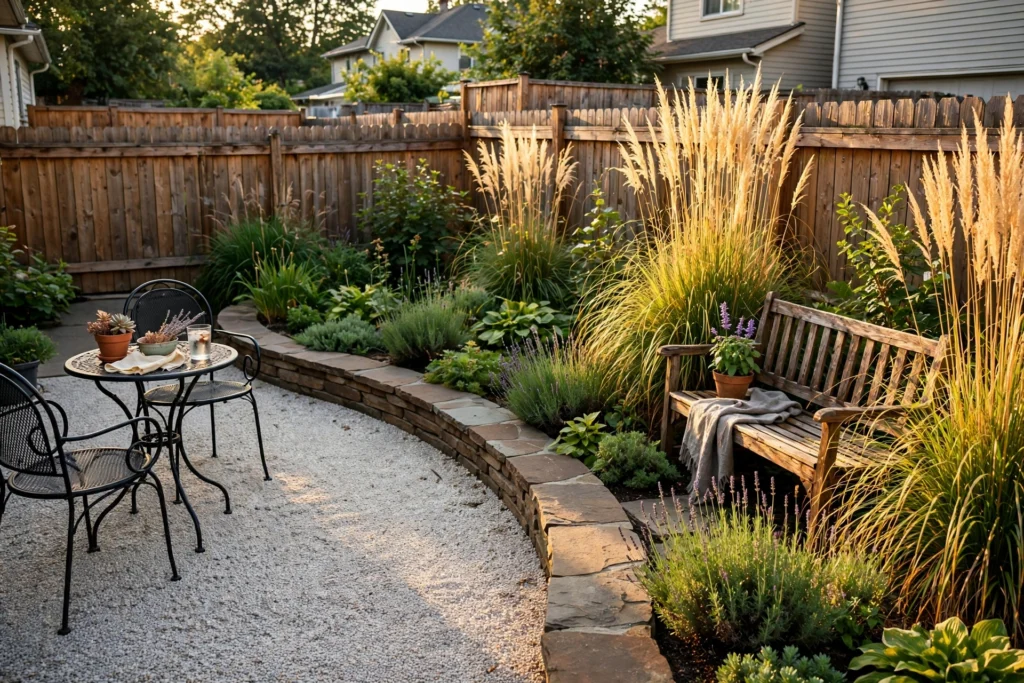
Straight lines make small yards feel like corridors. Gentle curves do the opposite: they slow the eye down, hide what is around the bend, and make a little plot feel like it unfolds. Round the corners of your patio, sweep a curved bed along one fence, or choose an oval lawn shape if you keep any grass at all. Curves also forgive the awkward angles that come with irregular city lots.
Keep the curves generous. A tight S-shape crammed into ten feet looks fussy; one long, confident sweep looks intentional. Cut the curve with a garden hose or rope first, step back, and look at it from the house windows before you commit, because the view from inside matters most in winter and on rainy days. Edge the curve with steel or stone edging so it stays crisp, and repeat the curve somewhere else, a round fire pit, a circular rug, so it feels like a theme rather than an accident.
Products to Consider:
- Flexible steel landscape edging
- Round outdoor area rug
- Curved resin garden bench
5. String Lights Overhead for Instant Magic
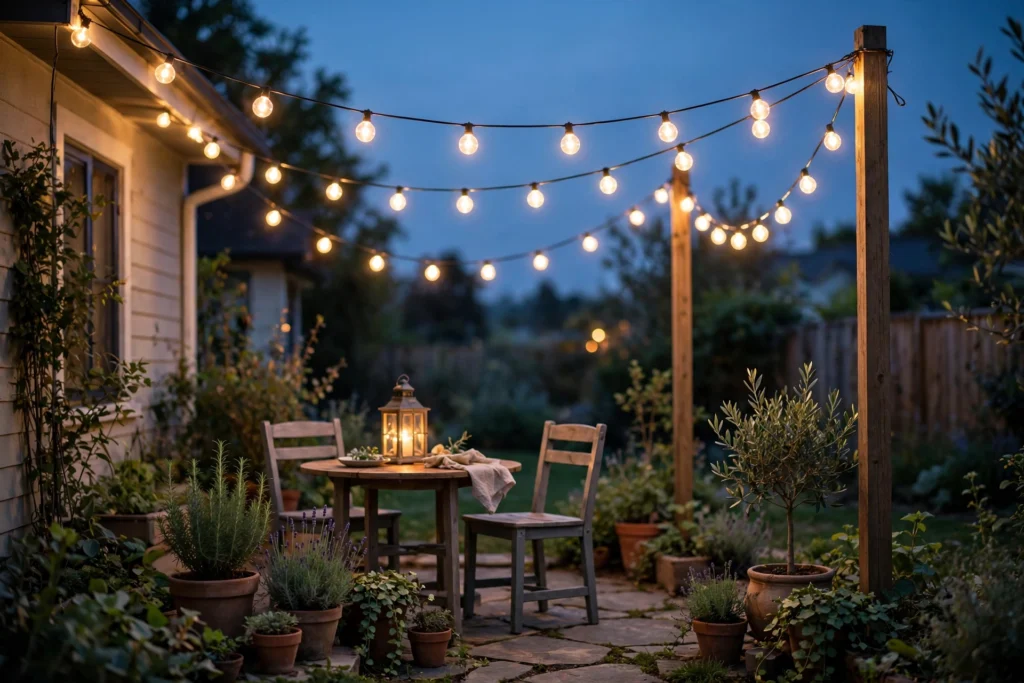
No single purchase changes a small backyard after dark the way string lights do. A canopy of warm-white globe lights turns a plain patio into a place people want to linger, and the glow overhead draws attention up and outward, which makes the whole space feel bigger than it is. Unlike a floodlight, which flattens everything, strings of small lights create depth and sparkle.
Hang them from the house to a fence post, between two sturdy posts, or from a pergola, keeping a gentle sag rather than a tight line. Use outdoor-rated lights with warm-white bulbs around 2700K; cool white reads harsh and blue outside. Plug them into an outdoor smart plug with a timer so they come on at dusk automatically, and check that your posts are set in concrete if they will carry real weight and wind load. A yard that glows every evening gets used every evening, which is the whole point of the effort.
Products to Consider:
- Outdoor LED string lights, warm white
- Weatherproof outdoor timer plug
- Freestanding string light poles
6. Choose Compact, Hardworking Furniture
Small yards punish oversized furniture. That deep-seat sectional built for a Texas patio will swallow a Brooklyn backyard whole. Choose compact pieces with visible legs, slimmer profiles, and light visual weight: a bistro set, a loveseat instead of a sofa, armless chairs that tuck under the table. When you can see ground beneath the furniture, the patio reads bigger.
Buy for how you actually live outdoors, not the fantasy. If you eat outside three nights a week, the dining set comes first and lounging is secondary. Look for pieces that do double duty: a storage bench that seats two, a fire pit with a lid that becomes a coffee table, stackable or folding chairs for when friends come over. Measure your patio, tape out the furniture footprint with painter’s tape, and walk around it before you order. Leave at least 24 inches behind chairs so people can push back comfortably without falling off the patio edge.
Products to Consider:
- Compact metal bistro table set
- Outdoor storage bench
- Stackable folding patio chairs
7. Add a Small Fountain or Water Feature
Water changes everything in a small space. A bubbling fountain adds movement, masks street and neighbor noise with its white sound, and gives birds a reason to visit, which makes the yard feel alive. Because a fountain is vertical and compact, it fits where almost nothing else will: a corner, a bed edge, even a large planter on a balcony-style patio.
Solar fountains are the easiest entry point, no wiring, no plumber, just sun and water. Place them where they catch daylight and top off the water every few days, because small reservoirs evaporate fast in summer heat. If you want something permanent, a glazed ceramic jar fountain on a small recirculating pump is a weekend DIY job and runs quietly enough for a townhouse. Keep the scale honest: a three-tier fountain in a ten-foot yard looks silly, while a modest basin reads elegant. Clean the pump filter monthly in warm months to keep the flow strong.
Products to Consider:
- Solar-powered garden fountain pump
- Glazed ceramic outdoor fountain
- Submersible pump filter kit
8. Plant the Perimeter, Keep the Middle Open
Small yards feel biggest when the center stays open and the planting hugs the edges. Run generous beds along every fence and wall, layering tall plants at the back, medium plants in the middle, and low edging plants in front. This layering hides the fences that box the space in, while the open middle gives you room to actually use the yard. It is the outdoor version of pushing furniture against the walls, and it works just as well.
Choose plants that earn their footprint. In narrow beds, columnar evergreens, ornamental grasses, and tall perennials like Joe Pye weed or salvias give height without spreading sideways. Mix evergreen structure with seasonal perennials so the borders look good in February, not just June. For a low-maintenance version, mulch the beds deeply with shredded bark and plant drought-tolerant natives suited to your zone; you will water less, weed less, and still get that lush, established look within a season or two.
Products to Consider:
- Ornamental grass starter plants
- Shredded bark mulch bags
- Columnar evergreen shrubs
9. Anchor It All With One Small Tree
One well-chosen tree gives a small yard what nothing else can: canopy, shade, and a sense of permanence. It becomes the anchor every other choice hangs on, and its dappled shade makes summer afternoons genuinely comfortable. People worry a tree will overwhelm a small plot, but a compact variety with a tidy crown fits yards as small as 15 by 15 feet.
Pick for mature size, not nursery cuteness. Japanese maples, serviceberries, dwarf redbuds, and compact crabapples all stay under 20 feet and suit most US zones. Plant it where afternoon sun hits hardest, usually the west or southwest side, and give it real room from the house foundation and utility lines, a good rule is planting at least as far from structures as half the tree’s expected crown width. Water deeply for the first two summers, then let it find its own way. A single tree makes a yard feel established in a way no amount of potted plants can match.
Products to Consider:
- Japanese maple tree, dwarf variety
- Tree watering bag for new plantings
- Organic tree and shrub fertilizer
10. Lighten the Ground Underfoot
Dark, heavy ground materials make small yards feel smaller; light ones bounce light around and open everything up. Pale gravel, light-colored pavers, cream limestone chips, or a simple whitewashed deck stain all lift a cramped plot. This is especially powerful in shaded yards that feel gloomy even at noon, because the bright ground becomes a reflector.
Gravel is the budget hero here: a few bags of pea gravel or decomposed granite transform a muddy corner into a usable patio surface in an afternoon, no permits or contractors required. Lay landscape fabric underneath to keep weeds down, and choose angular gravel over smooth river rock if it gets foot traffic, because it locks together instead of rolling. If you have an existing dark deck or concrete slab, a light exterior stain or a large light-toned outdoor rug delivers most of the brightening effect for a fraction of a rebuild.
Products to Consider:
- Pea gravel bags for patio areas
- Light-toned exterior wood stain
- Woven outdoor rug in cream
11. Layer Your Lighting Like a Designer
One bright porch light makes a small yard look like a parking lot. Three or four small, warm light sources make it look like a garden you would pay to visit. Layer path lights along walkways, a spotlight aimed up into your tree or a handsome shrub, lanterns on the dining table, and the string lights from idea five overhead. Each layer adds depth, and depth is what makes small spaces feel generous after dark.
Solar path lights have come a long way; modern ones actually throw usable light, though they need full daytime sun to charge well. For shady yards, low-voltage wired lighting is more reliable and still a manageable DIY project, since the kits plug together without an electrician. Keep every bulb warm white, around 2700K to 3000K, for consistency. And aim spotlights carefully: uplighting a tree or a textured wall is gorgeous, while light spilling into a neighbor’s bedroom is a fast way to start a feud you will lose.
Products to Consider:
- Solar path light set, warm white
- Low-voltage LED spotlight kit
- Outdoor hurricane lanterns
12. Stick to a Tight Color Palette
A riot of clashing colors makes a small yard feel chaotic and therefore cramped. A disciplined palette, say, greens plus white plus one warm accent like terracotta or golden yellow, makes the same space feel calm, curated, and visually larger. Restraint reads as design. Your eye moves smoothly across a limited palette instead of stuttering on every competing color.
Let the plants carry most of the palette and use pots and cushions for the accent color. White flowers and silver foliage are the small-yard workhorses: white impatiens, white coneflowers, dusty miller, and lamb’s ear all glow in evening light and tie mixed beds together. Then pick one accent and repeat it at least three times, terracotta pots here, a rust-colored throw there, a coral cushion on the bench, so it feels intentional. When everything repeats, the yard feels composed rather than collected by accident.
Products to Consider:
- Terracotta planter pots, set of 3
- White flowering annual seed mix
- Outdoor throw pillows in warm tones
13. Build a Cozy Corner Fire Pit
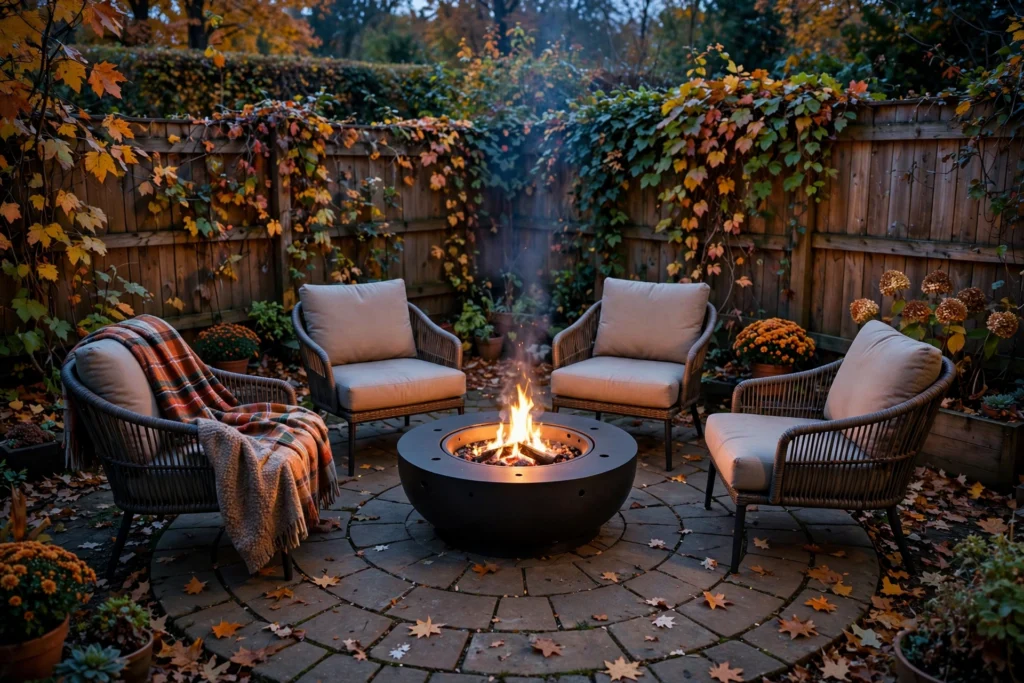
Nothing extends the backyard season like fire. A compact fire pit or tabletop fire bowl turns a small patio into a three-season living room, and it gives people a reason to gather after dinner instead of drifting back inside. On a chilly October night, four chairs around a small fire is the best seat in the house.
For truly small yards, a smokeless fire pit or a portable propane fire bowl is the practical choice: less smoke drifting into neighbors’ windows, easier to store, and usually fine under HOA and local burn rules that ban open wood fires. Check your city’s fire code before you buy, because many US municipalities restrict wood burning within certain distances of structures. Place the fire at least 10 feet from the house, fences, and any overhanging branches, keep a fire extinguisher within reach, and give everyone a real chair with a back. Nobody lingers on a backless stool around a fire for long.
Products to Consider:
- Smokeless portable fire pit
- Propane tabletop fire bowl
- Fire-resistant outdoor chair cushions
14. Blur the Fence Line With Planting
Fences define small yards, and a bare fence defines a small yard as small. Plant in front of it and the boundary dissolves. Tall grasses, a row of slim evergreens, or a staggered mix of shrubs in front of the fence turn a hard wooden line into a soft green backdrop, and when you cannot quite see where the yard ends, it feels bigger than it is.
Vary the heights and let some plants lean in front of others for a natural, layered look rather than a soldier row. Fast-growing options like privet, arborvitae, or clumping bamboo in containers give privacy quickly, while flowering shrubs like lilac, forsythia, or panicle hydrangea add seasonal interest. Stain or paint the fence itself a deep green or warm dark brown first; a dark fence recedes visually and makes plants in front of it pop. Then resist the urge to plant the whole bed in one weekend: stagger it, live with it, and fill gaps next season once you see how everything grows.
Products to Consider:
- Fast-growing privacy shrubs
- Exterior wood fence stain, dark green
- Clumping bamboo in large planter
15. Add Overhead Structure With a Pergola or Shade Sail
A small yard with no overhead plane can feel exposed, like a stage. A pergola, a fabric shade sail, or even a simple retractable canopy adds a “ceiling” that makes the space feel like an outdoor room instead of a leftover patch. That sense of enclosure is what turns a patio into a destination, and it is the single biggest upgrade for yards that currently feel like an afterthought.
You do not need a contractor for this. Freestanding pergola kits bolt together in a day, and a triangular shade sail with proper tension hardware costs less than a dinner out while blocking real heat. Grow a fast vine up the pergola posts for living shade that cools better than any fabric, or hang outdoor curtains on the beams for privacy and wind protection. Just be honest about your climate: in hurricane- and high-wind regions, use rated hardware and take sails down before storm season, and check local permit rules, because some cities regulate structures over a certain height or size even in backyards.
Products to Consider:
- Freestanding cedar pergola kit
- Triangular outdoor shade sail
- Weatherproof outdoor curtain panels
16. Grow a Container Herb and Veggie Garden
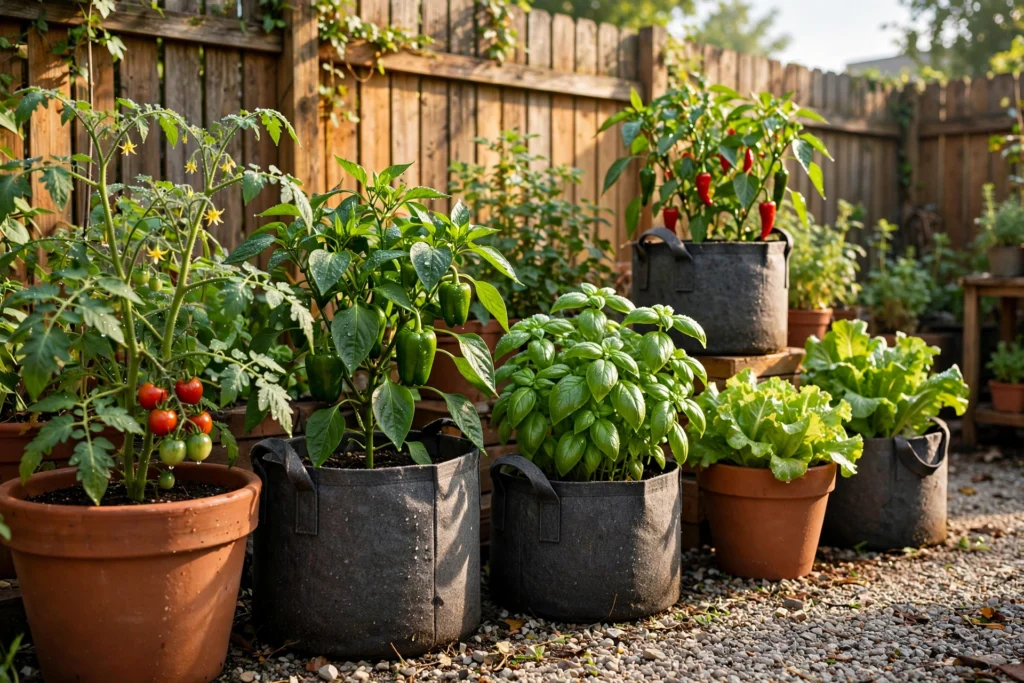
A full vegetable plot needs space you do not have; containers need almost none. Tomatoes, peppers, lettuce, and every herb worth cooking with all thrive in pots on a patio edge or along a sunny fence, and a row of productive containers makes a small yard feel abundant rather than ornamental. There is something deeply satisfying about snipping basil for dinner that grew ten feet from your kitchen door.
Go big on the pots: large containers hold moisture longer, which matters on hot August afternoons when small pots dry out by noon. Use quality potting mix, not garden soil, and feed container plants regularly with a balanced fertilizer, since watering flushes nutrients out fast. Match plants to your sun: tomatoes and peppers need six-plus hours, while lettuce, spinach, and herbs like mint and parsley tolerate partial shade. Group containers in odd-numbered clusters at different heights for a look that reads as designed, and put the thirstiest plants nearest the hose or door so watering actually happens.
Products to Consider:
- Large fabric grow bags, set of 5
- Balanced organic vegetable fertilizer
- Self-watering herb planter
17. Carve Out a Café-Style Bistro Nook
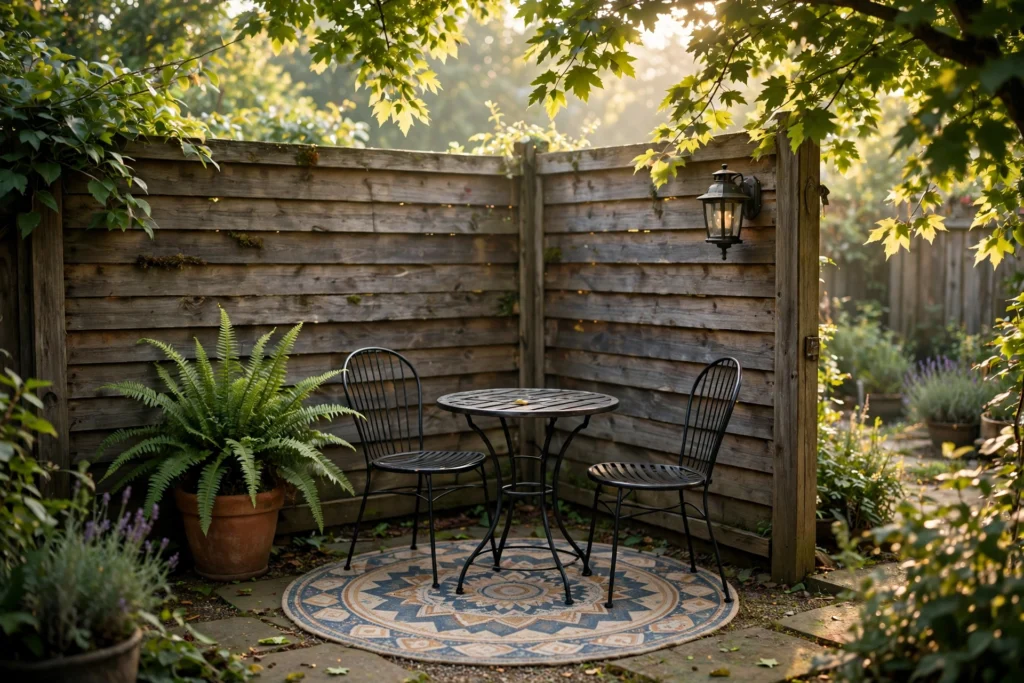
Every small backyard deserves one irresistible little spot for morning coffee, and a café-style nook delivers it in about four square feet. A small round table, two chairs, one good potted plant, and maybe a wall-mounted lantern: that is the whole recipe. Tuck it where the morning sun lands, and it will become the most-used corner of your home.
The details are what make it sing. A round table beats a square one in tight quarters because there are no corners to bump, and a patterned outdoor rug underfoot makes the nook feel deliberate. In autumn, keep a folded throw and a lantern nearby so the nook stays inviting as evenings cool, the same cozy layering you would use for cozy fall front porch decor ideas works beautifully out back too. If your nook faces a wall or fence, hang one piece of outdoor art or a mirror-style metal wall hanging to give your coffee a view worth waking up for.
Products to Consider:
- Round metal bistro table and chairs
- Patterned outdoor rug, small round
- Wall-mounted outdoor lantern
18. Anchor Seating With an Outdoor Rug
An outdoor rug is the cheapest way to make a patio feel like a room. It defines the seating area, adds color and pattern, and softens hard concrete or pavers underfoot. In a small yard, the rug is doing zoning work too: it tells the eye where the living area is, which makes the surrounding planting read as its garden rather than empty space.
Size it like you would indoors: the rug should extend under the front legs of every seat in the arrangement, or the grouping looks like it is floating. Polypropylene rugs are the workhorse choice, hose them off, dry them in the sun, and they survive seasons of weather. Just roll it up and store it dry over winter in freeze-thaw climates, because trapped ice shortens its life. Choose a pattern with enough movement to hide a little patio dust, and avoid very light solid colors unless you enjoy sweeping. The rug should make the patio more inviting, not more maintenance.
Products to Consider:
- Polypropylene outdoor area rug
- Rug pad for outdoor use
- Outdoor rug storage bag
19. Bounce Light With Bright, Glossy Surfaces
Light-colored and glossy surfaces reflect sunlight and lamplight around a small yard, making it feel brighter and more open. Glazed ceramic pots, a light stone birdbath, pale gravel, or even a whitewashed fence section all act as gentle reflectors. In a shaded yard, this trick alone can lift the gloom, because reflected light reaches corners the sun never touches directly.
Cluster glossy pots where they will catch the light, near the patio edge or under the string lights, and watch them glow at dusk. A small metal garden sphere or a gazing ball tucked into a bed adds a jewel-like focal point that draws the eye through the planting. Keep the finishes weather-safe: glazed ceramics and powder-coated metal handle seasons well, while raw wood and unsealed terracotta weather faster. One note of caution from experience: avoid placing highly reflective objects where they can concentrate direct sun onto dry mulch or siding, because that is a real fire risk in hot climates.
Products to Consider:
- Glazed ceramic planter pots
- Decorative metal garden sphere
- Light stone birdbath
20. Dress It Up for the Seasons
A small yard earns its keep when it changes with the calendar. Swap a few cushions, add seasonal planters, and string up simple holiday touches, and the same little space feels new four times a year. Autumn is the easiest win: mums in pots, ornamental kale, pumpkins on the steps, and a warm wreath on the gate. If you love the holiday look up front, carry it around back too, and check out our outdoor Halloween decoration ideas and fall front porch decor ideas for inspiration that works in the backyard just as well as on the porch.
Keep a small seasonal bin in the garage so the swap takes twenty minutes, not a whole Saturday. Spring means fresh annuals and a cleaned fountain; summer means the shade sail up and citronella in the lanterns; fall brings the mums and a fire pit blanket box; winter is evergreen boughs in the empty planters and the string lights on a timer for those long dark evenings. The backyard never has to be “done” for the year, and honestly it is better when it is not. A yard that visibly changes with the seasons is a yard that gets noticed and used.
Products to Consider:
- Seasonal outdoor wreath
- Fall mum plants in nursery pots
- Weatherproof outdoor storage bin
21. Hide the Clutter With Smart Storage
Clutter shrinks a yard faster than anything else. A small space cannot absorb a tangle of hoses, scattered toys, and bags of potting soil the way a big one can, so every item needs a home. A storage bench by the patio, a slim deck box against the fence, and a few hooks inside the garage or shed swallow the visual noise that makes yards feel cramped and chaotic.
Make tidying effortless and it will actually happen. Keep the hose on a reel instead of coiled on the ground, give kids one weatherproof toy bin with a lid, and store cushions in the bench they sit on so the five-minute evening reset is truly five minutes. Choose storage that looks like furniture, a nice cedar chest or a resin deck box in a neutral tone, rather than bright plastic that screams utility. Once the clutter disappears, you will be amazed how much bigger the yard feels. It is the least glamorous idea on this list and probably the most transformative.
Products to Consider:
- Resin outdoor deck box
- Wall-mounted garden hose reel
- Cedar outdoor storage chest
Frequently Asked Questions
1. How do you make a small backyard look bigger?
Divide it into zones, build upward with trellises and wall planters, lighten the ground materials, and layer warm lighting for the evenings. Curved edges, diagonal layouts, and planting that hides the fence line all trick the eye into reading more space than there is. The biggest single lever is usually decluttering, because a tidy small yard always feels larger than a messy one.
2. What is the cheapest way to improve a small backyard?
Start with a deep clean and a declutter, which cost nothing. Then add the highest-impact low-cost wins: a bag or two of pea gravel to define a patio area, a set of warm-white string lights, and one large outdoor rug. Fresh mulch on the beds and a few nursery perennials finish the refresh for well under a few hundred dollars, and the transformation is dramatic.
3. What should you not do in a small backyard?
Do not buy oversized furniture, do not leave the center of the yard cluttered, and do not pave every inch, since plants are what keep small spaces from feeling like parking lots. Avoid dark, heavy materials that shrink the space visually, skip high-maintenance features you will not keep up, and resist planting a tree that will outgrow the plot in a decade.
4. Can you have a garden in a very small backyard?
Absolutely. Container gardening, raised beds along the perimeter, vertical trellises, and wall planters let you grow herbs, vegetables, and flowers in almost no ground space at all. Focus on high-value crops you actually eat, tomatoes, peppers, herbs, salad greens, and place containers where they get the sun they need. Even a 6-by-6-foot corner can produce a real harvest.
5. How do I get privacy in a small backyard without a tall fence?
Layer fast-growing shrubs, ornamental grasses, and a small tree in front of your existing fence to blur the boundary naturally. A pergola with outdoor curtains or a shade sail with side panels creates a private ceiling and walls for a seating area. Freestanding planters with tall plants work for renters, and the sound of a small fountain masks neighbor noise, which adds a surprising amount of perceived privacy.
Final Thoughts
A small backyard rewards the person who treats it like a real room instead of leftover land. Start with the structure, zones, light, and one good anchor like a tree or a fire pit, then let the planting and the seasons do the drying over time. You do not need a big budget or a big plot to have a yard you love coming home to. Pick the two or three ideas from this list that fit your space and your weekends, do them well, and enjoy the best seat in the house: outside, in the evening, under the string lights, in a yard that finally feels like yours.